Barbour Publishing sent us two of the books from their new Kingdom Files series of Biblical Biographies for kids. The books are intended for kids ages 8-12 and are fairly quick reads at less than 90 pages each
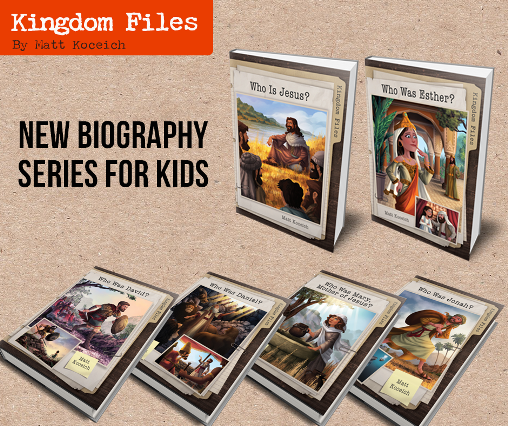
There are currently six books in the series: Who is Jesus?, Who was Daniel?, Who was David?, Who was Esther?, Who was Jonah?, and Who was Mary, Mother of Jesus? Each book begins with a double page "Fact File" spread that gives some basic information about the book's main character (name, town, occupation, and a mini-timeline as well as other pertinent information. The bulk of the book (dubbed the "Action File") tells the story of the character, including text from the Bible and explanations and background information. This section reminds me a lot of a what you might hear in a sermon series, but on a kid's level, split into several chapters. Throughout the Action Files there are Clue Boxes with relevant questions or ideas to provoke a little deeper thinking about a certain aspect of the story. The last section in the Kingdom Files for each book is the "Power File" which breaks out 10 Power-Up ideas that help the reader connect and apply the Scripture to their daily lives. They each also include a memory verse to go with the application.
Fact File
In Who Was Jonah? there are 8 chapters:
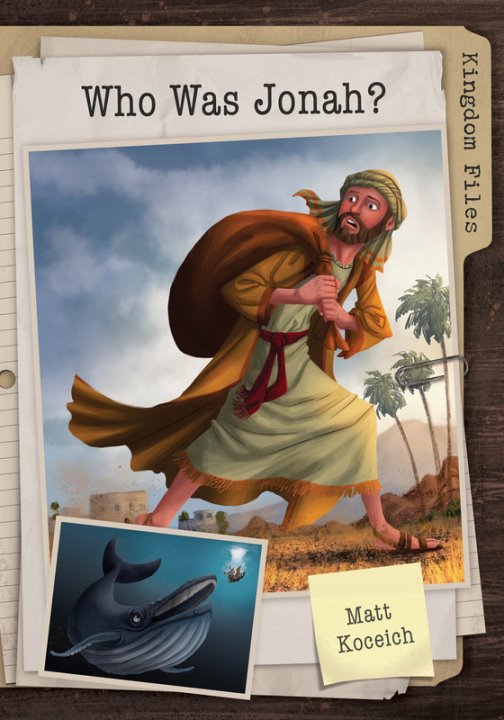
Run Away
Who's Responsible?
The Monster Fish
Praying Hard
On To Ninevah
The King's Response
Jonah's Anger
God's Gift
I really appreciate the way that the material is covered from a narrative point of view. As I mentioned before, it reminds me of a sermon series, but on a kid's level. To some degree I wish that the Power Files specifically coordinated with each chapter, and directly followed each one, as that would make it much easier to figure out exactly how to schedule reading this book out as a devotional or regular Bible reading, but there are 10 Power-Ups with corresponding memory verses to go with the 8 chapters, which makes it a little more confusing.
Power-Up page
I will mention that The Kingdom Files webpage includes some educator ideas for extending your study of each character, with projects in writing, arts and crafts, and more, so that's worth checking out.
The chapters in Who Was Mary, Mother of Jesus:
Great News!
O Holy Night
Wise Men Visit (I appreciate that they are Biblically correct in not giving a specific number of magi, and also speak about them visiting Jesus in a home, not the stable.)
Jesus at the Temple
A Special Wedding
A Misunderstanding, the Cross, and Everything After (Also Biblically correct in mentioning that Jesus had family (brothers) beyond Mary and Joseph. Points like these are ones that rate highly when I'm perusing Children's Biblical literature.
All in all, I am impressed with the quality of these biographies. My son enjoyed the way the books were written also, in a very conversational tone.
Please click the banner below to visit the TOS Homeschool Review Crew and see what others had to say. As always, I hope that this review was useful to you as you choose where best to spend your homeschool budget.
Over the years I have been blessed to review a number of Progeny Press Literature Guides, for a variety of ages. The vast majority of them (as you will see when I list links to them towards the end of my review) have been for the High School crowd, and then the Middle School ages, but Progeny Press also caters to the elementary ages (I've reviewed one title from Lower Elementary), and my latest review is from the Upper Elementary level, The Green Book - eGuide.
I probably would not have known about The Green Book by Jill Paton Walsh if it were not for this review, and we would have been missing out! My Youngest LOVES to read and may have been put off by the slimness of this volume (he goes for books in the 300-page realm) if left to his own devices. However, good things come in small packages is not true simply for girls and little boxes. This is a gem of a story with many good themes to be pulled out, with the help of Progeny Press and Rebecca Gilleland.
One of my favorite things about Progeny Press (that you will find repeated in each of my reviews) is the lens through which each work of literature is viewed. In addition to learning vocabulary and completing comprehension questions, students are challenged to "Dig Deeper" and discuss the story and the characters through a Christian Worldview. To see how choices and consequences of the characters line up (or not) with the Bible, and how they might apply to our lives today.
So, what exactly will you find in Progeny Press' The Green Book - eGuide?
You will receive two files to download. The actual study guide is an interactive adobe file in which your student can type their answers (or you can print the pages up). Note~ if you have a Mac, you need to open the file in Adobe, not Preview, or it won't work... at least with my old, un-updated Mac... I have no idea how it performs on a non-apple product.
Note to the Instructor on how to use the guide
Synopsis of the Story
Background information on the Author of the Story/Novel
Prereading Activities
Chapter-by-Chapter guide broken down into
Vocabulary work~ (Which takes a number of forms from defining words to matching words and definitions to crossword puzzles and wordsearches~ not the same thing for each chapter. I appreciate the variety!)
Questions~ covering content
Think About the Story~ comprehension questions, and literary elements (simile, metaphor, foreshadowing, etc...)
Dig Deeper~ Worldview questions, discussions, and application
Optional Projects and Activities~ these range from discussions to writing assignments, related science experiments, hands-on projects (including art and cooking to name a couple), field trip suggestions, etc...
Overview (Discussing the plot, conflict, themes, etc..) This particular guide also includes a Venn Diagram and a crossword puzzle.
After You Read Projects that include science, art, cooking, research and writing, performances, etc...
Additional Resources ~ lists of books and links to extension activities
Answer Key
The second file is the Answer Key for the Instructor, pictured above.
As I mentioned above, The Green Book is a slender volume (69 pages), but you can get at least six or seven weeks of in-depth Literature study out of it, and I suspect your student will adopt the story as a favorite (this has happened with almost every story for which we have used Progeny Press guides)! Although all the extras (science, cooking, art, and other hands-on activities) are great, I feel that this affinity for the books often comes about possibly as a result of the application of the story to our lives from a Christian perspective, in addition to the selections being quality stories on their own.
In this particular instance, many of the activities included for The Green Book were things that we have already explored~ making a journal (from an art review), visiting the aquarium (Jellyfish!), spinning fibers, cooking, learning about maple syrup, making an oil lamp... so I thought I would include some photos of those aactivities that we were able to relate back to, even if we didn't actually do them this time around. It's always nice to be able to connect past activities to a current read. :)
If you would like to check out some of my other reviews they are listed below...
My son really enjoyed reading The Green Book, and I feel that this is a very valuable literature unit, that would be a good addition to any upper elementary homeschool study.
Please click the banner below to visit the TOS Homeschool Review Crew and see what others had to say about this and the other titles reviewed (One from each level, Early Elementary reviewed The Josephina Story Quilt, more Upper Elementary reviews of The Green Book, Middle School reviews of The Scavengers, and the High School selection of Perelandra. Other than The Josephina Story Quilt the rest of the titles were new to me! As always, I hope that this review was useful to you as you choose where best to spend your homeschool budget.
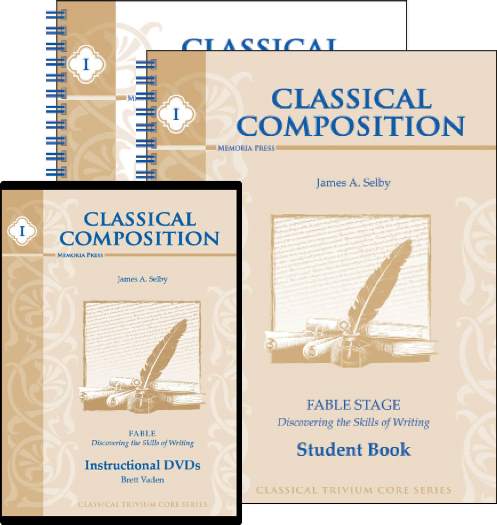
When Memoria Press offered us a selection of products to review, I chose to introduce my Youngest to their Classical Composition I: Fable Set. This set includes the Student Book, the Teacher Guide, and Instructional DVD. I appreciate that both the instructional DVD and the Teacher Guide are included, as this opens up options for student work location. Not always tied to electronics (Instructional DVD) to do the work, because the Teacher Guide includes the instructions required, which means that lessons can be taken outside, to the park, or in the car. However, it is also very nice to have the option to have someone other than Mom or Dad "teach" the lesson, particularly if one isn't as familiar with walking through an outline with their kids.
OK, so now that I've given you a little hint to the content, let me tell you how the lessons are set up. As is typical with Memoria Press, each lesson looks pretty much the same, and they basically drill the concept over and over until it becomes natural.
Fable ~ The specific fable for the lesson is printed at the beginning of each lesson
Three Plot Components (If applicable) of Recognition, Reversal, and Suffering
Variations Part 1 ~ Student comes up with synonyms for 3 or 4 words in a given sentence and then rewrites the sentence three different ways.
Narration (Not in the Student Book, but definitely a component of the lesson, and one of my favorite parts! :) )
Outline ~ Summarize fable in outline form. This is a very useful skill to work on, so I appreciate that it shows up in each lesson. The Teacher Guide includes suggested outlines, so you can work from that directly, but the walk-through on the DVD is also valuable.
Paraphrases ~ Generally two paraphrases per fable. The first generally adds in specific Figures of Description (using the Latin names for each one*), and the second is usually written "by reduction" in the briefest form possible without any descriptors.
*The Appendix includes 18 Figures of Description with examples for each. These words may or may not be familiar to you, depending on your experience with Classical Education. Here are a few: Anemographia, Dendrographia, Dialogismus, Effictio, Prosopographia, Sermocinatio... These are things that I certainly didn't learn in my public school education. ;)
Variations Part 2 ~ Same thing as Part 1, but with different words/sentences
Appendix~ I mentioned the Figures of Description above. The Student Book also includes an "Introduction to the Progymnasmata" by James A Selby, that might be interesting for an older student to read.
The Teacher Guide begins with teaching guidelines and an advanced rubric for grading purposes. The rest of the book has identical pages to the student book, with instructions specific to each lesson, including vocabulary words, and a more general grading rubric geared to that lesson.
If Classical Education is your style, Memoria Press definitely offers materials that will challenge your child, with ample opportunity to practice the skills that they are being taught.
One minor point that I will mention here~ if you have a student for whom handwriting still isn't smooth and natural, the lines and spacing of the Student book may be a little short. On his best days, his handwriting isn't fabulous, but the more college ruled spacing definitely contributed to a bit of a defeatist attitude. When I suggested that he write his outline on a piece of wide-ruled notebook paper (and do it in cursive), the readability improved drastically. Still not fantastic, but better.
Memoria Press offers sample pages of the Student Book and Teacher Guide as well as a "General Sequence and Outcomes of Program" to download on the product page linked below.
Please click the banner below to visit the TOS Homeschool Review Crew and see what others had to say about this and the other products that were offered for review: Products from the New American Cursive Penmanship series, the Traditional Logic Series, and the Classical Composition Series, of which Fables is the first part.
As always, I hope that this review was useful to you as you choose where best to spend your homeschool budget.
Over the years, beginning with my Eldest and continuing down through my Youngest, we have enjoyed reading biographies, and have especially appreciated collecting books from YWAM Publishing's many series, including the Christian Heroes: Then & Now series, where we read about, well...Christian Heroes of the faith from the past and the present. This spring we were given a few options to choose from for review, and I was happy to see Christian Heroes- C.S. Lewis: Master Storyteller, particularly as my Youngest and I are reading aloud the Chronicles of Narnia this year.
The book is set up in a similar fashion to others that we have read, covering the entire life of the person from early childhood to death. * Side Note: I realized that we haven't any of the "now" books in the collection when my Youngest commented that the only thing he didn't like about the series was that the books always end when the person dies... I hadn't thought of that before. Guess I'll have to pick up one of the others like Charles Mulli next time... ☺
Word to the wise, there are "spoilers" in the biography so you might not want to read it until AFTER you have finished reading the Chronicles. Unfortunately, I didn't preread, so I wasn't aware.
Alright then, on to the review.
My son thought it was interesting that C.S. Lewis was nicknamed "Jack" and that stuck with him for the rest of his life, because my father-in-law is named John, but also called "Jack," something I just don't understand. :) He particularly enjoyed reading about his life as he is very interested in the WWII time period, and hearing about regular life during those times. He did feel that the story overall wasn't quite as gripping as say, Milton Hershey's life story which we reviewed last summer. As a result, I would suggest that an older middle-schooler might actually get more out of this study than a later elementary student.
I will say that the Unit Study Guide available for this book is also on a slightly higher level, in part based on the topics covered including love and marriage and divorce, which aren't necessarily topics I would have brought up with the youngest ages this book is suggested for. However, as homeschoolers, we are able to tailor our schooling, and we don't have to ask ALL the questions, so it's all good ~ we can allow some details to go over their heads when appropriate.
A word or two about the contents of the Study Guide.
It includes an introduction for the instructor and then moves into the areas of study.
Key Bible Verses ~ 4 verses that can be used for Memorization, Meaning (thinking about how they apply to C.S. Lewis' life) Devotional, or Display (which could tie into art)
Display Corner ~ Suggestion that is more useful in a group setting, but some homes are suitable for this sort of motivating idea~ it's fun and adds to the memories if you can do it.
Chapter Questions~ Each chapter has 6 questions: one Vocabulary, one Factual, two Comprehension and two Open-ended. I do appreciate that the guide recommends tailoring the questions to your students level and ability, as mentioned above. I tend to do these orally anyway, so it all works out well for me.☺
Student Explorations ~ These include suggestions like Essay Questions, Creative Writing Projects, Hands-On Projects, Audio Visual Projects, and Arts and Crafts Projects.
Community Links ~ Suggestions for activities out in the community that would connect with the book. For instance, because of the British background of C.S. Lewis' life, there is a suggestion to visit a Tea House for High Tea. Fun times, and if we weren't in the midst of Baseball Season and three teams, I'd consider it. ☺There are many other suggestions for ways to interact with people in the community that will add to the details in the book.
Social Studies ~ Includes Places, Terms/Vocabulary, Geographical Characteristics, including mapping locations~ this was one of the activities we chose to do, as well as Conceptual Questions (these move from simpler to more complex).
Related Themes ~ Gives suggestions of possible related themes in the topics of History, Current Events, Literature, Christianity, and even Travel Skills.
Culminating Event~ for families that like to celebrate the end of a Unit Study in a more formal manner, there are ideas for Food, Music, Presentations, Display, Clothing, and Cultural Activities
Books and Resources ~ Offers a large list of extra resources about C.S. Lewis, other books, other books in the same series, and related articles and internet sites.
I would be remiss if I didn't mention that there is also an answer key to the first four chapter questions in each chapter (Because the open-ended questions can't be quantified in an answer key).
All in all, we have been very happy with the various historical YWAM biographies, and enjoy adding them to our home library as we have time and funds. Not So Nutty Nitty Gritty
Please click the banner below to visit the TOS Homeschool Review Crew and see what others had to say. As always, I hope that this review was useful to you as you choose where best to spend your homeschool budget.
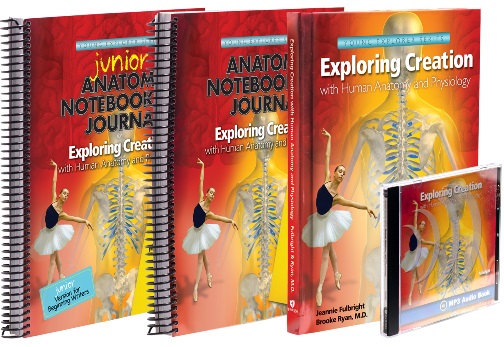
I enjoyed using Apologia's Young Explorer Series in the past, with my two older children, so I was delighted to be asked to review Exploring Creation with Human Anatomy and Physiology, which includes the text, an mp3* audio narration of the text, and two levels of their notebooking journal, the regular and the junior version.
I'm guessing that most of my readers have heard of Apologia if they've been homeschooling for very long, but for those who are new to this homeschooling thing, let me give you a quick run-down on some of the reasons why I appreciate Apologia.
The text is written directly to the student, and is somewhat more conversational than the textbooks I grew up with.
Science is approached from a Christian Worldview, clearly and logically articulated, and reinforced through questions and activities that include that worldview.
The activities and experiments suggested in the book are generally able to be completed with normal household materials that one is likely to have on hand.
Now, when I first used Apologia's Exploring Creation series, well over a decade ago, it simply consisted of the text. There was no MP3 audio CD (Helpful for those who have reading disabilities, or who simply process more easily when listening to audio), nor were there premade journaling notebooks. We had a printable pdf with notebooking pages, mostly for narration purposes, but nothing like the resource that was sent to us with the text for this review.
The course includes 14 Lessons, with a recommended pace similar to their High School Modules of 2 weeks per lesson, so a full year course. The Lessons are:
Introduction to Anatomy and Physiology
The Skelatal System
The Muscular System
The Digestive and Renal Systems
Heath and Nutrition
The Respiratory System
Life in the Blood
The Cardiovascular System
The Nervous and Endocrine Systems
The Nervous System Extended
Your Senses
The Integumentary System
The Lymphatic and Immune System
Growth and Development
The two journals include all the pages you will need (and more) to maintain a record of what your child has learned in the course with pages to write their narrative answers to the "Tell someone what you've learned" questions. There are a few variations, of course. For example, the Junior Journal includes coloring pages, more flap books for vocabulary activities and the copy work pages use guidelines, where the older journal does not, while the regular Journal includes more detailed and difficult crossword puzzles
Journal Page found in both books
I will admit that my 5th grader's handwriting is not fabulous yet (remember the recent cursive review?) so the opportunity to have him practice in the notebook is helpful, but in this instance, he might benefit more from the younger journal instead of the older one as he is still working on uniform letter size.
Sample Copywork pages from Regular and Junior Journals
This was also his first experience with a larger crossword puzzle (more words) with smaller boxes~ Ummmm... I said to use a pencil for a reason... ;) This was also one of those activities that took much longer than I expected, but he is improving. :)
Use a pencil, bud! ;)
Both journals include full-color Minibooks to add to each lesson. These pages are found in the back of the journal. Although not my circumstance, because I only have one student, I appreciate that these are almost identical (with the exception of the writing lines, which again, have guidelines in the junior version) so that those with multi-age students are able to have some journaling activities that are the same.
I am including a photo of the back of the Muscle Minibook prior to gluing it into the journal, so that you can see how clear the directions are.
A little bit more about the MP3~ It is read by the author, Jeannie Fulbright, herself. Her voice and inflections are pleasant to listen to, and I will note that she does not entirely read the text word-for-word, but all of the material is covered.
* The MP3 audio CD must be played on an MP3 compatible player, typically on your computer. This becomes a bit of an issue as more computers are made without DVD drives, so offering it as a download might be a useful suggestion.
Here's a little bit of information on how/why the Exploring Creation Immersion approach to science works, in Jeannie Fulbright's words:
I will also mention that when you purchase the text, you gain access to a password-protected resource that includes MANY extra links for further research and study if something, in particular, catches your child's interest. Here is a screenshot of the first part of the resources.
As you can see, Apologia offers a very thorough and very engaging course for your young scientist, and their curriculum is something that I can highly recommend, as it has been one of my personal choices to purchase and use since almost the very beginning of my homeschooling career.
Please click the banner below to visit the TOS Homeschool Review Crew and see what others had to say. As always, I hope that this review was useful to you as you choose where best to spend your homeschool budget.