Showing posts with label 2015/2016 Homeschool Year Reviews. Show all posts

Friday, August 19, 2016

Enlivenze LLC, Statue of Liberty FlipStir Puzzle


Being a puzzle-loving sort of mom with some semi-puzzle-loving kids, I was pleased to be included on the Enlivenze LLC FlipStir Puzzle review. Enlivenze LLC offers self-contained puzzles in a variety of levels, with a few different graphics to choose from. I received the Level 2 Statue of Liberty FlipStir Puzzle.  Level 2 puzzles have wavy edges which make them a little harder to manipulate. Level 1 puzzles are flat edged, and I imagine those pieces would slide into place more easily.

The puzzle is contained in a clear tube with a base and lid that are not removable. The knob on the top is the handle for a wand with a scoop on the end which is used to manipulate the puzzle pieces. FlipStir Puzzles are very compact in size (The tube is less than 7 inches tall, with the actual solved puzzle graphic being only about 4 inches in height). This makes it a good option to slip into a bag for entertainment purposes when traveling or going somewhere where waiting will be required.


My kids had a variety of opinions on the puzzle:

Youngest (9) is somewhat sensitive to squeaky sounds (He doesn't even like to wear new shoes because they are "too squeaky"... o.O). Unfortunately for him, if the wand is drawn across the opening while moving up and down to manipulate the pieces does create a definite squeak. Because he isn't dexterous enough to keep it in the very center of the hole while moving it, this was not a puzzle he enjoyed attempting, as it was squeaking at every move.


Middlest (15) was willing to try the puzzle, even though puzzles aren't really his thing. He expected to solve it instantaneously, and was a little frustrated that it wasn't quite that easy. It *is* a puzzle, and there *is* a challenge to it. We found that it takes close to 15-20 minutes to solve on average. He didn't seem to bothered at all by the noise of the wand, so clearly, that is something that will vary from person to person.

Eldest (19) is my puzzle-lover, but she is also somewhat sensitive to sounds, so her enjoyment of the puzzle/challenge was overshadowed by the little squeaks, and the extra work required to not let the wand slide on the plastic opening.

Mom~ Well... the squeaky-ness didn't really annoy me (And I think it *may* be getting less squeaky as it is played with more, but I'm not totally sure about that), and I enjoyed the challenge of manipulating the pieces to their proper positions.

I could see that a puzzle of this type might be very frustrating to someone with fine motor skill issues, and would be a better fit for those who enjoy working with their hands. On the flip side (see what I did there? ;), it could also be a good exercise for those who need some practice, not only with motor skills but spatial reasoning.


Other puzzles received by the TOS Review Crew included the Level 1 Rainbow Pencils and the Tyrannosaurus Rex Puzzles as well as the Solar System Puzzle (another Level 2). There is a 3rd Level 2 puzzle available (Periodic Table) that was not included on this review.

Not So Nutty Nitty Gritty 
You can visit Enlivenze on Facebook and Twitter, and 
FlipStir Puzzles on these Facebook and Twitter accounts. 

Please click the banner below to visit the TOS Review Crew and see what others had to say. As always, I hope that this review was useful to you as you choose where best to spend your homeschool budget.
Blessings~

Click to read Crew Reviews
Crew Disclaimer

Friday, July 29, 2016

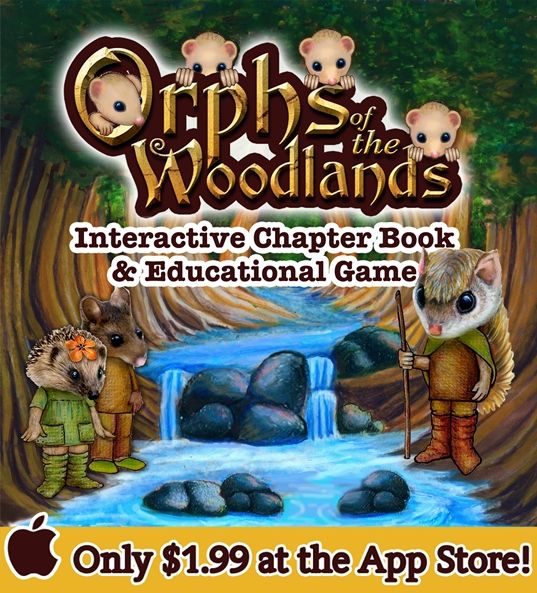
Star Toaster(App review of Orphs of the Woodlands at Tangletree)

Last spring Youngest was introduced to the Orphs of the Woodlands via a computer program review. He enjoyed his time with the program, and was happy to have the opportunity to review a coordinating app produced by Star ToasterOrphs of the Woodlands at Tangletree

The app is similar in some aspects to the program. but there is also some variation on the theme.

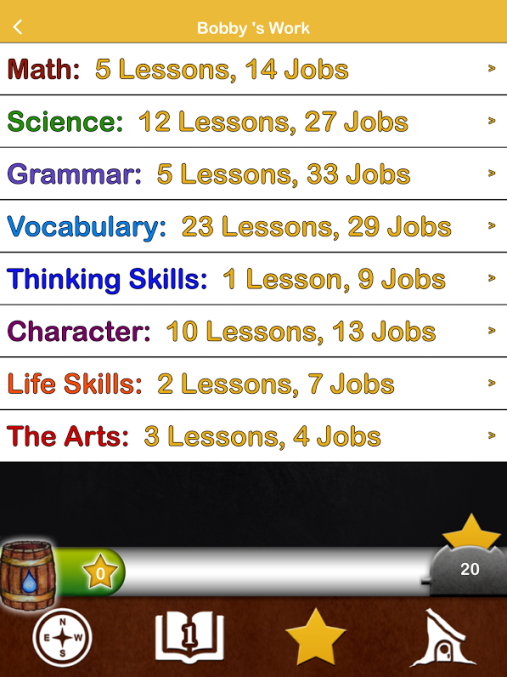
Once again the student reads an adventure story featuring the Orphs of the Woodlands, this time the journal of Abba, the Flying Squirrel. Within the text there are links to lessons on a variety of subjects as you can see on the graphic on the right.  When clicking on the words within the text it is good to know that they coordinate colors with those in the graphic to the right. Math lessons are linked with Red letters. Science is linked with Green lettering, and so on. These lessons are opportunities to learn skills in order to take and complete a variety of jobs. The stars earned when a job is finished successfully can be used to purchase supplies for the orphaned animals of Tangletree,

The story may be a little longer and more complex than the one in the computer program, a quick read for advanced readers, but a bit slower for those who are learning how to read, or working on those skills. There are 18 chapters in this particular Woodland Adventure. When I handed the ipad over to my son, he was very pleased, and read it through in fairly short order, even with the included lessons and jobs to complete.
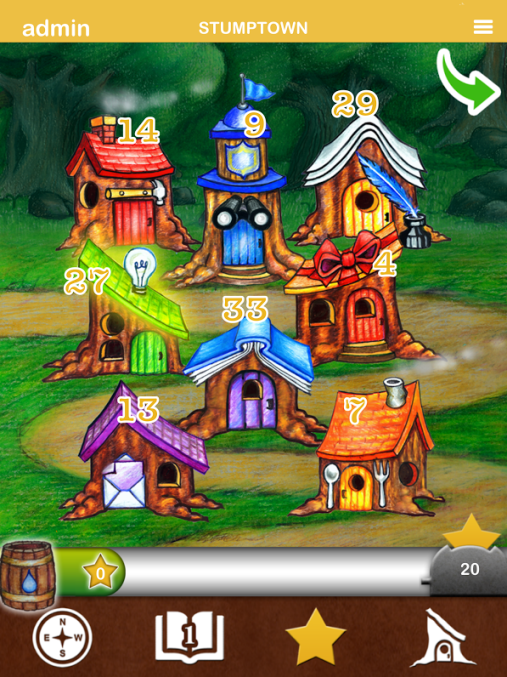
If your child ever forgets what Lessons they may have learned, and how many stars they have earned, they can figure it out by stopping by any one of the tiny houses in Stumptown (Shown in the graphic to the left-hand side). Each house shows the number of stars that can be collected through completing those Lessons and Jobs.

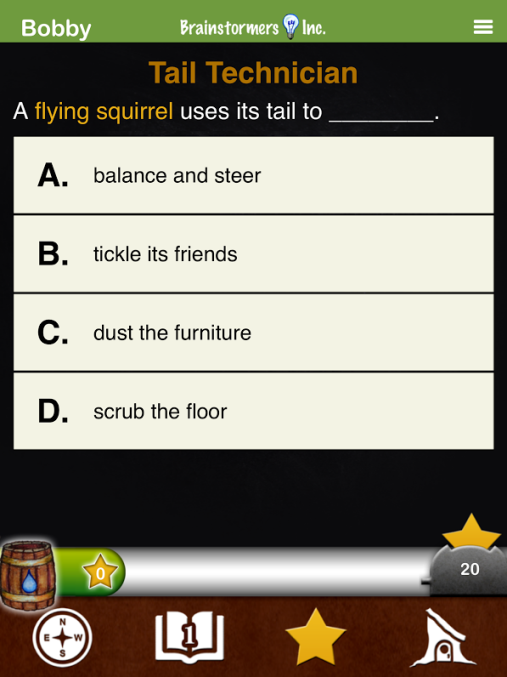
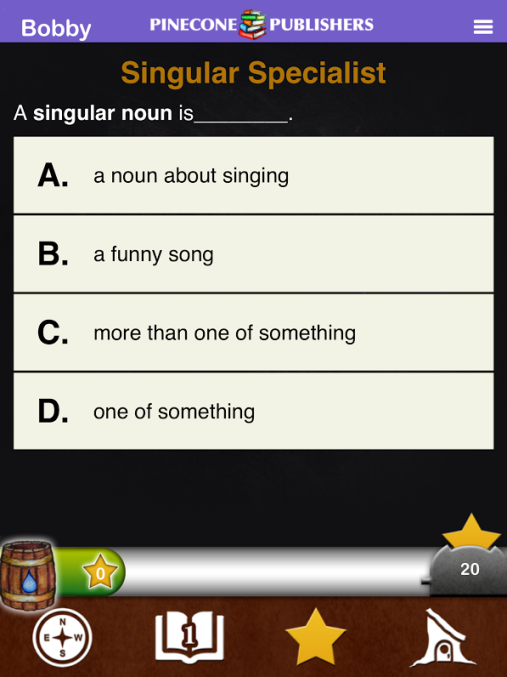
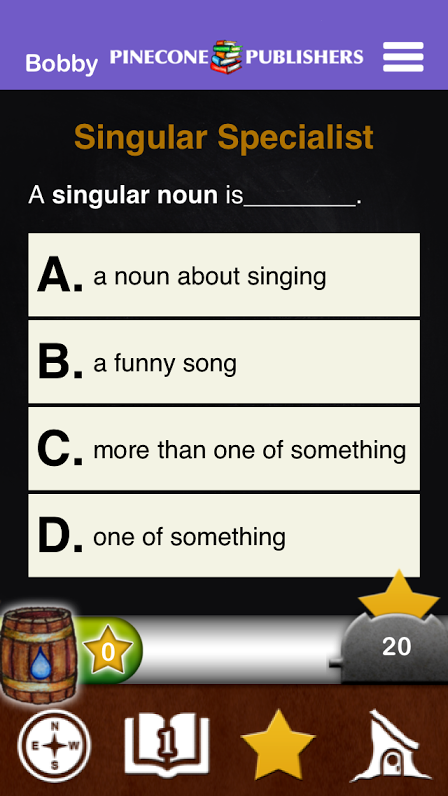
Following are screenshots of some of the Lessons, and Jobs:
  

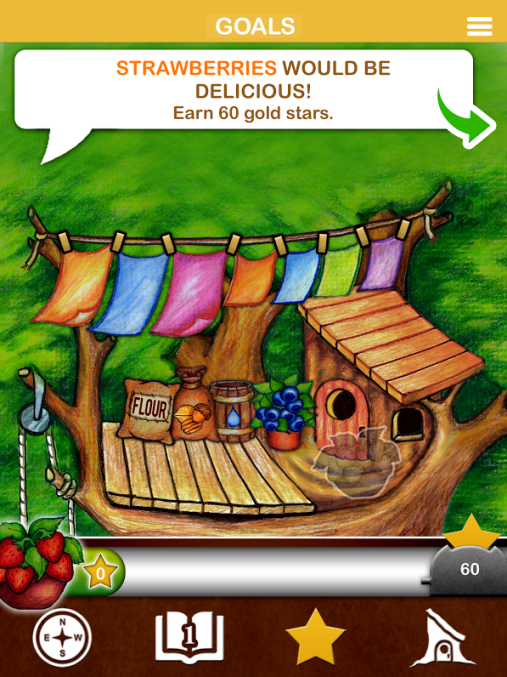
There is also information for the child, to show him his current goal: 


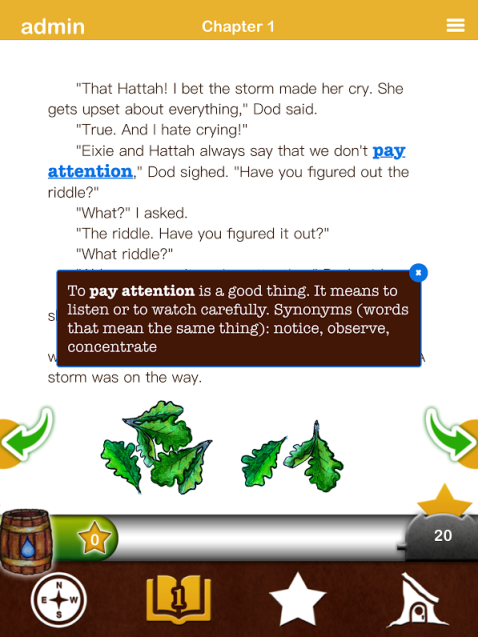
You can get a feel for the story itself with the following excerpt: 

I honestly currently have no "cons" to list for the Orphs of the Woodlands and Tangletree, other than maybe that it is hard to figure out if jobs can be attempted after failing them once. It would be nice to see that become a possibility. I haven't run into it as many times this year as last (hey! The boy is learning! Hurrah!,  but in the real world people are given 2nd chances (usually). 

Because he finished this story so fast, Youngest has been anxiously awaiting the stories that we understand will be available soon. He can't wait to read another installment (In-app purchases  are available as soon as they are published. 

Not So Nutty Nitty Gritty 
You can visit Star Toaster on their social media pages: Facebook and Twitter
Please click the banner below to visit the TOS Review Crew and see what others had to say. As always, I hope that this review was useful to you as you choose where best to spend your homeschool budget.
Blessings~

Click to read Crew Reviews
Crew Disclaimer

Thursday, July 21, 2016

Getting Your Highschooler Ready for Real-World Writing! (Review)


I think one of the hardest subjects to teach is Writing. It is intimidating to the student as well as to the teacher, in part because it is somewhat subjective. As our students get older, it gets even more interesting, particularly as they must begin writing more non-fiction in preparation for real world writing... reports, reviews, grants, etc...

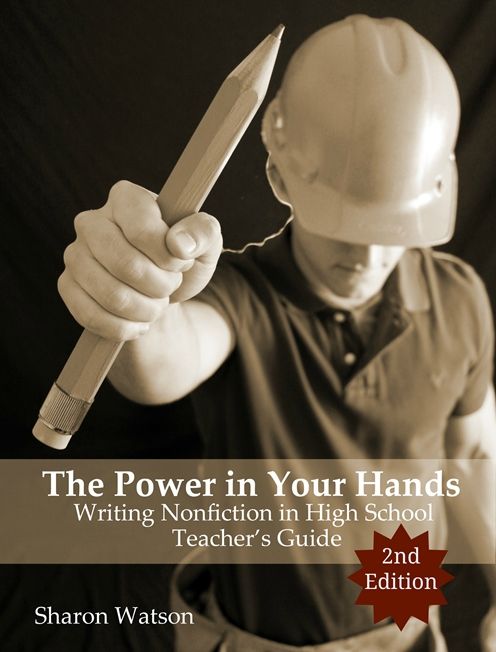
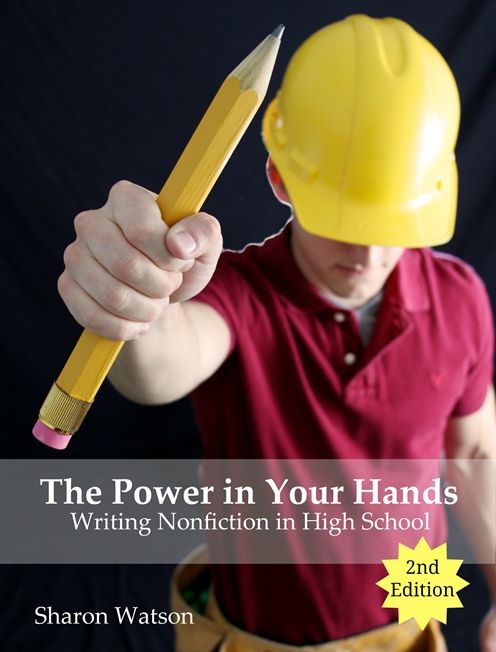
In line with that thinking, TOS Review Crew members were sent Writing with Sharon Watson's The Power in Your Hands: Writing Nonfiction in High School, 2nd Edition. 
My 15yo son was the test subject for this review.

First a word about the Teacher's Guide.

This is an excellent resource for the homeschool parent. The bulk of the manual is a well organized "Key" for the lessons in the Student Manual. There is so much thought that has gone into this part of the manual that it is very easy for Mom (or Dad) to be confident in their use, and guiding of their student.

Obviously, in a writing course there won't be simple subjective answers (although there are some of those as well, dealing with the mechanics of writing, and comprehension and evaluation of those mechanics), and that is where the first portion of the Teacher's Guide comes into play. Sharon Watson has created a "Grading Toolbox" for teachers that explains "How to earn a____ (A, B, C, D, F)" by giving real-life examples of papers that earned those letter grades along with an explanation of why those grades are given. In addition to those examples (which I personally found very useful), Sharon Watson includes a grading rubric specific to the content as well as one for Grammar/Mechanics at the end of each chapter.

Now~ on to the Student Book
I love the fact that this isn't called a manual or a guide. Sharon Watson uses Construction Industry/Power Tool imagery with the title The Power in Your Hands. She writes in a very conversational tone, which kept my son's attention very well. He really appreciated that he didn't feel like he was reading a text book, but rather was actually being taught by Sharon Watson herself. Here is what he had to say:

I like how they start you off with a topic and you then build on it implementing the rules and techniques that you learn. I also like how it seems less like a "textbook" and more like a conversation.

Using relevant topics to teens is of course a good idea (gun control, global warming, teens owning credit cards, global warming etc.),but I really like how they break the techniques and orders and rules that you learn down and let you build on what you've already started. 

It really does seem to keep my attention more than some other writing courses have... Feels like a teacher is instructing you not like you're reading a book. The "puns" and relevant topics really help keep your attention and just make it more interesting in general. Easier to read and less bland I guess?

My son really appreciated that he was given a topic to consider and that topic carried through for more than just one lesson, so he didn't have to start from scratch each time a new technique or rule was learned. 

As I mentioned before, there ARE some work-book style exercises integrated into the text. These are some of the POWER TOOLS being put in the hands of my teen, so that he can construct quality papers. I look forward to using this throughout the school year, as he learns to construct:

  • Persuasive Essays using 
    • Logic
    • Compare and Contrast
    • Moral/Ethical
    • Emotional appeals
  • ExpositoryWriting in the form of 
    • Letters and Emails
    • Position Papers
    • Devotionals
    • Newspaper Writing
    • Biographies
    • Compare and Contrast again with a different emphasis
    • Literary Analysis
    • Definition Essays
    • Descriptive Essays
    • Narration
    • Interview Narrative
    • Personal Narrative
  • Tools
    • Proofreading (This actually comes fairly early on in the book, but I'm including it here for ease)
    • Reference lists for a variety of editing helps including do/don't lists and general definitions
I am really a book in the hand, notebook for the student work sort of person, but I do want to mention that there is also a downloadable version of this book, which might be a great option for larger homeschooling families, especially if your kids like to fill out exercises more "workbook style" or if you have more than one student taking this course at the same time. 

I think this is going to be an invaluable resource for my son as he continues through high school and on into college life. I also expect that my graduated daughter may find it useful as well, as she enters into the college world of writing. 


Not So Nutty Nitty Gritty 
Visit Writing with Sharon Watson Social Media Pages: Facebook and Pinterest

Please click the banner below to visit the TOS Review Crew and see what others had to say. As always, I hope that this review was useful to you as you choose where best to spend your homeschool budget.
Blessings~

Click to read Crew Reviews
Crew Disclaimer

Friday, July 8, 2016

Laurelwood Books Once Upon a Time in Latin (Reader and Workbook) Review


I was recently given the opportunity to use Laurelwood Books' first set in their series of Fairytale based Latin Readers, Olim, Once upon a Time in Latin, Reader I and 
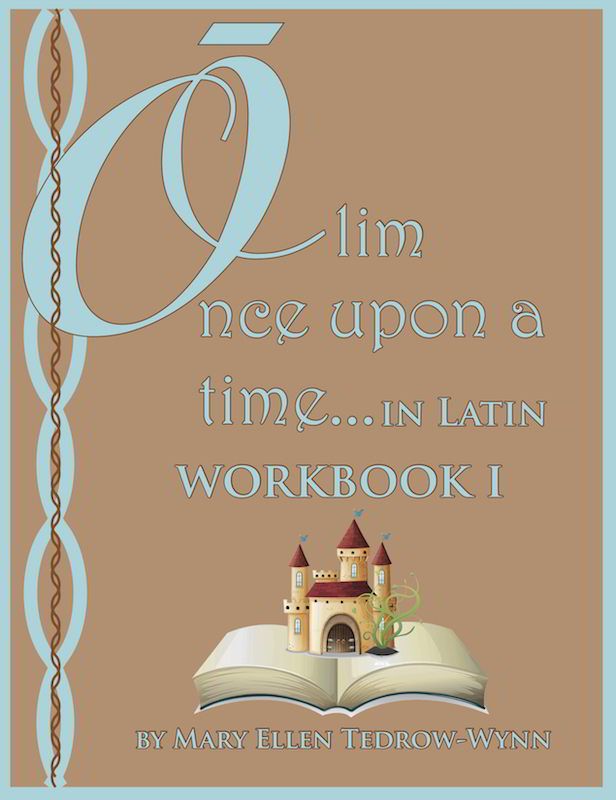
Olim, Once Upon a time in Latin, Workbook I for review. Each set in the series covers one or more fables, parables, or Bible Story in English and Latin. 

Reader 1 includes The Three Little Pigs, The Tortoise and the Hare, and The Crow and the Pitcher. 
Reader 2 includes The Good Samaritan, The Ant and the Chrysalis, and The Lost Sheep
Reader 3 includes The Feeding of the 500 and The Lion and the Mouse. 
Reader 4 includes The History of Creating the World
Reader 5 includes We Know a Tree by it's Fruit, and Daniel part 1
Reader 6 includes The Prodigal Son


The reader has a Latin pronunciation guide in the front, along with general instructions on how the Reader can be used. The suggestion is to do a page per day, along with the associated workbook page. I will admit that we took it a little slower, in part because it is summer, but more because my Youngest was having a hard time memorizing the words in Latin. He could give me the English translation, but coming up with the Latin words was much harder (as is to be expected). As a result, I tended to read the page with him, then read it again the next day before attempting the workbook page.

So how does it work? The reader tells the story in English, and then tells it in Latin. To assist with learning the meaning of the Latin phrases, the Latin vocabulary for each page is printed down the side bar.


We started with the story of the Tortoise and the Hare (because, while I love the story of the Three Little Pigs, I personally prefer the version where the wolf *doesn't* get eaten...whoops!).

The bottom of each Latin story page has a STOP symbol and the accompanying Workbook Exercise listed. This is very helpful. :)

The workbook includes a variety of exercises using the vocabulary from each page:
Translate words or phrases from Latin to English
Translate words or phrases from English to Latin
Fill in the blank with the English word(s), then translate the word(s) into Latin
Match the Latin word to the English Translation


Digging Deeper~ My son wasn't ready for Latin verb tense (or Nominative, Accusative, Genitive, Dative, or Ablative), so after reading through the first Digging Deeper with him, I decided that these sections would be better saved for a much later date.

Because I am not fluent in Latin myself, I wish that the pronunciation guide for the Latin words was included with the vocabulary on each page (Or even phonetic pronunciation for each word). I find myself turning back to the front of the book with every word (OK, this older brain isn't retaining that knowledge too well...) in order to help my son with his pronunciation. Since he already has a few issues with English pronunciation at times, this is a bit on the tough side.

I suspect that those who subscribe to a Classical Education style will really appreciate this take on teaching elementary Latin, and Charlotte Mason Learners might appreciate it in the sense that the lessons can be short and sweet. However, I felt that it was a lot more than my more relaxed style could maintain for very long, without creating a serious dislike of Latin in my son.

I like the concept, but I feel that it is akin to the idea of whole language reading ~ and I personally prefer the building blocks of phonetics. Please take a few minutes and see what other Crew Reviewers had to say, as we all come from different teaching/learning backgrounds, and others may have a very different view of this curriculum. Besides which, Laurelwood books has many other items that were reviewed including a State Study, Patriotic Penmanship, Latin Derivatives, and the Scripture Scribe Series.

Not So Nutty Nitty Gritty 
Laurelwood Books can be found on Facebook if you'd like to check them out on Social Media.

Again, please click the banner below to visit the TOS Review Crew and see what others had to say about this and other offerings from Laurelwood Books.  As always, I hope that this review was useful to you as you choose where best to spend your homeschool budget.

Blessings~


Click to read Crew Reviews
Crew Disclaimer

Friday, July 1, 2016

Summer STEM learning in a game!


Everyone once in a while I'm sent a fun game to review, and sometimes those games are even educational! I jumped at the opportunity to receive Circuit Maze from #ThinkFun for review. We've had a couple of weeks to play with it, and my *almost* nine-year old has enjoyed using it.

If you've ever used an electrical circuit "toy" then you'll be somewhat familiar with the concept of how the electrical portion of this game works. If you've ever played any solitaire logic games (Rush Hour and the like), you'll be familiar with the logic portion of the game.  What a great idea to put the two concepts together!

The pieces in this product are tokens (squares with metal contact strips in a variety of configurations), a start token that includes the battery power pack, and a finish token.

The concept of the game is to set up the game grid using the game cards~ each card shows the start and finish tokens, as well as some other tokens in a specific set-up. There are also some missing tokens, and the puzzle part of this game is to put them in the right place in order to complete the circuit and light up the light(s). There are three beacon tokens with one green, one yellow, and one red light.


One of the cards my son worked on appeared to be solved correctly, but the yellow light wasn't lighting up... hmmm... sometimes the tokens don't seat firmly and the lights flicker on/off (my only *con* with this game), but this didn't appear to be the case this time around.


After fiddling around with it for awhile, he decided to put it away for the evening.

The next day I asked him to pull the game out again, and retry the challenge. I also reminded him to make sure that the positive and negative sides were matching up correctly so that the current would flow. Sure enough! That was his trouble the night before. Paying attention to direction of the little + and - signs made a huge difference!


I anticipate this being a good game to bring on trips and to use any time that a brain and hands require something to keep them busy for awhile, without being in front of a screen! 

What a fun way to get some STEM learning in this summer without the kids even realizing that it's something other than a cool logic game! 

Not So Nutty Nitty Gritty 
  • Company: Think Fun
  • Product: Circuit Maze
  • Ages: 8+ 
  • Price: $29.99
I hope this was a useful review as you search out fun and educational games to occupy your children this summer! 

Blessings~


Thursday, June 16, 2016

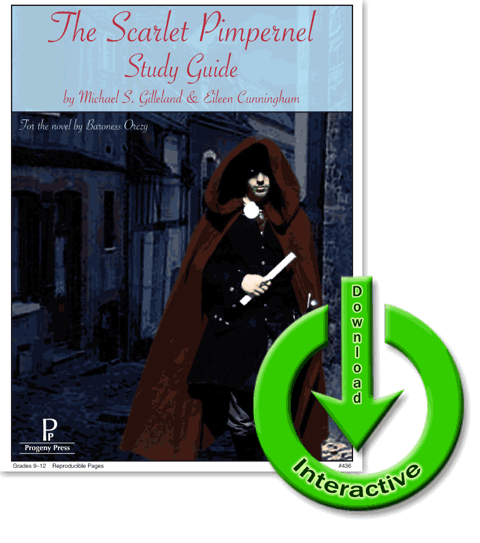
Progeny Press ~ The Scarlet Pimpernel E-Guide (Review)

Invariably, whenever anyone asks me for recommendations for high school literature, Progeny Press is one of the first names out of my mouth, so I was very pleased to be able to add The Scarlet Pimpernel E-Guide to our review line up. I was introduced to Progeny Press in 2012 when I reviewed the High School Pride and Prejudice E-guide and Middle School The Bronze Bow E-guide. In 2013 we reviewed Treasure Island and The Hobbit E-guides, 2014 brought The Hunger Games and The Giver. This past fall I got my first look at the elementary E-Guides when I reviewed Sam the Minuteman. I also reviewed another High School Title, To Kill A Mockingbird. In addition to those guides received for review, I have independently purchased guides for Jane Eyre, A Wrinkle in Time, and Amos Fortune, Free Man. I suppose you could say I'm a Progeny Press Junkie when it comes to Middle and High School Literature guides. :)

So, what's all the hoopla about? WHY do I love these guides?

  • Thorough vocabulary lists and a variety of exercises ~ sometimes matching definitions and writing sentences, others listing synonyms and antonyms. Writing their own definitions, then looking up dictionary definitions and comparing the two. The variety of exercises keeps the study from getting dull, which is great. I also appreciate that sometimes the exercises are fairly time consuming, and others they are rather quickly done. To a teen's mind there are few things more time-consuming and dreary than knowing that you have to write the dictionary definition for 20 words in EVERY single unit~ SOOO grateful that Progeny Press shakes things up a bit. ;) 
  • Comprehension questions are actual comprehension questions and not just "Who? What? When? Where?" questions, but  also "How? and Why?" questions, which I often find missing in other studies. 
First and foremost however, in addition to the above, I greatly appreciate the Christian Worldview presented throughout the guide. Although the authors aren't necessarily Christian writers, their works are discussed through a Christian lens. When something doesn't line up with the Bible, it's pointed out. Character qualities are discussed, and moral dilemmas may be considered. The Christian Worldview *may* come through during the Literary Analysis questions which encompass Literary form, technique, and style questions, but it definitely comes into play in the Dig Deeper section. 
Here is an example of a couple of questions in a Dig Deeper section from The Scarlet Pimpernel:


9. A moral dilemma is defined as having to make a choice between two things that are either both right (something one should do) or both bad (something one should not do). The result being that no matter what one does, the consequence is either painful or morally unacceptable. This is often referred to as being “between a rock and a hard place,” because both options are hard and painful. In Chapter 10, Chauvelin confronts Marguerite with a moral dilemma: should she act to save her brother, or should she refuse to act and save the Scarlet Pimpernel and French aristocrats. She should save both her brother and protect the Scarlet Pimpernel; however she cannot do both.
What appears to be Marguerite’s choice at the end of these chapters? Do you think she chooses wisely? What would you have done? Why?

10. Each of us has faced or will face moral dilemmas in our lives. For example, perhaps someone is being bullied in school or the neighborhood, but he or she has asked you not to tell. Do you keep their secret and allow the bullying to continue or do you betray their trust and do you tell someone in an effort to stop the bullying? Two friends are going on a mission trip and both need support, but you can afford to help only one. A family member or good friend is broke and needs a place to live for awhile, but you know that any money they get will go toward alco- hol or drugs and they will bring that lifestyle into the home. Do you help them and let them stay with you, or do you protect your family (and possibly your friend) by refusing them shelter?
Have you ever faced a moral dilemma in your life? What was it and how did you decide what to do? How do you decide what to do when you are faced with a moral dilemma?

Pretty good stuff, yes? ;)

The guide includes "optional activities" that are often opportunities for further discussion. It ends with an "overview" that could be used as a "Final" test, and a list of Essays or Projects that can be assigned.

One of the other things I appreciate is that each Progeny Press Unit (at the high school level) can be counted as 1/4 credit on a high school transcript. That is very useful information for the homeschool teacher! :)

A couple of notes on our specific time with The Scarlet Pimpernel:
Middlest had computer issues, so was not able to take advantage of the interactive qualities of the study guide. (Apparently some computers don't come with Adobe Acrobat Reader, and the program may crash repeatedly when downloaded). This was a little dismaying to my more techie kid, as he would prefer to type directly into the document, but such is life (when his sister had done Progeny Press E-guides, she has simply used a spiral bound notebook for her work, and she's quite happy with that option. :)
Middlest is taking a middle ground approach, and typing his answers into a document, which he can then email to me.

Middlest's thoughts on The Scarlet Pimpernel:
The book started out very slowly, and was difficult to get into, due to lack of action, and getting used to the language. The first chapter was written from a different perspective, so that was also a little confusing. After that it picked up, and was more exciting and action/adventure filled. His favorite part of the E-guide is the vocabulary section, as it has helped him understand more clearly what was being said in the book. He also likes the Comprehension questions because they are more straightforward. Mom's note: The Analysis and Digging Deeper questions are more difficult to answer, and often require an opinion, which is often not forthcoming with him, so they are NOT his favorite part, but they ARE one of the things *I* appreciate the most. ;)

Not So Nutty Nitty Gritty 
Social Media Links: 

Please click the banner below to visit the TOS Review Crew and see what others had to say about The Scarlet Pimpernel E-Guide, as well as the following titles:
K-3 titles ~ The Minstrel in the Tower and The Drinking Gourd
4-6 titles ~ Mr. Popper's Penguins and The Sword in the Tree
6-8 titles ~ Give Me Liberty and The Indian in the Cupboard
9-12 titles ~ The Scarlet Pimpernel and Great Expectations
As always, I hope that this review was useful to you as you choose where best to spend your homeschool budget.
Blessings~


Click to read Crew Reviews
Crew Disclaimer

Wednesday, April 20, 2016

A+ Interactive Math Math Mini-Courses (A Review)


My Youngest has been a regular number cruncher ever since he was an itty bitty, but every now and again I like to check and see if there are any "Holes" in his maths education. Our latest review from A+ Interactive Math can help with catching and filling some of those holes. Although I haven't been on any of the other reviews, the TOS Crew has reviewed A+ Interactive Math's individual grade level packages in the past. This time we had the chance to check out their newest offering, Math Mini-Courses, for grades K-8.

There are 20 Math Mini-Courses available. I'm listing them below in approximate order of grade:
  • Counting and Identifying Numbers (1st-3rd) - 15 lessons
  • Place Value and Number Combinations (1st-3rd) - 15 lessons
  • Naming, Comparing and Arranging Numbers (1st-3rd) - 17 lessons
  • Early Elementary Fractions (1st-3rd) - 10 lessons
  • Early Elementary Addition (1st-3rd) - 17 lessons
  • Early Elementary Subtraction (1st-3rd) - 15 lessons
  • Elementary Geometry (1st-4th) - 19 lessons
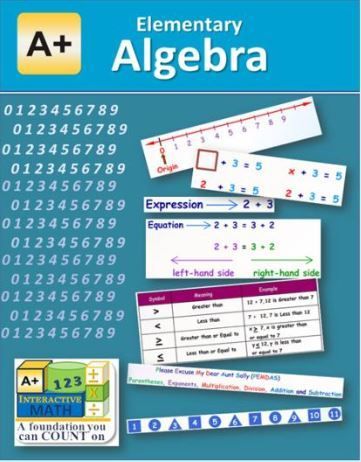
  • Elementary Algebra (1st-4th) - 27 lessons
  • Time (1st-4th) - 20 lessons
  • Money (1st-5th) - 18 lessons
  • Tables, Charts and Graphs (1st-6th) - 17 lessons
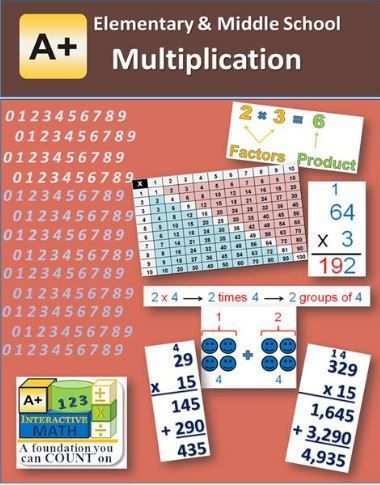
  • Elementary & Middle School Multiplication (2nd-6th) - 13 lessons
  • Elementary & Middle School Division (2nd-6th) - 15 lessons
  • Measurements and Conversions (2nd-6th) - 23 lessons 
  • Number Types and Conversions (3rd-6th) - 35 lessons
  • Ratio, Proportions, Probability & Statistics (3rd-6th) - 14 lessons 
  • Decimal Numbers (3rd-7th) - 20 lessons
  • Advanced Geometry (4th-7th) - 35 lessons
  • Advanced Fractions (4th-8th) - 26 lessons
  • Percentages (5th-8th) - 13 lessons


Some of the concepts are very basic, and others more advanced or something that might be left out, particularly if you don't follow a specific curriculum and teach math more "organically," which is actually something I did with my Eldest through about 4th grade.
She learned basic math (Addition, Subtraction, Multiplication, Division, Fractions, Decimals, Time and Money) as we went through life, and with a hodge-podge of worksheets and activities. 
If these had been around then, I might have chosen to use the Tables, Charts, Graphs or Measurements and Conversions, Number Types and Conversions, or Ratio, Proportions, Probability & Statistics, as those weren't things that came up in our daily life. 

Moving on to the present time, and my Youngest... as I said, he's been fond of numbers (and used them fairly well) since he was about two. He has had the benefit of using more actual "Curriculum" for the early grades than his siblings, but even so, there are some skills that could use a little more work. 

Because we are right in the middle of 3rd grade, it seemed like a good idea to check out 
Elementary & Middle School Multiplication as well as Elementary Algebra.

I will say that the interface for A+ Interactive Math isn't exactly intuitive for me, so it took a while to get used to where to find things, and how to actually submit answers, and finalize quizzes. They do supply a pdf guide to help you get started, but if your student is used to entering a number and then using the "enter" key to submit the answer, it may take a while to get used to this. We also made the mistake of closing the window when reaching the end of a worksheet or quiz without saving or finalizing the worksheet, and *poof* it was gone. Not a major issue, just something that we had to "learn" in order to use the program properly. :) This is a screenshot of part of the pdf explaining how the program works. 

The first page of the Quick Start-up Guide shows what the student dashboard looks like. From here they will access the Video Lessons which include Interactive Review questions before moving on to the next icon which is where the online worksheets and tests are generated. If your student prefers pencil and paper for their mathwork, visit the blue icon to the right to access pdf worksheets. The green icon is also for those who like to have a hardcopy in their hands. This is the place to print the information from the video lessons in pdf form~ a print-on-demand "Textbook" if you will.


The bottom row of icons are the "details" ~ The first icon for Assigned Online Worksheets and Tests doesn't show up on my son's dashboard, as I chose not to "assign" anything, but rather to let him work through at his own pace. Very adaptable as to how you use this program!  The second icon gives you a place to view worksheet reports, test reports, Interactive question reports (from the video lesson), and video lesson completion summary. 

This screenshot is from the worksheet report the week we started using the Mulitplication course:  
Elementary and Middle School Multiplication (2nd-6th grade) lessons: 
  • 1 - Introduction to Multiplication
  • 2 - Multiplication in Relation to Addition
  • 3 - Multiplication Using Objects
  • 4 - Multiplication Using a Multiplication Table
  • 5 - Multiplication Tricks
  • 6 - Multiplying a 2-digit Number by a 1-digit Number
  • 7 - Multiplying a 3-digit Number and a 1-digit Number
  • 8 - Multiplying a 2-digit Number and a 2-digit Number
  • 9 - Multiplying a 3-digit Number and a 2-digit Number
  • 10 - Multiplying a 4-digit Number and a 2-digit Number
  • 11- Multiplying a 5-digit Number and a 2-digit Number
  • 12 - Multiplying a 3-digit Number and a 3-digit Number
  • 13 - Multiplication with Three Numbers

As you can see, it does get more difficult, so we haven't worked all the way through this course just yet. I do appreciate the ability to just hang out on a topic and have worksheets generated (and graded) until I'm sure that he has a handle on the concept. 

We've also done some work in the Elementary Algebra Mini-Course. 

1.1 Recognizing and Predicting Patterns
1.2 Extending Patterns
1.3 Increasing Number Patterns
1.4 Decreasing Number Patterns
1.5 Balancing Equations
1.6 Arithmetic Number Patterns
1.7 Geometric Number Patterns
1.8 Find the Missing Number
1.9 Properties of Addition and Multiplication
1.10 Completing Equations
1.11 Numeric Expressions and Equations
1.12 Number Comparisons using Symbols
1.13 Completing Number Sentences with Addition
1.14 Comparing Number Expressions with Addition
1.15 Completing Number Sentences with Subtraction
1.16 Comparing Number Expressions with Subtraction
1.17 Number Patterns using Addition and Subtraction
1.18 Number Patterns using Multiplication and Division
1.19 Unknown Variables in Mathematical Equations
1.20 The Number Line
1.21 Variables, Expressions and Equations
1.22 Writing Expressions and Equations
1.23 Inequalities using Variables
1.24 Formulas
1.25 Order of Operations
1.26 Evaluating Expressions
1.27 Equations with One Variable

While some portions of this course are solid, it was good to check out the patterns lessons. They include a variety of pattern types, so that my son learned to look at a string of numbers from a variety of angles to discover what the pattern might be. 
This screen shot shows the end of a pattern worksheet, and the directive to complete the worksheet. :)

The A+ Interactive Math Mini-Courses offer a comprehensive way to fill holes using a variety of methods... video lesson, pdf lesson (textbook), online interactive questions, unlimited generated worksheets/test (Graded for you!), pdf worksheets/test with solutions. Many different options. This can also be a great resource to include in your child's portfolio, especially for those who do math more organically and need something to show for it. ;)

Not So Nutty Nitty Gritty 
You can visit A+ Interactive Math on their Social Media Channels:
Facebook, Twitter, Pinterest

Please click the banner below to visit the TOS Review Crew and see what others had to say. As always, I hope that this review was useful to you as you choose where best to spend your homeschool budget.
Blessings~


Click to read Crew Reviews
Crew Disclaimer

Followers

LinkWithin

Related Posts with Thumbnails