Showing posts with label Writing/Grammar. Show all posts

Friday, September 7, 2018

GrammarPlanet (online grammar lessons from Analytical Grammar)

I have heard of Analytical Grammar, but have never had an up close and personal glimpse of the program. That all changed with my review of a subscription to GrammarPlanet, their online grammar program. This program is intended for students ages 10 through adult, for learning or reviewing, and currently has 13 units, with more being added regularly until it is complete at 60 units.


When you sign up, you will be taken to a parent/teacher dashboard where you add in your students. The teacher dashboard really just shows where the students are, and allows you to see the work completed. There is no instruction or extra material covered here. I think it would be helpful (for planning and preparing ahead of time) if the teacher dashboard in the paid subscription included things like all the unit notes in a downloadable file... instead of only accessing them through the student dashboard, and maybe a little bit of explanation for the feedback pages.

After your students sign in, they are taken to their own dashboard.

For the purposes of this review, I worked through some of the program myself, and had my 11-year-old use it as well.

Each unit is locked until the previous unit is completed. Each unit includes printable notes (we just opened them up in a separate window on the computer, and usually had both windows side by side) which can be accessed by clicking the "reprint notes" button on the right side of the screen.

An instructive video is included for each unit. I had my student read the notes, and then watch the video. The video goes over the notes, with a couple of short quizzes (one or two questions) to make sure the student understands the instruction, followed by examples and a reinforcement of the process to be used when identifying the parts of speech for that Unit.

I will point out that the videos have close-captioned capabilities which I often use as another point of reinforcement (or for those who really don't like the auditory side of things, it's another walk-through of the notes with a little extra added in).

After going through the materials, the student moves on to the exercises. Each unit has 5 levels, so going through one/day would be a good pace. It is suggested that the student not spend more than 15 minutes per day on GrammarPlanet, keeping the lessons short and sweet. The exercises are essentially diagramming sentences, but they start out simply with identifying nouns, then adding in proper nouns, articles and adjectives, and so on, as shown in the outline towards the top of the review. The student gets instant feedback, showing them what they identified correctly and what they missed or misidentified.


Here is a little quirk of the program that we found somewhat confusing. In the example above the name "Father Niccolo Lorini" was properly identified using the proper noun with wings symbols  --PN   PN-- (when used on the first and last word, this added the PN in the middle automatically).
In the example below, I'm not quite sure why the PN symbols in the middle weren't added automatically when the --PN  PN-- was used on "Father" and "Physics."


In my opinion, it would be helpful if the mistakes were clickable with an explanation, especially for those who are on the younger end of the age range, which might help clear up any confusion with things like this~ or it could be a mistake on the part of the program.

My son was also getting confused by words that can be more than one part of speech (nouns and adjectives like gold and silver for example), and explanations would have been extremely helpful to him, or reminders to ask all the questions. The way the program is set up currently is great for an older student or as a refresher, but there could be a few more "helps" added in for the 10-12 year olds.

I also found the order of terms interesting, learning all things relating to nouns before moving on to verbs. I might have preferred to have subject/verbs introduced directly after proper nouns, which would have alleviated some confusion for my son. He knows what verbs are, but not being allowed to identify them for so long made him second-guess himself on a regular basis, resulting in multiple incorrect exercises.

So... what happens when a student identifies a number of words incorrectly? First, they are given extra exercises to work a little more. If there is still an issue, an email is sent to the parent/teacher advising them that there is a problem, and the account is locked so that you can go over the material with your student again before unlocking the account. A feature here that I appreciate is the ability to click on the lessons that were a problem so you can discuss what went wrong.

In this unit I had to unlock the account a couple of times... You can see that I'm checking out "Practice 12" and that the majority of the words are correctly identified, even though there is a big red X by the practice in the list on the left... the same goes for the tests where only one word was misidentified, but there is a big red X... I think those graphics could be changed to be a bit more encouraging, maybe? I will say my mathematically inclined son took issue with the concept that "A majority of the words were incorrectly identified" when he was locked out~ he actually counted his errors and wasn't pleased when they were definitely not a majority~ a significant number perhaps would be better wording here for concrete thinkers. ;)


Occasionally my son would just speed through the lesson, which led to careless mistakes, and repeated exercises... hopefully reinforcing the concept of checking his work twice before clicking submit.

After the five lessons in each unit are completed, there is a unit test (which doesn't give immediate feedback like the lessons), and the student can move on or not, based on how well they do. In the graphics I included here, a blue background is for the practice exercises, and the yellow/mustard background is for the tests.

Suggestions and room for improvement aside, I think that this program is a good tool to help your student get a handle on the English language, as they learn when, where, why, and how words are used the way they are. You can check it out for free and see what you think yourself. For kids who absolutely hate writing, this can be a boon, and for the parents, it does the correcting for you, which can also be greatly appreciated.

When I asked my son, he says he gives GrammarPlanet a B+ (that boy!). He found the content interesting,  he liked the feedback, and thought the notes were well done. In spite of some of his frustrations he felt overall the system was good, and even though it took him longer to get through some units, he feels like he is learning well.

Not So Nutty Nitty Gritty 
  • Company: GrammarPlanet
  • Product: no-ad online subscription
  • Ages: 10-99+
  • Price: $39 which covers the program until they get all the way through, no time limit.
You can visit GrammarPlanet on the Analytical Grammar social media pages on Facebook, Twitter, and Pinterest

Please click the banner below to visit the TOS Homeschool Review Crew and see what others had to say. As always, I hope that this review was useful to you as you choose where best to spend your homeschool budget.
Blessings~
Click to read Crew Reviews
Crew Disclaimer
#hsreviews  #GrammarPlanet #grammar #onlinelearning

Thursday, June 7, 2018

Memoria Press (Classical Composition I: Fable Set) A Review


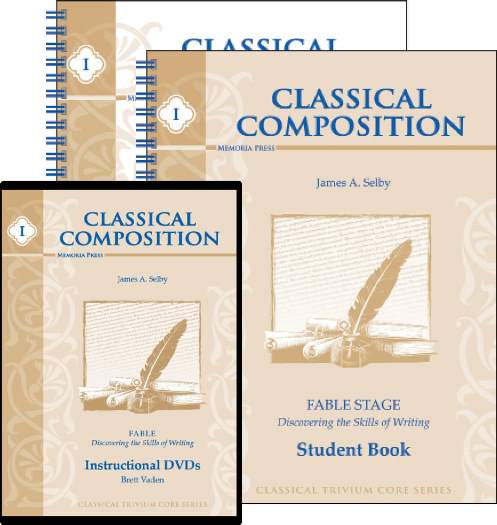
When Memoria Press offered us a selection of products to review, I chose to introduce my Youngest to their Classical Composition I: Fable Set. This set includes the Student Book, the Teacher Guide, and Instructional DVD. I appreciate that both the instructional DVD and the Teacher Guide are included, as this opens up options for student work location. Not always tied to electronics (Instructional DVD) to do the work, because the Teacher Guide includes the instructions required, which means that lessons can be taken outside, to the park, or in the car. However, it is also very nice to have the option to have someone other than Mom or Dad "teach" the lesson, particularly if one isn't as familiar with walking through an outline with their kids.

OK, so now that I've given you a little hint to the content, let me tell you how the lessons are set up. As is typical with Memoria Press, each lesson looks pretty much the same, and they basically drill the concept over and over until it becomes natural.

  • Fable ~ The specific fable for the lesson is printed at the beginning of each lesson
  • Three Plot Components (If applicable) of Recognition, Reversal, and Suffering
  • Variations Part 1 ~ Student comes up with synonyms for 3 or 4 words in a given sentence and then rewrites the sentence three different ways. 
  • Narration (Not in the Student Book, but definitely a component of the lesson, and one of my favorite parts! :) )
  • Outline ~ Summarize fable in outline form. This is a very useful skill to work on, so I appreciate that it shows up in each lesson. The Teacher Guide includes suggested outlines, so you can work from that directly, but the walk-through on the DVD is also valuable. 
  • Paraphrases ~ Generally two paraphrases per fable. The first generally adds in specific Figures of Description (using the Latin names for each one*), and the second is usually written "by reduction" in the briefest form possible without any descriptors.
    • *The Appendix includes 18 Figures of Description with examples for each. These words may or may not be familiar to you, depending on your experience with Classical Education. Here are a few: Anemographia, Dendrographia, Dialogismus, Effictio, Prosopographia, Sermocinatio... These are things that I certainly didn't learn in my public school education. ;) 
  • Variations Part 2 ~ Same thing as Part 1, but with different words/sentences
  • Appendix~ I mentioned the Figures of Description above. The Student Book also includes an "Introduction to the Progymnasmata" by James A Selby, that might be interesting for an older student to read. 

The Teacher Guide begins with teaching guidelines and an advanced rubric for grading purposes. The rest of the book has identical pages to the student book, with instructions specific to each lesson, including vocabulary words, and a more general grading rubric geared to that lesson.

If Classical Education is your style, Memoria Press definitely offers materials that will challenge your child, with ample opportunity to practice the skills that they are being taught.


One minor point that I will mention here~ if you have a student for whom handwriting still isn't smooth and natural, the lines and spacing of the Student book may be a little short. On his best days, his handwriting isn't fabulous, but the more college ruled spacing definitely contributed to a bit of a defeatist attitude. When I suggested that he write his outline on a piece of wide-ruled notebook paper (and do it in cursive), the readability improved drastically. Still not fantastic, but better.

Memoria Press offers sample pages of the Student Book and Teacher Guide as well as a "General Sequence and Outcomes of Program" to download on the product page linked below.


Not So Nutty Nitty Gritty 
Visit Memoria Press on their Social Media pages on  Facebook, Twitter, Pinterest, Instagram, Google+, and  YouTube

Please click the banner below to visit the TOS Homeschool Review Crew and see what others had to say about this and the other products that were offered for review: Products from the New American Cursive Penmanship series, the Traditional Logic Series, and the Classical Composition Series, of which Fables is the first part.

As always, I hope that this review was useful to you as you choose where best to spend your homeschool budget.
Blessings~

New American Cursive & Traditional Logic {Memoria Press Reviews}

Crew Disclaimer
#hsreviews  #memoriapress  #classicalchristianeducation  #classicalyhomeschooling  #Classical CompositionI:FableSet  #classicalchristianhomeschooling  #memoriapresscursive

Wednesday, November 9, 2016

The Critical Thinking Co.™ (Do You Diagram?) (Review)


The Critical Thinking Co.™ has long been a favorite provider of mine. They offer a variety of supplements and curriculum, including Critical Thinking/Logic, of course, but also a variety of Language Arts and Math, typically presented in a clear and engaging format. I mean really, who wouldn't be interested in a workbook entitled "Dr. DooRiddles" or "MindBenders."

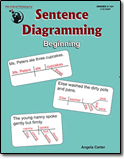
I have both reviewed (2010, 2012, 2015) and purchased an assortment of their products, and been pretty happy with all of them, so was pleased to be offered the chance to review another book, Sentence Diagramming: Beginning Grades 3-12+.

I don't know what your public or other school education looked like, but I don't actually recall learning how to diagram sentences. It's possible that we did, but I truly do not have a clear recollection of diagramming, which is interesting, as I was a student who enjoyed my English Language classes (perhaps the personalities of my teachers overshadowed what they were teaching? Mr. Harrington's ability to throw a small bouncy ball caroming off the ceiling and the blackboard to hit a dozing student on the back of the head was somewhat legendary...).

I digress. Coming back to Sentence Diagramming: Beginning, I decided to use it with both my 4th grader and and my 10th grader, as it clearly wasn't something that we had done before. My 4th grader has been enjoying doing these "puzzles" and is possibly "competing" a little with his older brother.

Because we are working on it together, I am having them do most of their work in a notebook. The Critical Thinking Co.™does allow limited duplication within a home setting, but our ink supply needs replenished, so this works for us. Makes for a little more work for the boys, since they are drawing their own lines, but I figure that is good practice!

So, I sit on the couch with the book, one boy on either side with their notebooks, and we go through the lessons.
 

Each of the 12 lessons has 4 main parts, following the new concept explanation.
  1. Find the errors and diagram correctly - sometimes it's a little tricky, others less so, but "finding the errors" is a great tool for learning. 
  2. Fill in the diagram - using the provided sentence~ good practice
  3. Write a sentence to match the diagram - This is a page that I do print, just because it makes life easier ~ worth the ink even when it's in short supply. ;) 
  4. Diagram each sentence without the predrawn lines - mastering the technique

I really like the building block progression of each part, from finding tiny errors to diagramming with no assistance.

The diagrams go from simple + construction to multi-forked builds in the later lessons. Again, a building block progression, from simple to complicated, so that it makes perfect sense. I can see that this is a fantastic way to learn grammar, especially if you have a visual learner, and I'm quite surprised that more curricula don't utilize this, from the very beginning, as it shows very concretely what each word is, and how it relates to the other words in the sentence. It also turns grammar into a puzzle, which is much more exciting than  exercises like "find the noun____ " or "label the adjectives."

Lesson 1: Simple Subject and Main Verb
Lesson 2: Direct Object
Lesson 3: Adjectives
Lesson 4: Adverbs Modifying Verbs
Lesson 5: Predicate Adjectives
Lesson 6: Predicate Nouns
Lesson 7: Prepositional Phrases (Adjectival)
Lesson 8: Prepositional Phrases (Adverbial)
Lesson 9: Compound Subjects
Lesson 10: Compound Predicates
Lesson 11: Compound Direct Objects
Lesson 12: Compound Predicate Adjectives and Nouns

The book includes a review/test at the end that covers each lesson, and for those who aren't sure about their answers, there is an Answer Key at the back. I found this helpful, as I wasn't sure what to do with "the" and "a" when they showed up (makes perfect sense that they are diagrammed as adjectives, which is the way I understand it, because they describe that there is only "one" of the object. If I'm wrong in that assessment, feel free to explain it to me. ;) ).

I think this is also a helpful review for older students, which may come in handy if they have to break down sentences on their standardized tests ~ it's a comprehensive but gentle Charlotte Mason-ish approach also~ short lessons that encourage rather than overwhelm. :)

Not So Nutty Nitty Gritty 
You can visit The Critical Thinking Co.™ on their social media pages:
Facebook, Google+, and Pinterest


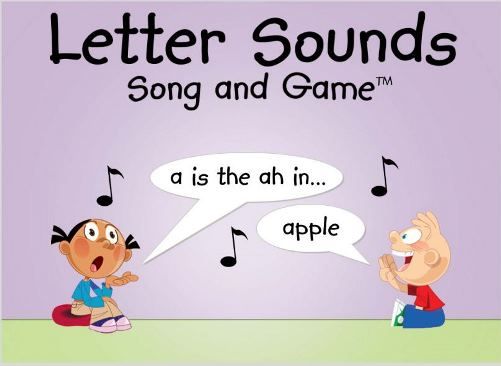
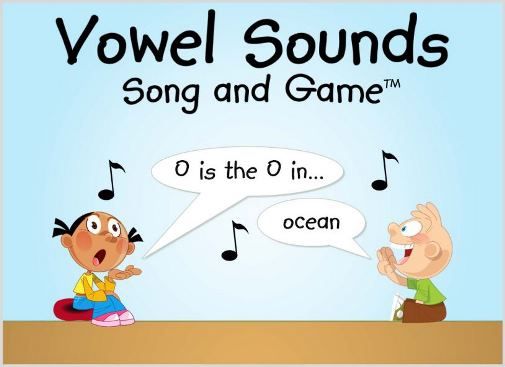
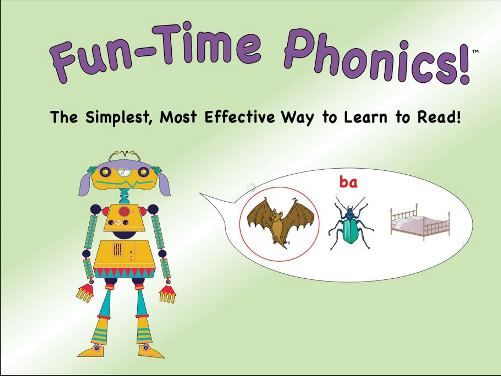
Please click the banner below to visit the TOS Review Crew and see what others had to say about this and the other titles reviewed: Language Smarts Level E (Which is a full 4th Grade Language Arts curriculum), and a variety of software downloads for Toddler/PreK to Grade 2 (Alphabet Song Game, Letter Sounds Song and Game, Vowel Sounds Song and Game, and Fun-Time Phonics). FYI, the Software is not MAC compatible, one of my few pet peeves for The Critical Thinking Co.™ , as I am a MAC girl.  As always, I hope that this review was useful to you as you choose where best to spend your homeschool budget.

Blessings~
Click to read Crew Reviews
Crew Disclaimer

Thursday, July 21, 2016

Getting Your Highschooler Ready for Real-World Writing! (Review)


I think one of the hardest subjects to teach is Writing. It is intimidating to the student as well as to the teacher, in part because it is somewhat subjective. As our students get older, it gets even more interesting, particularly as they must begin writing more non-fiction in preparation for real world writing... reports, reviews, grants, etc...

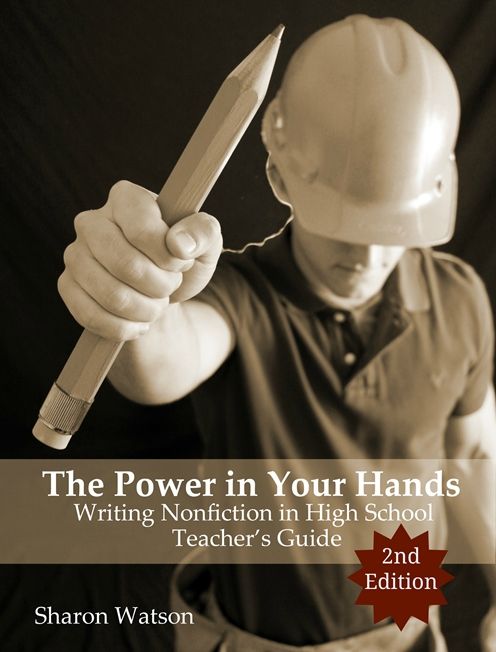
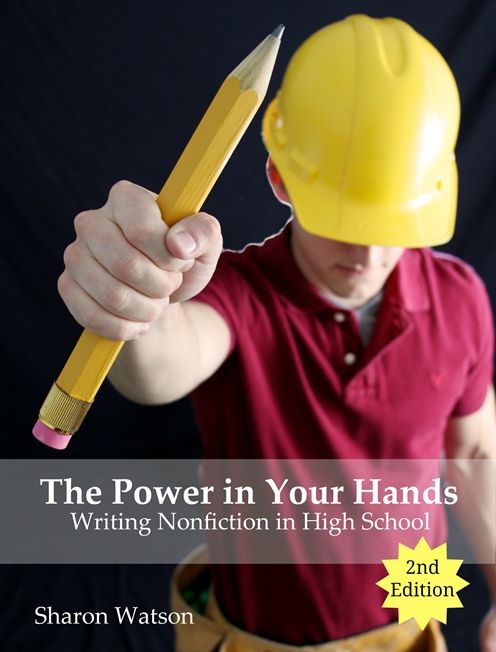
In line with that thinking, TOS Review Crew members were sent Writing with Sharon Watson's The Power in Your Hands: Writing Nonfiction in High School, 2nd Edition. 
My 15yo son was the test subject for this review.

First a word about the Teacher's Guide.

This is an excellent resource for the homeschool parent. The bulk of the manual is a well organized "Key" for the lessons in the Student Manual. There is so much thought that has gone into this part of the manual that it is very easy for Mom (or Dad) to be confident in their use, and guiding of their student.

Obviously, in a writing course there won't be simple subjective answers (although there are some of those as well, dealing with the mechanics of writing, and comprehension and evaluation of those mechanics), and that is where the first portion of the Teacher's Guide comes into play. Sharon Watson has created a "Grading Toolbox" for teachers that explains "How to earn a____ (A, B, C, D, F)" by giving real-life examples of papers that earned those letter grades along with an explanation of why those grades are given. In addition to those examples (which I personally found very useful), Sharon Watson includes a grading rubric specific to the content as well as one for Grammar/Mechanics at the end of each chapter.

Now~ on to the Student Book
I love the fact that this isn't called a manual or a guide. Sharon Watson uses Construction Industry/Power Tool imagery with the title The Power in Your Hands. She writes in a very conversational tone, which kept my son's attention very well. He really appreciated that he didn't feel like he was reading a text book, but rather was actually being taught by Sharon Watson herself. Here is what he had to say:

I like how they start you off with a topic and you then build on it implementing the rules and techniques that you learn. I also like how it seems less like a "textbook" and more like a conversation.

Using relevant topics to teens is of course a good idea (gun control, global warming, teens owning credit cards, global warming etc.),but I really like how they break the techniques and orders and rules that you learn down and let you build on what you've already started. 

It really does seem to keep my attention more than some other writing courses have... Feels like a teacher is instructing you not like you're reading a book. The "puns" and relevant topics really help keep your attention and just make it more interesting in general. Easier to read and less bland I guess?

My son really appreciated that he was given a topic to consider and that topic carried through for more than just one lesson, so he didn't have to start from scratch each time a new technique or rule was learned. 

As I mentioned before, there ARE some work-book style exercises integrated into the text. These are some of the POWER TOOLS being put in the hands of my teen, so that he can construct quality papers. I look forward to using this throughout the school year, as he learns to construct:

  • Persuasive Essays using 
    • Logic
    • Compare and Contrast
    • Moral/Ethical
    • Emotional appeals
  • ExpositoryWriting in the form of 
    • Letters and Emails
    • Position Papers
    • Devotionals
    • Newspaper Writing
    • Biographies
    • Compare and Contrast again with a different emphasis
    • Literary Analysis
    • Definition Essays
    • Descriptive Essays
    • Narration
    • Interview Narrative
    • Personal Narrative
  • Tools
    • Proofreading (This actually comes fairly early on in the book, but I'm including it here for ease)
    • Reference lists for a variety of editing helps including do/don't lists and general definitions
I am really a book in the hand, notebook for the student work sort of person, but I do want to mention that there is also a downloadable version of this book, which might be a great option for larger homeschooling families, especially if your kids like to fill out exercises more "workbook style" or if you have more than one student taking this course at the same time. 

I think this is going to be an invaluable resource for my son as he continues through high school and on into college life. I also expect that my graduated daughter may find it useful as well, as she enters into the college world of writing. 


Not So Nutty Nitty Gritty 
Visit Writing with Sharon Watson Social Media Pages: Facebook and Pinterest

Please click the banner below to visit the TOS Review Crew and see what others had to say. As always, I hope that this review was useful to you as you choose where best to spend your homeschool budget.
Blessings~

Click to read Crew Reviews
Crew Disclaimer

Thursday, March 31, 2016

Logic of English~ Essentials 2nd Edition ~ Review


A couple of years ago I reviewed the Logic of English Essentials Complete Set. In the intervening time, Logic of English  has published  Essentials 2nd Edition. The new edition has been expanded, and there is so much new material included that it has been split into 2 volumes. It looks like there is double the information, as the books are the same size. WOW!  Volume 2 has yet to be published, but Volume 1 has enough material to cover a full semester if following a general schedule of one lesson a week.

Members of the TOS Review Crew received a mix of totally new complete Essentials sets ( as well as the Foundations sets, which are for the younger learner) for those who have never reviewed it before, and an upgrade set that includes the new Teacher Manual, Student Workbook. Because we had previously reviewed, we were sent the Upgrade set.

The new Teacher's manual isn't just colorful on the outside, it's colorful on the inside. There are now three levels of teaching, and they are color coded, so that you can easily skip the information that isn't necessary for the level at which your student is learning.


Note: the student workbook is not "fun and games" colorful, and remains basic black and white. I didn't see too many changes, other than added and expanded material to coordinate with the extra material in the teacher's manual. No reason to change something that is working just fine. It also helps to ensure that an older student doesn't feel that they are being given material that is too young for them. :) However, this doesn't mean that there aren't fun and games included. Each week's lesson incorporates games using the various card sets included, as well as a number of games printed in the workbook.

Back to the Teacher's Manual...
Each Lesson starts with an "index card" on the printed page with an overview of what is included in the lesson for each level, which makes it easy to pull together all the materials required.  If you'll notice from the image of the Complete Set (up above), and as I mentioned, there *are* a number of card sets used with this program, so having the information laid out at the beginning of the chapter is very helpful. :)


One of the new features in the second edition is the inclusion of more vocabulary, and leveled spelling lists. Level Band C vocabulary include Greek and Latin roots, which interestingly enough seems to be one of my 8 year old's favorite parts of the program. He has enjoyed decoding the different parts of words, seeing how suffixes and prefixes can change the root meaning.

The lessons are also now broken down into "Days" which makes it easier to follow. I appreciate the new format, which solved one of my problems in the first edition of simpler phonograms being initially "introduced" but not reinforced before giving a "spelling test." With the new format, the test doesn't come until Day 5, while the spelling words are introduced on Day 2 with a "Spelling Analysis."  The Spelling Analysis goes over each word, with the teacher introducing the word, using it in a contextual sentence, and having the student repeat the word. They then break it down into its separate sounds, with the teacher giving clues when there are ambiguous sounds (which could be spelled a number of ways). Throughout the week all of the phonograms are reviewed (often in game or flashcard format), with special emphasis given to those that are trickier, but now the student doesn't go into the test as "blind" as before.

The manual is still very scripted, with precise directions on how to teach the various phonograms and spelling rules, as well as how to give the above-mentioned clues. The worksheets in the students book are also clearly labeled to help make sure that each one is completed at the correct time.

A couple more "notes"
The program does seem a little complex, and it most definitely isn't "grab-and-go" material. It is most certainly teacher-led, and not "independent" learning. Because of the volume of material, and the multiple levels included, the information may seem a little overwhelming to begin with, but it gets easier after the first week or two.

Because my son is a prolific reader, and apparently a natural speller like his siblings, we used a bit of a mash-up of levels for him. Some of the more complex words include some discussion that is a little long for him to follow, so I simplify that, but keep to the lists, making it work for us.

I did run into something else that gave me pause. There are some unusual words used for simple grammar. For example, at the beginning, on the level C list, "abstract" was listed as a noun, even though it is more commonly used as an adjective. This seemed odd to me, and is an example of where I chose to simplify for my 8 year old, but makes perfect sense for an older student, who might hear the term in their science or math class.

All in all, this revamped edition is very thorough and methodical, structured to help the instructor cover the material on a specific schedule, for a variety of ages and abilities. Although I don't have children who face difficulty with spelling, I imagine that this method would be one that would help those with difficulties gain solid success reading, writing, and understanding the written word.

Not So Nutty Nitty Gritty 
You can visit Logic of English on Facebook, YouTube, Twitter, and Pinterest.

Please click the banner below to visit the TOS Review Crew and see what others had to say. As always, I hope that this review was useful to you as you choose where best to spend your homeschool budget.
Blessings~


Click to read Crew Reviews
Crew Disclaimer

Friday, June 12, 2015

Institute for Excellence in Writing (IEW), Deluxe Combo Teacher/Student Writing Package Level C and MORE!

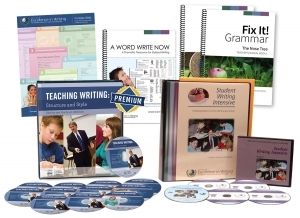
Fair warning to you~ this may be a slightly more lengthy review than usual, which would only be in keeping with the quantity/quality of the material being reviewed. Institute for Excellence in Writing (IEW) sent me the Deluxe Combo Teacher/Student Writing Package Level C (Fix-It! 1 and 2),   A Word Write Now and the Portable Walls. What a HUGE set of material!


*Note: other crew members received a variety of levels, and/or other products, including some special needs packages which include the Bible Heros Student and Teacher books, and the Primary Arts of Learning Reading and Writing Packages. Please be sure to follow the link at the end of my review if you are interested in any of these products, to see what they thought of them. I have not see the Bible Heros books, but I wrote a (non-special needs/non-remedial)  Primary Arts of Learning Review in 2012, and back in 2011 I wrote a fairly comprehensive Level B Teaching With Structure and Style/Student Writing Intensive Review, which is the only reason that this review isn't insanely long~ I'm hoping that you'll check out what I had to say back then, because much of it still holds true!

The Student Writing Intensive (SWI) Level C appears to cover much of the same basic instruction as Level B, but uses some different literary pieces, geared towards the student's age and maturity level. For instance, when we reviewed level B, one of the first stories was more of a  Jr. High novel science type of story that my daughter remembers to this day (smile). The same lesson in Level C used material about Thomas Jefferson, and another piece about the development of standard time zones.

Looking ahead, Level C also goes on to tackle various styles of essays, which is most appropriate and useful for the high school student.

The core of this material is made up of the Student DVD's and the Student Notebook with Handouts and Lesson Plans. Watch the Video Lesson, do the work on the handouts, following the lesson plans, hand it in to mom~ pretty simple to follow!

What exactly does SWI do? Rather than rewriting my thoughts, I'll quote from my first review:
The units move at a fairly steady pace and build writing skills, focusing on just a few techniques and structural elements at a time. I should mention here that if your student has an extremely creative literary bent and is ALWAYS writing, this program might feel a little stifling.  However, Andrew Pudewa has taken pity on the poor souls who never know what to write about, and has given them specific excerpts to re-write. The basic concept is that it is too hard for many children (And adults) to concentrate on learning how to write AND come up with their own content at the same time. I think that depending on your student, and possibly allowing them to choose their own topics, even prolific stream-of-consciousness writers can gain some insight on how to "dress up" and improve their writing.
It's much easier to solidify one's voice or style once one understands the structure of good writing.

My Middlest has expressed a desire to continue with this course through his next school year, as he enjoys the video classes, and the scheduled assignments. Not much higher praise than a student AND the parent/teacher wanting to continue with a specific curriculum.

After 15 years, the Teaching Writing with Structure and Style (TWSS) seminar has been updated! Please do go visit my previous review, because much of the innate program remains the same, but now there is MORE material, and the workbook has a streamlined, updated look.

Here is a chart detailing the differences between the 2000 and 2015 editions:


IEW has put together a pdf detailing more of what's new, with highlights of Workbook updates, the new Premium Subscription, and the Streaming Video Subscription, which helps to keep up with these more techno-mobile times. Great for families who school on the go!


Fix-It! Grammar has a very Charlotte Mason-ish feel to it. By this I mean that the lessons are very short~ 33 lessons meant to be completed in 15 minutes (or less) in 4 exercises per week. Who doesn't like that? When chosen for this review we requested books 1 and 2 just because my Middlest was a little rusty with some of his grammar. After a few lessons, he felt that these would be great books to zip through in the summer (moving a little more quickly than one exercise/day~ perhaps a full lesson/day), as a refresher course before the new school year. IEW suggests that the high school student could go through one book per semester if they doubled up on the exercises. Fix it Grammar makes an excellent elementary, remedial, or refresher course.

The lessons start simply, and focus on learning the notation or proper use of one or two new things each week. For example, the first week covers nouns, end punctuation marks, and the [there, their, they're] homophones. The next week covers articles, but all of the previous notations must still be used, and so on. This is one instance where one can see how the cumulative effect works.

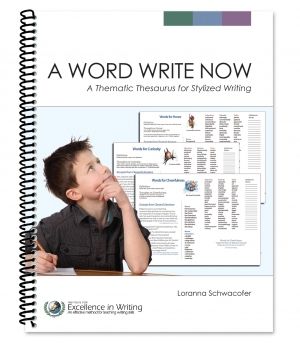
A Word Write Now is a thematic thesaurus for the writer~ a quick reference for some of the more common topics that might come up in a student's daily writing: Character Traits, Words to Describe, Words for Movement and Senses, and an Appendix with more information. Middlest hasn't needed to use it much yet, but he knows where to turn when he is searching for a more interesting word choice.
The Portable Walls is a great tri-fold quick reference folder that lives in Middlest's IEW Binder. If one had a distractible student, it would be very useful as a "study corral" to help them keep distractions at a minimum, while having useful material nearby, but Middlest mostly has it at hand so he can pull it out if he needs a specific word, or to reference the topic of a specific unit.
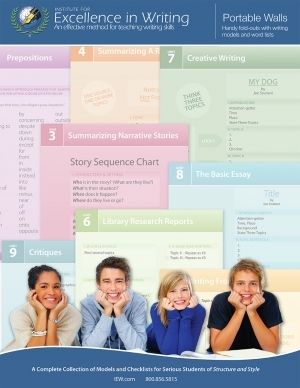
If these resources intrigue you, I highly recommend visiting IEW on the world-wide web. They have a vast amount of information to share with you, and help you on your journey to helping your children become Excellent Writers!
IEW can be found on
Not So Nutty Nitty Gritty 
Please click the banner below to visit the TOS Review Crew and see what others had to say. As always, I hope that this review was useful to you as you choose where best to spend your homeschool budget.
Blessings~


Click to read Crew Reviews
Crew Disclaimer

Followers

LinkWithin

Related Posts with Thumbnails