Showing posts with label Science. Show all posts

Friday, March 6, 2020

Marie Curie (Magnets and a rabbit trail to the Theramin)

In our study on Marie Curie (who was studying magnets and steel when she met her future husband Pierre, who was exploring crystal structures at the time), we did a little exploring with magnets of our own, including learning about how disrupting a magnetic field with your body can create music (if you have a theremin... )

Very speedy discussion of how the theremin works


And an example of how amazing music out of thin air can be...


Hope you have as much fun listening to these as we did. Let me know your thoughts in the comments if you like. :)

Blessings~

Thursday, July 26, 2018

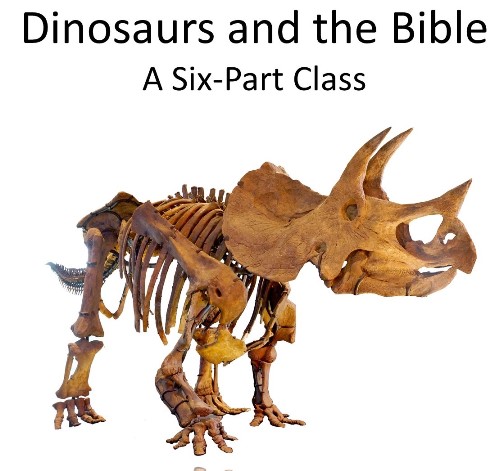
Northwest Treasures ~ Dinosaurs and the Bible (An online Geology classreview)


Northwest Treasures is a nifty little niche company (based in Washington state) that offers online and live classes in geology, as well as field trips and educational kits, all with a Biblical Worldview. We were offered two of the online classes to choose from for the purposes of this review: Dinosaurs and the Bible, and Geology and Apologetics, as well as Taking the Mystery Out of Geology. I chose Dinosaurs and the Bible, as I figured it would have the broadest appeal for our family, although we are all interested in Geology, rockhounding and such. (I seem to have passed on my interest which was definitely nurtured by growing up in the fossil and rock rich state of Montana, with a history buff for a father, and a rockhound for a grandfather. ;) )

Here is a trailer to give you a feel for this particular class:


Trailer of the Dinosaurs and the Bible class from Patrick Nurre on Vimeo.

Each lesson runs around 20 minutes, and comes with a worksheet (Set of 8-13 questions) to check comprehension and retention of the information found in the lesson. These worksheets are a little tricky to locate, so here are some instructions (that I think could be included on the course page).
When you are logged in (on a computer), there is a list of lessons with a "watch" button following each one. It isn't clearly obvious that the lessons themselves are clickable links that bring you to an overview of the lesson and links to the worksheet, and answer key (the answer key only needs to be downloaded one time, as it covers all 6 lessons). 

The final lesson also includes a 15 question multiple choice exam that covers information from the entire course.

The lessons are pretty much Vimeo powerpoint slide presentations (We watched on our TV via the Vimeo Roku channel, but you can also watch in a browser on your computer or tablet), with narration/instruction by Patrick Nurre. Through each of the videos, Patrick discusses the differences between Secular Paleontology and Christian Geology, always bringing it back to the framework of the Bible, as well as pointing out inconsistencies promoted by Evolutionary theorists and noting when Science becomes confused with Philosophy...

One of the things I particularly appreciated was the placement of the scientists in historical and geographical context, which helped to explain some of their philosophy and personal opinion/conjecture. The lessons progress from general discussions of the modern secular view of dinosaurs (and how it came about), their classification, to discussions of the catastrophic events that would have caused their demise and fossilization. All very interesting and intriguing for both my 11-year-old and myself. The lessons are:

  • How We Got Our Modern View of the Dinosaurs 
  • The Classification of Dinosaurs
  • The Great Dinosaur Rush
The first three segments are more historical/technical aspects of the discussion, the terms, and classification. The last three highlight the Biblical answer of "how" the extinction occurred, and the fossils were created... something that eludes those who hold a secular view, but so simply explained in the Bible. 
  • The Extinction of the Dinosaurs
  • Dinosaurs and the Ice Age
  • Fossils, Age, and Soft Tissue
I particularly enjoyed the last two lessons, as they referenced my home state, Yellowstone National Park, the Gallatin Valley, and other National Parks we visited last year as a family including Devil's Tower and the Petrified Forest. I grew up hunting for fossils (Although sadly I don't know what happened to the trilobites and others that were discovered on hikes and outings as a kid) and petrified wood. Thankfully I still have the chunks of petrified wood that I found as a kid in the Gallatin Valley. 

my petrified wood, crystals, and a piece of jewelry created by my rockhounding grandfather

I mentioned the worksheets at the beginning of this review, and I would suggest that if you are using them with kids on the younger age that they are printed up and used as a note-taking exercise while watching the video. Older students could use them as quizzes...


Taking the Mystery Out of Geology clarifies 13 terms that are frequently used in the field of Paleontology and Geology and shows how Science, History, and the Bible really do go together. 

As mentioned at the end of each of the video lessons, Northwest Treasures offers kits and hands-on material to enhance the lessons, and they also offer field trips to those fortunate enough to live in the Northwest, and/or those who have funds to travel for school. My father had moved out to the Glendive area where the Dinosaur and Agate Expedition tour takes place, and I would highly recommend anyone able to participate to do so. The Glendive Dinosaur and Fossil Museum doesn't get the press of the Creation Museum, but it is actually a larger facility and extremely close to the dinosaur site digs. We found it fascinating when we were there in 2016, and would have loved the opportunity to go to the fossil fields (weather and time constraints did not permit...). 

Glendive Dinosaur and Fossil Museum

I understand that they offer some classes on SchoolhouseTeachers.com, and while I haven't personally used/checked those out, if you have a membership and are interested in Geology, I expect they are well worth checking out. ;) 


Not So Nutty Nitty Gritty 
Visit Northwest Treasures on their Social Media Channels on Facebook and Pinterest 

Please click the banner below to visit the TOS Homeschool Review Crew and see what others had to say about this and the other two courses. As always, I hope that this review was useful to you as you choose where best to spend your homeschool budget.
Blessings~

Online Geology Classes{Northwest Treasures Reviews}

Crew Disclaimer
#hsreviews  #geology #dinosaurs #apologetics

Wednesday, April 18, 2018

Do you know how our bodies work? Apologia has answers for your Elementary Student!


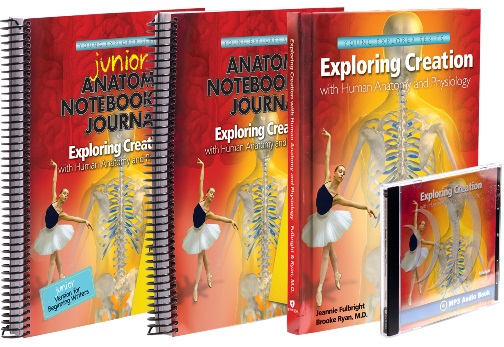
I enjoyed using Apologia's Young Explorer Series in the past, with my two older children, so I was delighted to be asked to review Exploring Creation with Human Anatomy and Physiology, which includes the text, an mp3* audio narration of the text, and two levels of their notebooking journal, the regular and the junior version.


I'm guessing that most of my readers have heard of Apologia if they've been homeschooling for very long, but for those who are new to this homeschooling thing, let me give you a quick run-down on some of the reasons why I appreciate Apologia.
  • The text is written directly to the student, and is somewhat more conversational than the textbooks I grew up with. 
  • Science is approached from a Christian Worldview, clearly and logically articulated, and reinforced through questions and activities that include that worldview.  
  • The activities and experiments suggested in the book are generally able to be completed with normal household materials that one is likely to have on hand. 
Now, when I first used Apologia's Exploring Creation series, well over a decade ago, it simply consisted of the text. There was no MP3 audio CD (Helpful for those who have reading disabilities, or who simply process more easily when listening to audio), nor were there premade journaling notebooks. We had a printable pdf with notebooking pages, mostly for narration purposes, but nothing like the resource that was sent to us with the text for this review.

The course includes 14 Lessons, with a recommended pace similar to their High School Modules of 2 weeks per lesson, so a full year course.  The Lessons are:

  1. Introduction to Anatomy and Physiology
  2. The Skelatal System
  3. The Muscular System
  4. The Digestive and Renal Systems
  5. Heath and Nutrition
  6. The Respiratory System
  7. Life in the Blood
  8. The Cardiovascular System
  9. The Nervous and Endocrine Systems
  10. The Nervous System Extended
  11. Your Senses
  12. The Integumentary System
  13. The Lymphatic and Immune System
  14. Growth and Development 
The two journals include all the pages you will need (and more) to maintain a record of what your child has learned in the course with pages to write their narrative answers to the "Tell someone what you've learned" questions.  There are a few variations, of course. For example, the Junior Journal includes coloring pages, more flap books for vocabulary activities and the copy work pages use guidelines, where the older journal does not, while the regular Journal includes more detailed and difficult crossword puzzles

Journal Page found in both books
I will admit that my 5th grader's handwriting is not fabulous yet (remember the recent cursive review?) so the opportunity to have him practice in the notebook is helpful, but in this instance, he might benefit more from the younger journal instead of the older one as he is still working on uniform letter size.

Sample Copywork pages from Regular and Junior Journals
This was also his first experience with a larger crossword puzzle (more words) with smaller boxes~ Ummmm... I said to use a pencil for a reason... ;) This was also one of those activities that took much longer than I expected, but he is improving. :)

Use a pencil, bud! ;) 
Both journals include full-color Minibooks to add to each lesson. These pages are found in the back of the journal. Although not my circumstance, because I only have one student, I appreciate that these are almost identical (with the exception of the writing lines, which again, have guidelines in the junior version) so that those with multi-age students are able to have some journaling activities that are the same.


I am including a photo of the back of the Muscle Minibook prior to gluing it into the journal, so that you can see how clear the directions are.


A little bit more about the MP3~ It is read by the author, Jeannie Fulbright, herself. Her voice and inflections are pleasant to listen to, and I will note that she does not entirely read the text word-for-word, but all of the material is covered.
* The MP3 audio CD must be played on an MP3 compatible player, typically on your computer. This becomes a bit of an issue as more computers are made without DVD drives, so offering it as a download might be a useful suggestion.

Here's a little bit of information on how/why the Exploring Creation Immersion approach to science works, in Jeannie Fulbright's words:


I will also mention that when you purchase the text, you gain access to a password-protected resource that includes MANY extra links for further research and study if something, in particular, catches your child's interest.  Here is a screenshot of the first part of the resources.


As you can see, Apologia offers a very thorough and very engaging course for your young scientist, and their curriculum is something that I can highly recommend, as it has been one of my personal choices to purchase and use since almost the very beginning of my homeschooling career.


Not So Nutty Nitty Gritty 


You can connect with Apologia on any of their many Social Media pages: 

Please click the banner below to visit the TOS Homeschool Review Crew and see what others had to say. As always, I hope that this review was useful to you as you choose where best to spend your homeschool budget.
Blessings~
Click to read Crew Reviews
Crew Disclaimer
#hsreviews  #homeschool,  #homeschooling,
#elementaryscience,  #youngexplorerseries,
#exploringcreation,  #apologiascience  #homeschoolscience

Wednesday, April 4, 2018

Creation Illustrated~ now available in both Print and Digital editions!


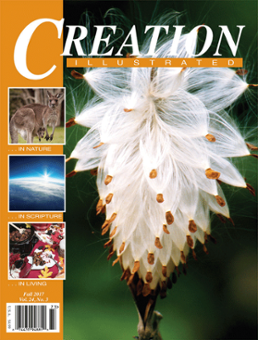
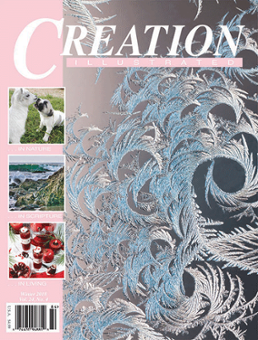
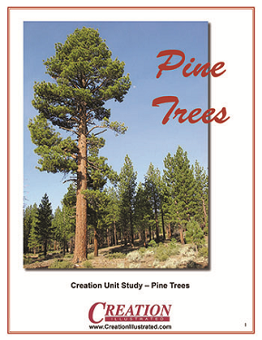
I was first introduced to Creation Illustrated a number of years ago and was impressed with the beautiful photography (reminiscent of National Geographic), and articles written from a Christian Worldview, so I was delighted to check out two of their new Nature Unit Studies which I was sent for review, along with the corresponding newly available Digital versions of their magazine.

The Unit Studies are a natural complement to the format of the magazine, which is set up in three different coordinating sections~ here is an example of the table of contents taken from one of the issues we were given access to (Offered free for your perusal as well), the Fall '17 Digital Edition, which is the issue corresponding to the Pine Trees Study, one of the two studies we were sent to review.

Creation Illustrated


There are currently eight Nature Unit Studies available:
Badgers, Black Bears, Dragonflies, Fragrance
Joshua Tree National Park, Manatees, Pine Trees, Snow
and the 9th study on Butterflies (which corresponds to the latest issues, Spring '18 Digital Edition), will be available soon.

PINE TREES UNIT STUDY


The Pine Trees Unit study is the one that we chose to look at more in depth, in part because we have already covered snow in our studies, (perhaps to a greater degree than some, because my daughter takes amazing macro snowflake photos... ;), so Pine Trees was the more natural choice for us. 

The Lessons included in the Full Unit Studies include a list of Reading Resources, Educational Video suggestions, Vocabulary and Spelling pages, a Bible Study, Geography, Science, Math, Writing and Penmanship, Art, a Puzzle (Wordsearch), and Teacher's Answer Keys. 


 I had my son do parts of this study independently, and the lessons vary in difficulty. He was able to complete the Vocabulary, Spelling, Geography and Puzzle pages with ease (he chose not to complete the pine tree drawing on the Art page), but the Bible Study, Science and Math pages required a little more time, and/or some hands on help from mom. This tells me that the age range of 5th-8th grade is pretty accurate. 

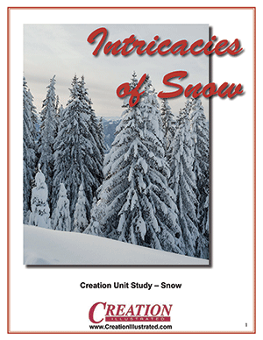
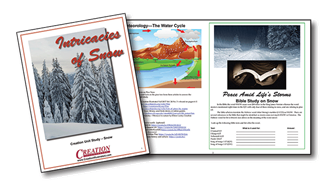
We were also sent the Snow Unit Study from the Winter '18 Digital Edition.


In looking it over, I can say that I really like the Art page in the snow study, and will probably pull that out next winter~ he can go through his sister's photographs and see how many of the 35 snow flake shapes she has captured with her lens (did you know there were that many different basic shapes???!!!).

I will note that each issue already includes a study guide that covers many of the articles in the issue, but they are different from those in the full unit study (that addresses one topic in depth from the issue). The Full Unit Study is appropriate for grades 5-8.


A few more general bits of information about each Creation Illustrated issues~
They include coloring, photo, and poetry contests for homeschoolers, as well as Genesis Cuisine recipes to try out. You can subscribe to the Print Editions (which come out Quarterly ~ currently 25% off) and subscriptions to the Digital Editions will be available soon. In the meantime, there are some print back-issues available and the digital back-issues are being made available as they are uploaded ~ you will find all of that including another Sample Digital Back Issue, a Sample Unit Study on Fragrance, a character-building lesson, and more at Creation Illustrated. 

Not So Nutty Nitty Gritty 
  • Company: Creation Illustrated
  • Product: Pine Trees Study and Snow Unit Study
  • Ages: Unit Studies 
  • Price: 
    • Unit Studies ~ Regularly $9.95, at the time of this post, 30% off at $6.95
    • Print Magazine Subscription $14.95/year (Quarterly) 
    • Digital Subscriptions (soon) $9.95/year
    • Limited Print Back Issues also available $4.99 each
You can visit Creation Illustrated in on their Social Media Pages on
Facebook, Instagram, Pinterest, and Twitter

Please click the banner below to visit the TOS Homeschool Review Crew and see what others had to say. As always, I hope that this review was useful to you as you choose where best to spend your homeschool budget.
Blessings~
Click to read Crew Reviews
Crew Disclaimer

Thursday, March 15, 2018

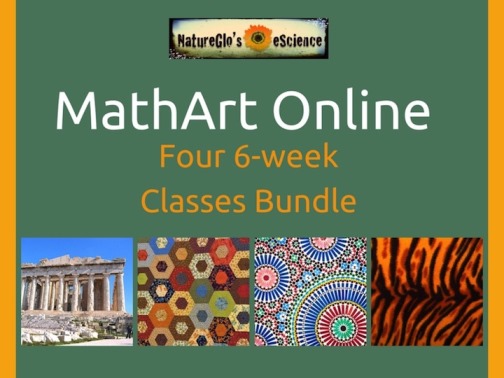
NatureGlo's eScience MathArt Online 4-Class Bundle (Review)


When the opportunity to review NatureGlo's eScience offering of their MathArt Online 4-Class Bundle arose (shortly after my college Art Ed major Eldest was sending us YouTube videos on Fibonacci from her math class), I thought the timing was rather fortuitous. And since my Youngest enjoys watching a variety of videos, and Art, and Science, and Math... we looked forward the opportunity to explore the Math Connections with the Real World class from the Bundle.


I will say right off the top that these classes are geared towards Middle and High School aged students, so Youngest is a little over his head with these, but I decided it was worthwhile to let him go through the classes (to some degree at his own pace), and glean what information he could at his own level.

The timing of this review was also interesting to me because our local Science Museum currently has a Fibonacci and Golden Ratio exhibit that we were blessed to go visit with some friends. It was a fantastic reinforcement as my youngest was familiar with the concepts, from the first few lessons in the class we were using, and the hands-on activities there helped to cement some of the concepts of how connected Math and Art (and Science) truly are.
Museum of Science Mirror Maze
Some basic information:
The classes in this bundle are
  • Math Connections with the Real World 
    • Introduction and history of the Golden Ratio and Fibonacci Numbers
    • The Golden Number and Fibonacci in Art, Architecture and Nature
    • Fibonacci Numbers - Flower Petals, Seed Heads and More! 
    • History and Golden Ratio of the Great Pyramid of Egypt
    • Quasicrystals and the Golden Ratio
    • The Mathematics of Music
  • MathArt in Ancient Cultures
    • Ancient Babylonians and Plimpton 322
    • Ancient Greek Math and the Platonic Solids
    • Pythagoras and the Music of the Spheres
    • Ancient India's MathARt: Rangoli, Mandalas and The Story of 1-9 and 0
    • Zellige Moroccan Tiles and Other Tesselations
    • Maya MathArt
  • Mathematics in the Arts and Sciences (I) 
    • Renaissance Artist Piero della Francesco
    • Aboriginal Art
    • Celtic Math Art
    • Patterns in Nature I
    • Branching/Fractal Patterns in Nature and Technology
    • Fractals in Nature and Technology II
  • MathArt Patterns in Nature (Not yet uploaded) 
    • Patterns in Nature: Animal Coat Patterns
    • The Geometrics of the Universe
    • Patterns in Nature: The Hexagon
    • Logarithmic Beauty of the Chambered Nautilus Part I
    • Logarithmic Beauty of the Chambered Nautilus Part II
Gloria Brooks is the Owner/Instructor of NatureGlo eScience, and has been teaching since 1997. The online classes are her newest way to reach out to homeschoolers, and are offered as both live and self-paced classes (with some of them utilizing recordings of the live classes). 

As I mentioned above, we mainly walked through the Math Connections with the Real World class, but I took a look at Mathematics in Art and Science as well. Here is a quick run-down of how it looks to work through a class.

After logging in you are taken to a student dashboard. You click on the course that you want to take, and it opens to a page that looks something like this...


Off to the side each lesson can be opened and each section in the lesson shows up. The section are check-marked and lined out as they have been completed. Simply click on the
lesson you want to go to and a page will open up for that particular section of the lesson.


When the student has completed the activity, be sure to click the button that says "Mark Complete" (We forgot to do that for the first few activities... oops!), and then move on to the next part of the lesson.

When your student has completed all of the activities in an entire lesson they will receive an "achievement" graphic.

If you want to get a good feel for NatureGlo's eScience classes, you can visit the website and take advantage of the Free Fibonacci Numbers in Nature lapbook (part of the MathARt curriculum)

If you click on the  "Free Sample Class" Beluga Whale that shows up when you hover over the Class Catalog Tab you will find another sample of what a lesson might entail. Gloria Brooks talks about the Beluga Whale lesson, as well as shows some of how it is set up, with videos, and study guides. If you scroll further down the page you can access a three-lesson class which includes a sample from the MathArt Classesas well as some of the other classes offered :
  • MathArt – Fractals: Infinite Patterns of the Universe
  • Herpetology – Glass Frogs: Transparent Living Jewels (again)
  • Marine Biology – Deep Sea Fish: Gulper eel, Slender Snipe Eel, Barreleye, Oarfish
A note about the class we focused on. I was a little disappointed in the narrated slideshow videos, as they were strictly narrations of the slides. There was no extra information given, as I might have expected from a power point presentation. I was happy to notice when I checked out one of the other classes that the power point presentation was the spine, but that there was additional information that added interest to the slides beyond just reading what was on the page.

I will also say that most of the graphics (the majority of which are lovely and well done) and activities are available on the internet, however, what makes these classes useful is that Gloria Brooks has compiled all of the information for you in one place, and set it up them up in a logical and cohesive manner. The amount of time it would take a typical homeschooling parent to do something similar would be rather onerous.

If you're looking for a less traditional approach to middle/high-school science,  with an artsy or mathy (is that a word? it is now... ;) ) you may wish to visit NatureGlo's eScience web page, and also read some other Homeschool Review Crew opinions. I can say that this class has given my 10 year old a familiarity with the Fibonacci numbers, and the Golden Ratio, which is more than many kids who've graduated high school have, so I take that as a win.


Not So Nutty Nitty Gritty 
  • Company: NatureGlo's eScience
  • Product: MathArt Online 4-Class Bundle
  • Ages: Middle-High School are the target audience
  • Price: Bundle is currently $536.40 (which is 10% off of a one year subscription. The classes are also available individually for $149.00 each
You can visit NatureGlo's eScience social media pages on Facebook, Twitter, Pinterest, Google+, and YouTube.

Please do click the banner below to visit the TOS Homeschool Review Crew and see what others had to say. As always, I hope that this review was useful to you as you choose where best to spend your homeschool budget.
Blessings~
Click to read Crew Reviews
Crew Disclaimer
#hsreviews  #escience #natureglo #math

Thursday, September 7, 2017

Marine Biology!


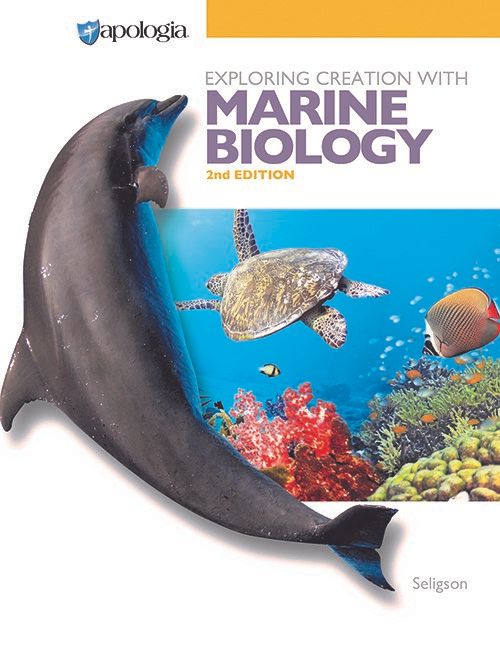
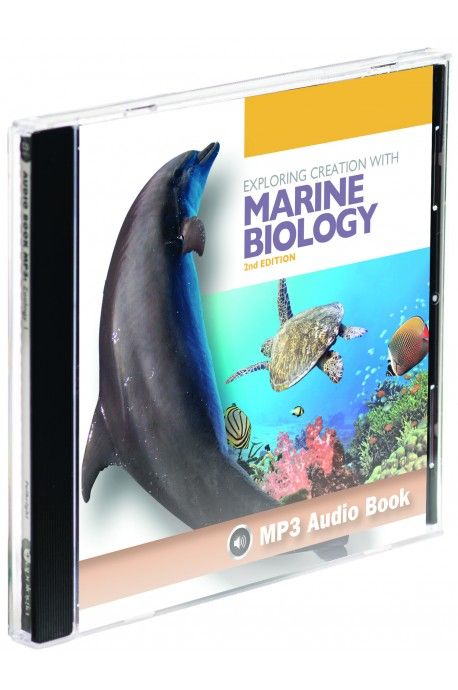
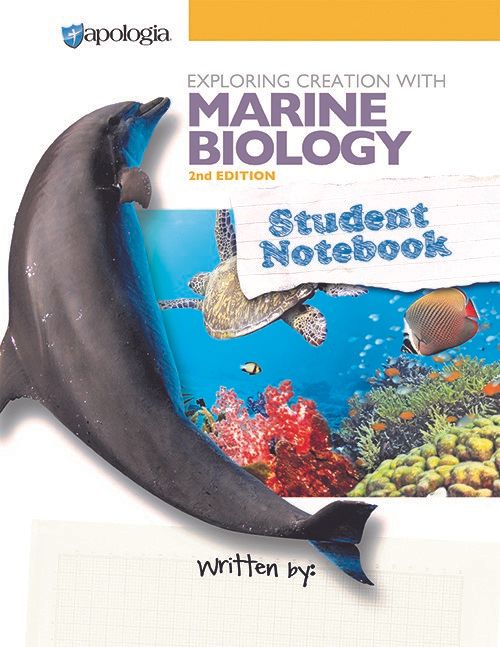
While I've had the opportunity to review many of Apologia Educational Ministries' new products as they roll out, I've not had a chance to review any of their science curriculum since my first year reviewing (2008/2009) when I reviewed Flying Creatures of the Fifth Day, and the basic General Science set. However, I have used many of their other science texts for elementary, and up through high school, so I was very pleased to be able to review one I hadn't seen/used yet, their Marine Biology 2nd Edition Advantage Set. The set comes complete with the student text, student notebook, solutions and tests book, and test booklet. We were also sent the Marine Biology 2nd Edition Audio CD.

As is typical with Apologia, the material is written directly to the student, and is easily understood. There are some things about this text that I really like from a visual point of view, that are different from the other editions I own (General Science, Biology, Chemistry, Physics...):

  • A colored strip running across the top of the page that lists the module
  • A "tab" along the length of the page that also lists the module, and can be seen when the book is closed, making it easier to find your place as you get further into the book (the Glossary, Appendices, and Index are also "tabbed" this way). 
  • Vocabulary words are boldly set apart and defined on the page where they are used in the text. This gives an extra emphasis and repetition, for memory retention. While the other texts did this as well, the definitions just didn't stand out in the same way. 
  • On Your Own questions are set apart with a colored background and "sea coral" motif~ hard to miss them when they don't blend into the text! :) 
Following the normal Apologia format, the answers to the "on your own" questions are found at the end of the module, followed by a study guide for that module. Module Summaries are found in the back of the book in Appendix B. This means that for the vocabulary and important information found on the test, review is built in. 
  1. Read the text (Some vocabulary twice if it has been highlighted outside the text)
  2. Do the On Your Own Questions 
  3. Complete the Study Guide
  4. Answer the Module Summary questions in the back of the book
  5. Take the test 
The Material covered in this course (with my mini-summaries) includes:
Module 1: The Oceans of Our Planet ~ including how they were formed
Module 2: Life In the Sea ~ how living organisms live and reproduce in the sea 
Module 3: The First Four Kingdoms (Microscope Labs) ~ study of simple marine plants and animals
Module 4: Marine Invertebrates I~ Simpler invertebrates (Jellyfish, worms, etc..)
Module 5: Marine Invertebrates II (Dissection and Microscope Labs) ~ Mollusks, Crustaceans, etc... 
Module 6: Marine Vertebrates I (Microscope and Dissection Labs) ~ Jawless, cartilaginous, and bony fish
Module 7: Marine Vertebrates II ~ Reptiles, Birds, and Mammals
Module 8: Marine Ecology ~ the balance of creation~ organisms with one another and their surroundings
Module 9: The Intertidal Zones ~ Let's go to the beach! 
Module 10: Estuarine Communities ~ special ecosystem that is neither saltwater nor freshwater
Module 11: Coral Reefs ~ Complex communities
Module 12: Continental Shelf Communities (Microscope Labs) ~ learn about soft-bottom shelf and hard-bottom shelf communities
Module 13: The Epipelagic Zone (Microscope Lab) ~ the upper layer of the oceans, and what lives there (most of our food sourced from the sea can be found here)
Module 14: The Deep Ocean ~ "inner space" creatures, and much that is unexplored
Module 15: Ocean Resources ~ food, medicine, industrial resources (oil and minerals), freshwater, and energy
Module 16: The Effects of Humans on Oceans ~ Negative impacts, and how we can be better stewards of the ocean, while not neglecting those who rely on it to survive. 

This is the first time that we have had the Audio CD Narration to go along with the text. The narrator (Marissa Leinart) reads the entire text with the exception of the text in the Figure graphics. She has a pleasantly modulated voice, and I believe the Audio CD would be very beneficial to the auditory learner, or to a reader who has difficulties~ they could listen to the audio while following along in the text. I can't imagine narrating an entire textbook, so when the few occasions arise that Marissa uses a different emphasis than I would if I were reading aloud, I definitely cut her a little slack. By and large she is very easy to listen to. Having the Audio CD is a great option if you are a family that is in the car a lot~ studying can be done on the way without reading-induced car-sickness! 


The other resource that we used for the first time was the Student Notebook. This was a favorite feature for my son. He loved the way it was set up, so that it followed the text with the On Your Own Questions, the Study Guide, and the Summary directly following. His feeling is that this makes studying for the test much easier because all of the information is right there in front of him. He doesn't have to look from the text book to his notebook to find the answers to each question, it streamlines the entire process.

I also appreciate that it lays the grading process and the schedule all out for the student. It really is intended to be a mostly self-directed course, which is appropriate for upper high school classes.

There are a number of note pages (at the beginning of each new module, prior to the On Your Own questions), that Middlest will be working on learning to use. Note taking is not a skill that I've emphasized (as I don't lecture my one person class), so using this Marine Biology course could help him gain this essential ability.
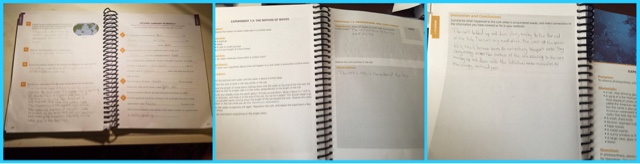
1. Study guide questions and Summary Questions, 2. and 3. Lab Experiment notebook

The back of the Student Notebook contains all of the experiments, their directions, and Lab Sheets to record the experiments, with space for the Hypothesis, Observations, and Discussion and Conclusions. This makes it so easy to keep everything in one place, and having the instructions for the experiments right there means only one book to deal with during the experiments. I am a big fan of efficiency!

A word about the experiments here. Once again, Apologia comes through with a Lab Science course that is thorough, but takes into account a homeschooler's budget! There are some that require a microscope with prepared slides, and I counted 3 dissection experiments (shudder... not my thing), but everything else can be completed with household or easily obtainable items.
     
The Tests and Solutions book, as always, includes all of the tests (Which can be copied) and their solutions (with grading points given, which makes life so easy for the teacher!), as well as solutions for the Module Summary questions. 

Apologia has another winning Science text on their hands, with this Marine Biology course written from a Christian Worldview. I so value the apologetics built into these courses, that give my kids a solid foundation to discuss Christianity AND science, and how the two DO connect and support one another.

If you want to check it out yourself, there is are samples from the first module found on the product page (see below) under the "downloads" button.


Not So Nutty Nitty Gritty 
Visit Apologia on Facebook, Instagram, Twitter, and Pinterest

Please click the banner below to visit the TOS Homeschool Review Crew and see what others had to say. As always, I hope that this review was useful to you as you choose where best to spend your homeschool budget.
Blessings~
Click to read Crew Reviews
Crew Disclaimer
#hsreviews #MarineBio #homeschoolBiology

Followers

LinkWithin

Related Posts with Thumbnails