Showing posts with label Classical Education. Show all posts

Thursday, September 13, 2018

Fitting Words Classical Rhetoric (Review)


Having a high school senior, I was very interested in the Fitting Words Classical Rhetoric curriculum by Roman Roads Media. Regardless of what career path a person is taking, the ability to speak and listen intelligently cannot be taken too lightly.
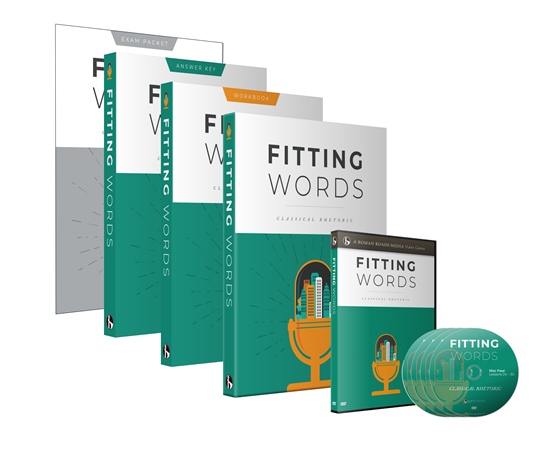

The complete set includes all the pieces that are necessary to teach the course yourself, the text, the workbook, answer key and exam packet. However, it also includes the DVD Video Course, by the author, which adds in-depth teaching going beyond what is included in the text, just as if in a typical classroom setting with an excellent teacher. * I don't know if this is typical, or if it was just a perk for reviewers, but our complete course came in a spacious Roman Roads Media tote bag!
So, a word about the materials from a strictly material point of view. As you can see in the photo of what we actually received, the workbook is spiral bound, which sets it apart from the Answer Key (softcover) and the Text (hardcover). Believe it or not, this was something my son appreciated and pointed out to me, as it made it much easier to reach for the appropriate book. The spiral bound was also a benefit to him as it lay flat while he was writing, and could be opened double page or a single page for more compact workspaces. Sometimes little details make a big difference in the usability of a product, even if they aren't directly related to the content. ;) 

The Lessons in the textbook contain 
  • The main text of the lesson ~ (which is fairly conversational in tone) often includes excerpts from famous works when they are discussed.
  • Sidebars when key concepts and Famous Orators are introduced~ Serve to highlight and emphasize important points in the text
  • Thinking Deeper Questions ~ Are good discussion topics
  • Developing Memory Exercises ~ Suggestions for memory work for each lesson. These aren't mammoth undertakings but instead more brief, good to keep the brain exercising it's memory muscles. 
  • Reading Further suggestions ~ Just what it says...
  • Notes citing sources quoted

My son started out just reading the text and going through the exercises on his own due to summer and less inside access to the DVD player. When we sat down to check out the Video Course, however, he was very impressed. The author/speaker is very easy to listen to, and although he does go through the lessons from the text, there are many aside comments that offer more in-depth information. Middlest also said that the video makes one slow down and doesn't allow one to skim over material, rather helping one to take it all in more easily. 

A little more information about video Lesson. It is set up so that there are two "Chapters" for each lesson. The first part is the "lecture" style portion mentioned above. I didn't actually time it, but I think they run close to 20 minutes. The other is the "lesson application." I believe those run close to 10-15 minutes. The author/instructor spends a couple of minutes introducing and discussing a figure of speech (These are covered as a group in Lesson 27, but I appreciate the "preview" given in the video course).  I will also mention that many of these are figures of speech that I recognize, but couldn't have named. There are often excerpts of famous contemporary speeches modeling the figure of speech.  The next part goes over the Thinking Deeper questions from the text. It then moves directly to the Exercises in the workbook. He gives some suggestions and clarifies what is being looked for in the questions in the workbook.

We haven't had time to get to Lesson 12 yet, but here's an example of the Application Video:


The video also includes Exam Reviews that cover the information that will be on the exam. This is extremely helpful and is similar to a "study guide" for your student as they prepare for their exams. 

The curriculum suggests that the student set aside a notebook as a Commonplace book.
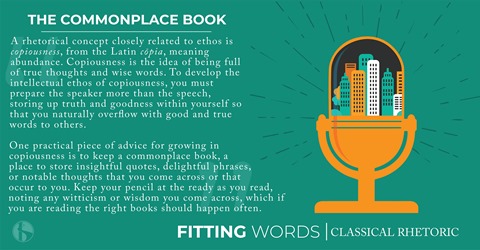
Which brings me to another thing that is unique to the video course: the introduction to Commonplace topics like Public Speaking in Lesson 3 with this example quote: "Wise men talk because they have something to say; fools talk because they have to say something."- Plato.

Fans of the Classical Approach should be delighted with this curriculum. Those who are more eclectic and dabble in many approaches... you should also be impressed, as were we. This is a solid curriculum that should be enjoyed by the student and homeschool parent/teacher alike. 

Not So Nutty Nitty Gritty 
You can visit Roman Roads Media on Facebook, InstagramYouTube, and Pinterest

Please click the banner below to visit the TOS Homeschool Review Crew and see what others had to say. As always, I hope that this review was useful to you as you choose where best to spend your homeschool budget.
Blessings~

Classical Rhetoric and Picta Dicta {Roman Roads Media Reviews}
Crew Disclaimer
#hsreviews  #RomanRoadsMedia  #FittingWords #Classical #Rhetoric

Thursday, June 21, 2018

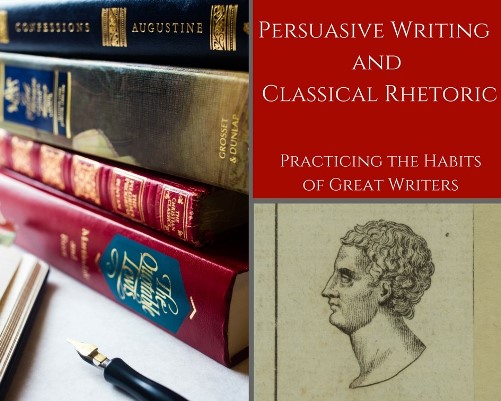
A Review of Persuasive Writing and Classical Rhetoric: Practicing theHabits of Great Writers


Writing is one of the more difficult subjects to tackle, in some respects because it is both subjective and objective, so I always appreciate the chance to check out a new curriculum. This Spring Silverdale Press LLC offered a few of their products to the TOS Review Crew, including a number of Unit Studies for grades K-12 as well as Persuasive Writing & Classical Rhetoric: Practicing the Habits of Great Writers for high school students. We were selected to review the Writing Course.

The material, which is a full 36-week course is offered as a digital download, and comes with four parts:
  • Rhetoric Lesson Book: each Lesson is written directly to the student (Not requiring a parent/teacher for learning), with an overview of the week, a schedule, interesting, instructive text, ending with a "Profile in Rhetoric" featuring some of the greatest writers. 
  • Rhetoric Reader: includes excerpts from the authors featured in the "Profile in Rhetoric" for the lesson. 
  • Rhetoric Workbook: Also written towards the student (obviously), with four parts:
    • Review questions from the lesson 
    • Review questions from the Reader 
    • A Writing Exercise that relates to the lesson
    • A Writing Prompt for a 500-word essay each week, again relating to the lesson.
  • Rhetoric Answer Book: Answers to the review questions from the workbook. 
The authors directly suggest that the students use the workbook to "correct" their own papers, but that it is very important for the parent/teachers to discuss and give feedback on the writing exercises and the weekly essay. A rubric has been included in the front of the answer book to assist with this, and to help the students see what is expected in their writing. 

This is very much a "Classical Education" approach to Rhetoric, based upon three main habits the authors focus on, Writing, Reading, and Thinking on a regular basis.

After two introductory lessons, the students focus on three stages of Classical rhetoric, with 14 lessons covering "Invention" including The Subject, Stasis Theory, The Claim, Inartistic Appeals, Logical Appeals (Deductive and Inductive), Emotional Appeals, and Ethical Appeals. This is followed by 7 lessons in "Arrangement" which include The Introduction, Statement of Facts, Confirmation, Refutation, and Conclusion. The final stage is "Style" and there are 7 lessons here as well, that speak to Correctness in Words and Sentences and also Punctuation, Clarity in Character and Actions, Zapping Clutter, Ornamentation and Propriety. The final 5 lessons discuss "real world" writing including knowing the audience, what real writers today do, pitching your work, and dealing with rejection.

This is a very complete course of instruction, broken down into step-by-step details, which should allow your student to become a successful writer.

The Author Profiles in the Lessons, and the works in the Reader cover a wide variety of people including Patrick Henry and Alexander Hamilton, William Wilberforce and John F. Kennedy, Dorothy Sayers and Jane Austin, Ronald Reagan and Winston Churchill, and E.B. White and Augustine, among others. Your student will be introduced to some of the facts of their history, as well as some of the things they were known for in their writing. I found this to be an interesting aspect of this curriculum, and appreciate the personalization of the lesson being taught.

A portion of the lesson book pdf layout.
You can see where the profiles are, with photos of the featured writer, as well as other illustrations.
From a purely aesthetic point of view, the lesson book and reader are set up very well with color illustrations, bold text, bullet points and spacing that make it easy to see the organization of the text/lesson. My son appreciated accessing the text electronically, rather than having one more set of books to keep track of (Which is a little bit of an issue when you live in a "reviewing" homeschool...).

He also thought that the lessons were a very reasonable length, and felt that the daily writing (whether answering questions, doing the exercises, or the longer essay) worked well as a way to improve his skills. The "Great Writers Write" point at the beginning of the book appears to have stuck.

The Workbook was not set up in a way that worked well with my son, however, again from a purely aesthetic point of view (not speaking to the content here at all). As is often the case with workbooks, the lines for the answers often leave too much space, or not enough. I personally would prefer to have the workbook be a streamlined set of questions, that wouldn't take as much ink and paper to print, (Or viewing them on the screen with the questions from each section on a single page) with answers written in a spiral or composition book, but that is purely my opinion.

You can download a sample from the product page linked below.
Not So Nutty Nitty Gritty 
Visit Silverdale Press on their Social Media Pages:
Facebook   Twitter  Pinterest  

Please click the banner below to visit the TOS Homeschool Review Crew and see what others had to say about this as well as the Unit Studies mentioned at the beginning of the reivew. As always, I hope that this review was useful to you as you choose where best to spend your homeschool budget.
Blessings~
Click to read Crew Reviews
Crew Disclaimer
#hsreviews #HomeschoolWritingCurriculum

Thursday, June 7, 2018

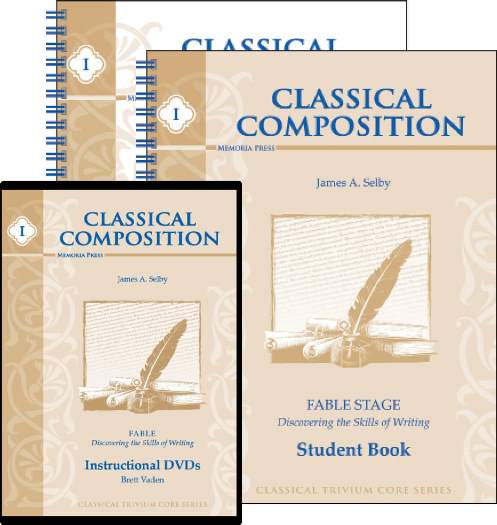
Memoria Press (Classical Composition I: Fable Set) A Review


When Memoria Press offered us a selection of products to review, I chose to introduce my Youngest to their Classical Composition I: Fable Set. This set includes the Student Book, the Teacher Guide, and Instructional DVD. I appreciate that both the instructional DVD and the Teacher Guide are included, as this opens up options for student work location. Not always tied to electronics (Instructional DVD) to do the work, because the Teacher Guide includes the instructions required, which means that lessons can be taken outside, to the park, or in the car. However, it is also very nice to have the option to have someone other than Mom or Dad "teach" the lesson, particularly if one isn't as familiar with walking through an outline with their kids.

OK, so now that I've given you a little hint to the content, let me tell you how the lessons are set up. As is typical with Memoria Press, each lesson looks pretty much the same, and they basically drill the concept over and over until it becomes natural.

  • Fable ~ The specific fable for the lesson is printed at the beginning of each lesson
  • Three Plot Components (If applicable) of Recognition, Reversal, and Suffering
  • Variations Part 1 ~ Student comes up with synonyms for 3 or 4 words in a given sentence and then rewrites the sentence three different ways. 
  • Narration (Not in the Student Book, but definitely a component of the lesson, and one of my favorite parts! :) )
  • Outline ~ Summarize fable in outline form. This is a very useful skill to work on, so I appreciate that it shows up in each lesson. The Teacher Guide includes suggested outlines, so you can work from that directly, but the walk-through on the DVD is also valuable. 
  • Paraphrases ~ Generally two paraphrases per fable. The first generally adds in specific Figures of Description (using the Latin names for each one*), and the second is usually written "by reduction" in the briefest form possible without any descriptors.
    • *The Appendix includes 18 Figures of Description with examples for each. These words may or may not be familiar to you, depending on your experience with Classical Education. Here are a few: Anemographia, Dendrographia, Dialogismus, Effictio, Prosopographia, Sermocinatio... These are things that I certainly didn't learn in my public school education. ;) 
  • Variations Part 2 ~ Same thing as Part 1, but with different words/sentences
  • Appendix~ I mentioned the Figures of Description above. The Student Book also includes an "Introduction to the Progymnasmata" by James A Selby, that might be interesting for an older student to read. 

The Teacher Guide begins with teaching guidelines and an advanced rubric for grading purposes. The rest of the book has identical pages to the student book, with instructions specific to each lesson, including vocabulary words, and a more general grading rubric geared to that lesson.

If Classical Education is your style, Memoria Press definitely offers materials that will challenge your child, with ample opportunity to practice the skills that they are being taught.


One minor point that I will mention here~ if you have a student for whom handwriting still isn't smooth and natural, the lines and spacing of the Student book may be a little short. On his best days, his handwriting isn't fabulous, but the more college ruled spacing definitely contributed to a bit of a defeatist attitude. When I suggested that he write his outline on a piece of wide-ruled notebook paper (and do it in cursive), the readability improved drastically. Still not fantastic, but better.

Memoria Press offers sample pages of the Student Book and Teacher Guide as well as a "General Sequence and Outcomes of Program" to download on the product page linked below.


Not So Nutty Nitty Gritty 
Visit Memoria Press on their Social Media pages on  Facebook, Twitter, Pinterest, Instagram, Google+, and  YouTube

Please click the banner below to visit the TOS Homeschool Review Crew and see what others had to say about this and the other products that were offered for review: Products from the New American Cursive Penmanship series, the Traditional Logic Series, and the Classical Composition Series, of which Fables is the first part.

As always, I hope that this review was useful to you as you choose where best to spend your homeschool budget.
Blessings~

New American Cursive & Traditional Logic {Memoria Press Reviews}

Crew Disclaimer
#hsreviews  #memoriapress  #classicalchristianeducation  #classicalyhomeschooling  #Classical CompositionI:FableSet  #classicalchristianhomeschooling  #memoriapresscursive

Wednesday, June 7, 2017

Memoria Press Nature's Beautiful Order (Natural History/Science Review)


Memoria Press has been a staple of Classical Homeschoolers for decades, with their Latin Curricula being one of the trademark products, however, as you may have noticed with my reviews over the years ( Famous Men of the Middle Ages and Prima Latina in 2009, Geography I in 2013, The Book of the Ancient Romans Set in 2015, The Book of Astronomy Set in 2016, and most recently The Illiad & the Odyssey Set in Spring 2017 ) they are not limited to one subject, by any stretch of the imagination. Once again the Crew were sent a selection of different curricula, with the set Nature's Beautiful Order being the product we were sent to review (scroll to the end of my review to find out what other products were reviewed, with a link to read them).


Natural History/Natural Science ~ what's in the set
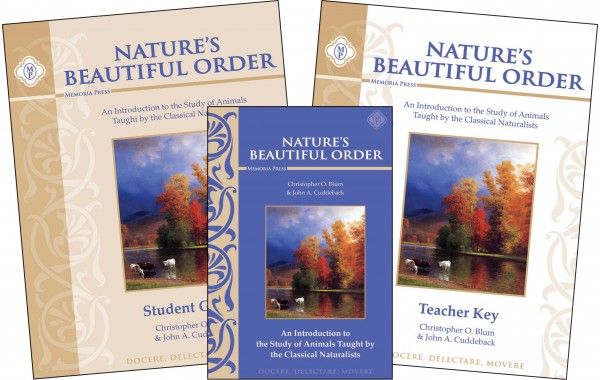
Nature's Beautiful Order was written by professors Christopher O. Blum and  John A. Cuddeback, with an eye to creating a rigorous course for 6th to 9th grades, or as a supplementary curriculum for high school biology students. The set includes the textbook, student guide, and teacher key.

There are 18 chapters covered:
  • What is an Animal? 
  • The Lobster
  • The Cuttlefish
  • The Sea Urchin
  • The Bee
  • The Trout
  • The Frog
  • The Turtle
  • The Canada Goose
  • The Miracle of Flight
  • Day's Herald Bird
  • Birds at Home
  • The Groundhog
  • The White-Tailed Deer
  • The Carnivora
  • Farm Friends
  • Man the Upright Animal (Please note that this curriculum does not undermine the nature of man, or promote evolution, but addresses man as a mammal as well as a created being of reason)
  • Man the Steward
The Textbook employs the writings of classical scholars, approached through a Christian, Young Earth Worldview. They lean heavily on the works of Aristotle, the first and some would say greatest of the biologists, with great emphasis on the works of John James Audubon, Jean-Henri Fabre, and St. George J. Mivart. I have to be very truthful and admit that the only names I was really familiar with myself were Aristotle (but not as a biologist per se), and Audubon!

The Workbook is very typical of the Memoria Press style~ no nonsense questions that require an original answer on the lines provided ~ no multiple choice or fill-in-the-blank options here~ if they can answer the question, they understand it!
Teacher Key upper left, Student Guide upper right, Text lower middle

The Teacher Key looks just like the Student Guide inside except that all the blanks are filled in, to help you assess if your student is heading in the right direction with his answer or not.

Sample pages of all three books can be found on the Memoria Press Nature's Beautiful Order information page.

My Thoughts

The Text
The language is somewhat wordy in the way books written in the 19th Century sometimes are.
The first glance at the animal shows us a six-jointed tail, in front of which is a large solid mass (the cephalo-thorax, or head and fore-part of the body), terminating, anteriorly, in a pointed process the rostrum.
As you can see from the selection above, the sentence structure and even the vocabulary is a bit advanced for a middle school-aged student, and without accompanying diagrams could be a little difficult to understand. Admittedly my son is a little younger than the recommended age for this set, but I wondered how easily adaptable it would be for those families who school multiple ages at once. When reading aloud I stopped regularly to see if he was understanding the vocabulary, and felt that I was interrupting any flow of the text when doing so.

I ended up giving him the book to read on his own. Words that interfered with his understanding could be looked up, but if they didn't stand in the way of his understanding (ie... anteriorly...) he could skip right over them. Note: While I generally support using the dictionary, in this case the text (I think it is very evident that the book is authored by college professors, used to teaching to older students) is fairly dense with so many terms that I think it would be counterproductive from a time perspective to require those younger than 8th grade to define *all* the words they don't understand. ;) Not a negative, just an observation for those looking at the younger end of the recommended age range.

NOTE: as I mentioned at the beginning of this review, this book is also recommended as a supplement to High School Biology courses, and I think it is supremely suited as such!

I found that the pages that included charts or diagrams stuck with him, and the pages that were filled with text didn't as much.


The Workbook ~
Because of the age of my student using the curriculum, I generally allowed him to dictate his answers to me (his handwriting isn't on a par with the spaces allowed in the workbook~ enforcing penmanship isn't my forte'), and sometimes we just went over the questions verbally, depending on time and inclination. In those instances I just opened the Teacher Key and used it to check his comprehension. If he didn't understand what I was asking, or didn't retain the information, we opened the text up together and I gave him clues for finding the answers on the page.

While not his favorite style of learning science, reading through some of the chapters has provoked him to do some searches on specific people and creatures mentioned in the text, so I call that a win!

Not So Nutty Nitty Gritty 
You can visit Memoria Press on any one of their multiple Social Media outlets:
Facebook, Twitter, Pinterest, Instagram, Google+, YouTube,  and LinkedIn

Please click the banner below to visit the TOS Homeschool Review Crew and see what others had to say about Nature's Beautiful Order, The Book of Trees, and the Memoria Press Latin Programs from Prima Latina to Fourth Form Latin. As always, I hope that this review was useful to you as you choose where best to spend your homeschool budget.
Blessings~
Click to read Crew Reviews
Crew Disclaimer
 #hsreviews  #memoriapress  #classicalchristianeducation
#classicalhomeschooling  #classicalchristianhomeschooling

Sunday, May 28, 2017

Memoria Press Iliad & Odyssey Complete Set (A Review)


We've appreciated the opportunity to use and review a number of classical curricula over my time on the TOS Homeschool Review Crew. This time Memoria Press  has generously sent the Iliad & Odyssey Complete Set (grades 7-12) for us to review. Other members received First Form Greek Complete Set for grades 7-12 and another group of crewmates were sent both 200 Questions About American History and The Story of The Thirteen Colonies & The Great Republic for grades 5-8. Be sure to click the link at the end of my review to head their reviews.

     
While Homer's epics were among the primary works typically studied in Ancient Greece and Rome, they have become somewhat less common in today's society. In fact, I am fairly certain that if you were to question the average adult on the street, they will most likely be familiar with the titles, but not really have any idea what they are about. This was somewhat true for myself, in that I had never read the Illiad, although I had a reasonable recollection of the Odyssey. It turns out that my familiarity is somewhat backwards in that the Odyssey relies upon the foundation of the Illiad in order to be fully understood and appreciated. Because this was pointed out, I decided that my sixteen year old would start with The Illiad, which is indeed an epic tome of 447 pages (The Odyssey on the other hand, is only 358 pages of text… :) )

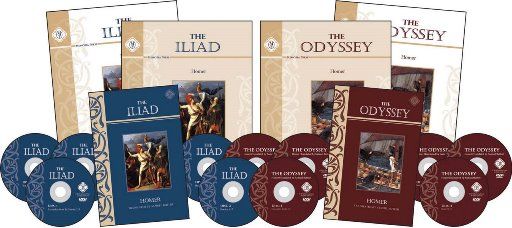
There are a number of components to this set~ the texts, the student guides, the teacher guides and the comprehensive sets of instructional DVD's for each title.

The texts have a very "soft, smooth" feel to the cover that makes them lovely to hold and read. That may not be a big deal to some, but I appreciate a book with a good hand. Samuel Butler's translations, which are used for the text, are interesting in that he chose to translate both works from their poetic form into prose. This makes them more accessible to today's readers, and at an earlier age than the typical college .

The student and teacher guides are typical of  Memoria Press ~ very straightforward, no fancy bells and whistles, just the facts with blank lines to write them in.

The DVD's are the highlight of this set in my opinion, as they offer the opportunity to have a classical scholar come lecture in the comfort of your own home. Without Sean Brooks' instruction I would find it very difficult myself to pull out the background information (both literary and cultural) that is interesting as well as helpful in understanding these ancient works.

When I first received the set I handed the book and student guide to my son and asked him to get started, and we would check out the DVD's later as we had time. I didn't realize that the best order would be to watch the DVD introduction to the entire book first, then read the text, watch the DVD lecture for that section, and then work through the student guide. Now you know, so don't make the same mistake... you can thank me later. ;) OH, and of course, *you* will want to look the teacher guide over before you begin the whole thing, but I'm sure you already knew that, just figured I'd make sure my suggestions were complete for the entire set. ;)
Screen shots of the samples (not including text) found on the Memoria Press website along with the corresponding page from my son's student guide. Note that thee Teacher Guide includes the (answered)student guide on the right portion of the paper with background information and helps surrounding.  

Sean Brooks is a delight to watch (from my parental/educator perspective) because he so clearly loves his topic and really wants to pull his audience into his great enjoyment of this Ancient Literature and its fusion of myth and history and treatment of the human condition. My son appreciates the way Sean explains things and makes the cultural and historical context of the Greeks more accessible while clarifying some of the characters and events of the story.

While I am appreciating the study of The Illiad, I checked out the DVD Introduction and first lesson for The Odyssey, and am looking forward to sharing the adventure of that epic with my son next. More of the same good information, and I think he will continue to be surprised at all the phrases he will find that continue to be a part of our culture today (like Achilles' Heel). It seems that Homer and Shakespeare may collectively be responsible for the greatest portion of literary allusions used even today.

If you visit the product page listed below you will find links to sample pages from each of the books and guides as well as sample videos, so that you can get a feel for the program yourself. If you are looking for quality Classical Education with a Christian Perspective, I suspect that you will be very pleased with what Memoria Press has to offer. 

Not So Nutty Nitty Gritty 
You can visit Memoria Press on their social Media pages: 

Please click the banner below to visit the TOS Homeschool Review Crew and see what others had to say about this set as well as the others. As always, I hope that this review was useful to you as you choose where best to spend your homeschool budget.
Blessings~
Click to read Crew Reviews
Crew Disclaimer
#hsreviews #memoriapress #classicalchristianeducation #classicalyhomeschooling #classicalchristianhomeschooling

Friday, July 8, 2016

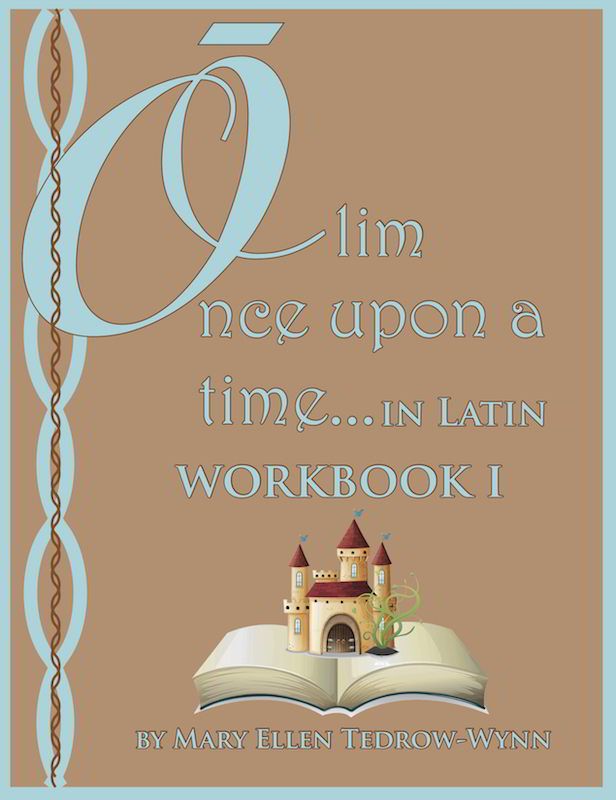
Laurelwood Books Once Upon a Time in Latin (Reader and Workbook) Review


I was recently given the opportunity to use Laurelwood Books' first set in their series of Fairytale based Latin Readers, Olim, Once upon a Time in Latin, Reader I and 
Olim, Once Upon a time in Latin, Workbook I for review. Each set in the series covers one or more fables, parables, or Bible Story in English and Latin. 

Reader 1 includes The Three Little Pigs, The Tortoise and the Hare, and The Crow and the Pitcher. 
Reader 2 includes The Good Samaritan, The Ant and the Chrysalis, and The Lost Sheep
Reader 3 includes The Feeding of the 500 and The Lion and the Mouse. 
Reader 4 includes The History of Creating the World
Reader 5 includes We Know a Tree by it's Fruit, and Daniel part 1
Reader 6 includes The Prodigal Son


The reader has a Latin pronunciation guide in the front, along with general instructions on how the Reader can be used. The suggestion is to do a page per day, along with the associated workbook page. I will admit that we took it a little slower, in part because it is summer, but more because my Youngest was having a hard time memorizing the words in Latin. He could give me the English translation, but coming up with the Latin words was much harder (as is to be expected). As a result, I tended to read the page with him, then read it again the next day before attempting the workbook page.

So how does it work? The reader tells the story in English, and then tells it in Latin. To assist with learning the meaning of the Latin phrases, the Latin vocabulary for each page is printed down the side bar.


We started with the story of the Tortoise and the Hare (because, while I love the story of the Three Little Pigs, I personally prefer the version where the wolf *doesn't* get eaten...whoops!).

The bottom of each Latin story page has a STOP symbol and the accompanying Workbook Exercise listed. This is very helpful. :)

The workbook includes a variety of exercises using the vocabulary from each page:
Translate words or phrases from Latin to English
Translate words or phrases from English to Latin
Fill in the blank with the English word(s), then translate the word(s) into Latin
Match the Latin word to the English Translation


Digging Deeper~ My son wasn't ready for Latin verb tense (or Nominative, Accusative, Genitive, Dative, or Ablative), so after reading through the first Digging Deeper with him, I decided that these sections would be better saved for a much later date.

Because I am not fluent in Latin myself, I wish that the pronunciation guide for the Latin words was included with the vocabulary on each page (Or even phonetic pronunciation for each word). I find myself turning back to the front of the book with every word (OK, this older brain isn't retaining that knowledge too well...) in order to help my son with his pronunciation. Since he already has a few issues with English pronunciation at times, this is a bit on the tough side.

I suspect that those who subscribe to a Classical Education style will really appreciate this take on teaching elementary Latin, and Charlotte Mason Learners might appreciate it in the sense that the lessons can be short and sweet. However, I felt that it was a lot more than my more relaxed style could maintain for very long, without creating a serious dislike of Latin in my son.

I like the concept, but I feel that it is akin to the idea of whole language reading ~ and I personally prefer the building blocks of phonetics. Please take a few minutes and see what other Crew Reviewers had to say, as we all come from different teaching/learning backgrounds, and others may have a very different view of this curriculum. Besides which, Laurelwood books has many other items that were reviewed including a State Study, Patriotic Penmanship, Latin Derivatives, and the Scripture Scribe Series.

Not So Nutty Nitty Gritty 
Laurelwood Books can be found on Facebook if you'd like to check them out on Social Media.

Again, please click the banner below to visit the TOS Review Crew and see what others had to say about this and other offerings from Laurelwood Books.  As always, I hope that this review was useful to you as you choose where best to spend your homeschool budget.

Blessings~


Click to read Crew Reviews
Crew Disclaimer

Followers

LinkWithin

Related Posts with Thumbnails