Showing posts with label 2010/2011 Homeschool Year Reviews. Show all posts

Friday, May 20, 2011

Wordy Qwerty~ All kinds of keyboards!

Photobucket


Every now and again I am given a review item that doesn't actually "match" the ages and/or abilities of any of my children. Such is the case with Wordy Qwerty.  However, if I had a child currently in the target age for this program, I would definitely be interested in purchasing it for a supplemental activity, as I feel it is engaging as well as educational. 

Wordy Qwerty is offered by Talking Fingers as a spelling and typing fluency program for 2nd and 3rd graders (Or ages 7-9). Although he didn't exactly "fit" the range, I figured that my 5th grader could use practice typing, even if his spelling is already pretty good. So, on with the "Show". :)


The basic set-up~ 
"Qwerty" (a computer keyboard) and "Midi" (a musical keyboard) are characters who help the student navigate through the lessons on a quest to earn "Spheres" so that Midi can build a musical machine (more on that in a bit).


There are 20 "lessons"  that cover 20 basic spelling rules, with 6 activities in each lesson. Every set of 4 lessons completed allows Midi to complete another section of his machine. 


This is what the "navigation" screen looks like. 
Navigation screenEach activity is represented in the boxes to the left of the center column, the lessons are represented by the numbered spheres (Neat feature~ if you mouse over a completed sphere it shows which spelling rule is represented. For example CKS or X would show if you hovered over the numeral 8). The boxes to the right of the center represent each section of the musical machine that has been completed.

1~ Patterns 
Step 1: PatternsThis screen shows the word "branch" being typed. If the student misspells the word, the program will guide with voice "Type 'c'" as well as the color coded hand showing how to correctly type the letter (I tried to get a screen shot showing the fingers moving, but was a little too slow). Once the word is correctly typed, it is "moved" to the appropriate side with the arrow key. This step shows the common patterns in spelling. 


2~ Karaoke

After the patterns are discussed, Midi comes up with a "Spelling Rule Jingle" to help cement the idea in the brain. These are some of the more, shall we say.... musical tunes I've heard used for this sort of thing. After the song is sung, there is an option to sing it karaoke-style, which also helps to make it more memorable.
 

3~ The Recycler 
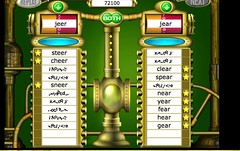
Step 4: sortingThis section focuses on words that rhyme, and the different vowel patterns that can be found. It helps the students learn to recognize correct long-vowel spellings. The words are sorted, and then the "nonsense" words are "recycled" (My 3 yo thought this was a fun part to watch, simply because he's big into recycling right now :) )
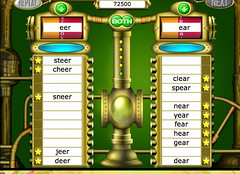
Step 4: recycled
4~ Pop-a-Word
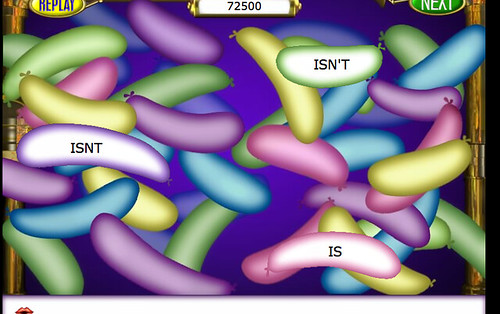
4~ Pop-a-wordThis section is an arcade-style game where a sentence is read that includes a "tricky" word (For instance "isn't"). The words then appear somewhat randomly in balloons, which must be popped in the correct order (My Eldest thought this one was kind of fun, and it was good to build quick discrimination between there, they're and their).


5~ Write a story 
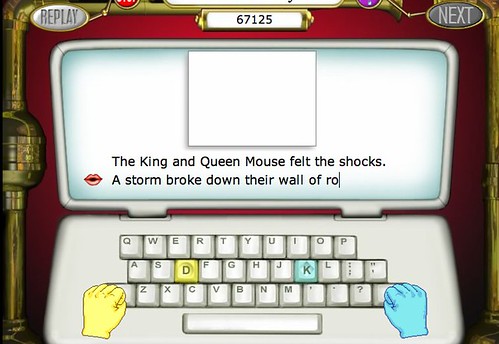
Step 5 Write a StoryThis activity works on dictation skills. There is a new 8-line rhyme for each lesson. Two lines are spoken and shown in print. The second line is then taken away, and must be typed correctly. There are cues when incorrect letters/words are typed. If the child can't recall the entire sentence, he can click on the lips, and the set is repeated, both in print and vocally. Very helpful feature~  the printed text is then returned to the point where the child left off, rather than returning them to the starting point. 


6~ Read a Story:
This activity tests reading comprehension by leaving some words blank. When the student gets to a blank, and clicks, a drop-down box appears with word choices.

Step 6: Read a Story

Here are some of our further thoughts on this program:

Pros:
  • We felt the variety of interesting games and activities helped to keep the interest level fairly high. 
  • Many of the activities contain "Stories", rather than random sentences, which my Middlest appreciated. 
  • The musical machines that are being built are pretty cool~ 
Cons: 
  • There is no way (That we have seen) to replay the musical machine sections of the program~ if you missed it, wanted to show it to Dad when he gets home, or littlest wants it played again, there will be some disappointment. 
  • The CD-rom version is not compatible with the newest MAC OS versions. :( We can use the online version, but sometimes portable is useful. 
  • I haven't found a way to pause the program, which would be a useful tool. 
Here is an introductory video that will allow you to see some of the program in action, as well as hear directly from the creator of Wordy Qwerty, Dr. Jeannine Herron. 


    Now for the nitty-gritty (Which isn't too gritty! :D )


    Price: 
    • 5 year online subscription for 1-5 children ranges from $25- $71.25 
    • CD editions (Not compatible with Windows 7 or MAC OS 10.6 and up) $35
    Clearly, efforts have been made to make this an affordable option for families of all sizes, which is very appreciated! You can get full pricing details on the website, and while you're there, you might be interested in checking out the free online demo of the first lesson on silent "e".  
    If you scroll down the demo page, there is currently an offer for 20% off your order when you sign up for the Talking Fingers, Inc. newsletter. Pretty nice! :) 


    As always, I hope that this has been helpful to you as you choose where to spend your homeschool budget. Please visit the TOS Crew Blog, and see what my fellow crewmates had to say (Many of them actually had children in the target age range, so they may have some different insight for you).


    Blessings~
    Disclosure of Material Connection: I received this/these item(s)/service for free as part of the TOS Crew Review Program. I was not required to write a positive review. The opinions I have expressed are my own. I am disclosing this in accordance with the Federal Trade Commission's 16 CFR, Part 255: "Guides Concerning the Use of Endorsements and Testimonials in Advertising."

    Wednesday, May 11, 2011

    Institute for Excellence in Writing


    Photobucket

    I am a fan of reading (Have you noticed that yet?). I also think I’m a tolerable writer (I will leave each of you, my readers, to be the judge of that). However, I am NOT confident as a teacher of writing and composition. I think it relates to my finding writing fairly intuitive, but therefore difficult to teach. I am also befuddled because my well-read children don't really enjoy writing. (How many of you have heard that "if your children are good readers they will absorb the ability to be good writers"? I can testify that it doesn't always work that way. For these reasons I was extremely delighted to have been chosen to review the Institute for Excellence in Writing’s Teaching Writing with Structure and Style(TWSS)/ Student Writing Intensive(SWI) combo package “B” (intended for grades 6-8) for the TOS Crew.

    As someone who had been in a workshop or two with Andrew Pudewa at a conference, I was familiar with the the Institute for Excellence in Writing, but I really had no idea what the SWI or the TWSS programs entailed. Here is some information that I think may be helpful for those considering purchasing either or both.

    The Basics:

    First, I need to mention that both products can stand alone, but they also work well together.

    In order to test this out, I started using the SWI first, before looking at the TWSS.

    Student Writing Intensive is a workshop for students, making use of taped live workshop sessions. We were sent Level B. There are 4 DVD’s in the course with 15 lessons (which can take 15-30 weeks or so). It also comes with a notebook which includes copies of the forms and lists that the children will be using, as well as plenty of space for their own writing papers.
    SWI is one of those wonderful programs that allows me (the parent and teacher) to invite another teacher into my home (Andrew Pudewa) to teach my child(ren). I really didn't have a handle on the concept that this entire program really is a course or "workshop" for my student, and that I get to be the "teacher's assistant" if you will. :) Yes, I'm repeating myself here, so that others will better understand that concept.

    By the way, Andrew Pudewa has a great sense of humor, albeit a rather "Boy-ish" one (imagine that!). He even had my fairly demure daughter chuckling over the explanation of his classroom "Fingering" system ("1 finger in the air means you have a question about..... 2 fingers.... and 3 fingers......). You'll have to actually watch the DVD to understand that one, but it is worth the chuckle.

    Eldest enjoys being somewhat independent with her schoolwork, and we have found that a few DVD classes tend to work well with her. I enjoyed being able to sit back and watch the lessons with her, but serve only as reinforcement. I think that the SWI could be used fairly independently, if your student is motivated.

    The units move at a fairly steady pace and build writing skills, focusing on just a few techniques and structural elements at a time. I should mention here that if your student has an extremely creative literary bent and is ALWAYS writing, this program might feel a little stifling.  However, Andrew Pudewa has taken pity on the poor souls who never know what to write about, and has given them specific excerpts to re-write. The basic concept is that it is too hard for many children (And adults) to concentrate on learning how to write AND come up with their own content at the same time. I think that depending on your student, and possibly allowing them to choose their own topics, even prolific stream-of-consciousness writers can gain some insight on how to "dress up" and improve their writing.


    SWI gets 2 thumbs up from Eldest~ She is looking forward to continuing with it next year, which leads me to the....

    Teaching Writing with Structure and Style  Seminar and workbook. Included in the package I received was the original TWSS seminar (recorded in 2000) on 6 DVDs. Just like the SWI, this is a live class or workshop, but for the teacher this time. This was similar in many ways to sitting in on a bunch of "Andrew Pudewa" homeschool convention workshop. Lots of great information and tips~ I'll list a few of my favorite "nuggets" a little later on. 

    TWSS also includes the Tips & Tricks DVD (recorded at a 2007workshop/seminar) as well as three DVDs that are sort of a quick version of the SWI for each level.
    One of the first "Tips"~
    "Don’t drag the program out!  Don’t get stuck on the first 2 units. 3-8 weeks TOPS! Just move on!" (Schedule the change to the next unit, and follow it, regardless of whether or not there is a firm understanding). (Uh-oh! I should have listened to this earlier!)  If you are planning to do much of the teaching yourself, and you have time, it would be very good to go through the entire seminar before starting to familiarize yourself with everything, AND listen to the Tips & Tricks DVD. You can "muddle along" like I did for a while, but really, it would be in your best interests to invest that time more or less up front. However, if listening to the entire course at once is too daunting, don't let that hold you back. Go ahead and start, just remember this first tip... keep moving! :)

    Doing the same work that your students will be asked to do (in the TWSS seminars) may be one of the most valuable tools. It helps to DO before you teach! :)

    Some nuggets that I feel are worth sharing as they apply to many things~
    • Don’t tell them “Don’t do that!”, instead teach them what TO do! You can’t efficiently get rid of a bad habit, without replacing it with a good one.
    • “Tests” inform children what they DON’T know (“I got ___ wrong on the test”), while writing and essays are good methods to show what they DO know.
    • The purpose of SWI and TWSS is to “Practice” writing differently, rather than writing the best possible piece. This will allow the student to eventually write excellent papers without having to actually "Think" about the mechanics, and instead focus on the content.
    • “Thinking” is not only answering the questions but learning to ask the questions of yourself.
    I think that the TWSS is a very valuable tool, and will help me to teach my children how to be better writers. I can see pulling this out yearly and going through the units until they really know what they are doing. 

    The nitty gritty~
    This is not an inexpensive program, but as with many things, I feel you get what you pay for. Quality.
    The package I received Teaching Writing/Student Writing Intensive Combo Pack $239
    Each component is available separately, but purchasing them together saves $29.

    To get an idea of which course would best suit your family I highly recommend taking some time to browse through the Institute for Excellence in Writing website.
    • There are numerous introductory videos and samples on the website (For instance, if you scroll to the bottom of this page, you will find an introductory video, a video excerpt from the class, and 2 sample files to download)
    • There is a fantastic "Help and Support" page that should answer many questions as well as lead you to many articles that are helpful and informative. 
    • Newsletters from 1996 on as well as the new "Magalogs" may be accessed through the "Help and Support" tab as well (Or you can just click here)
    Last but not least, another nifty little item we received was a Portable Wall($7). This is a tri-fold folder (Think the size of a regular folder but with 2 flaps that open outward instead of just one) that can help take the place of all the posters with which Andrew Pudewa recommends decorating our homes! This could be a little handier for those of us who don't have entire classroom walls at our disposal! :)

    As always, I hope that this review was helpful to you as you choose how best to spend your family's homeschool funds. For more opinions on this and other levels of SWI and TWSS, please visit the TOS Crew blog.

    Now I will leave you with two of my favorite "Nuggets" from TWSS.  These resonate strongly with this homeschooling mom!

    You do not learn from Multiple Choice tests! Multiple choice tests put the emphasis on what we do NOT know. "I got 4 wrong... I don't know 4 things."  Well, you're never going to know everything there is to know about everything anyway. So who cares what you don't know! What's more important is what you DO know, and can you communicate that effectively.  Andrew Pudewa

    Make writing a part of the study of everything.  Andrew Pudewa

    Blessings~
    Disclosure of Material Connection: I received this/these item(s)/service for free as part of the TOS Crew Review Program. I was not required to write a positive review. The opinions I have expressed are my own. I am disclosing this in accordance with the Federal Trade Commission's 16 CFR, Part 255: "Guides Concerning the Use of Endorsements and Testimonials in Advertising."

    Monday, May 9, 2011

    Monki See (monki do.....monki learn)

    Photobucket
    MonkiSee, Monki Do? 
    Children truly do learn by mimicking those around them. Neural pathways are being connected and reinforced constantly.  MonkiSee creator Krista Guerrero (A homeschooling mother of 6) recognized this, and created the MonkiSee program to help others after having success with teaching her younger children to read at an early age. You can read more of her story here, and some facts about the program here.

    The entire program utilizes DVD's, Books, and Flashcards.

    Photobucket


    MonkiSee is based on research by Glenn Doman, the author of "How to Teach Your Baby to Read". You can read some of his research and find other resources on this page (Glenn Doman's research is found at the IAHP links). In a nutshell, my understanding of the basic concept is to exercise and stimulate the same neural  pathways over and over so that what is seen (or heard, or touched) is "learned", and this learning takes place most quickly and easily the younger the brain....

    Photobucket My youngest is on the older end of the recommended age for MonkiSee, (ages 3 months -3 years) but he enjoyed watching the MonkiSee Baby's First Words DVD (Retail $24.95, currently on sale for $19.95). It is pleasant to watch, with calm music and children's voices. The accompanying pictures and puppets are also interesting.

    We didn't actually watch it EVERY day as recommended, as Youngest likes variety in what he watches, and I do try to limit his viewing. He wasn't very fond of reviewing the included slideshow, although he was willing to watch it a few times. I'm guessing he was a little old for the purposes of this program(Not quite as compliant as a younger child might be...;) He has his own, vocal opinions about what he watches and reads at the moment ;) ).
    Photobucket

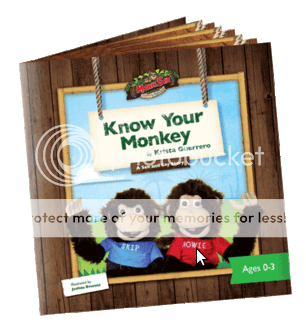
    I like the way that the MonkiSee book, "Know Your Monkey" (Retail $11.95, currently available for $9.95) is set up. 


    A 2-page spread with text (Mostly one-two words/page), Photobucket

    and the following spread has a picture with the same words repeated.

    Photobucket

    I think this is a useful tool!
    It gives the opportunity for the child to focus on the word shape before seeing the picture. When the word is repeated with the picture, the child begins to associate the shape of the word with the picture. This is very well done! I would like to see more "baby books" utilize this concept.  Oh, and the words in the book reinforce those found on the video, which was "thoughtful", and makes sense.
    I would say that this process would work best with someone who is fairly regimented, as frequent repetition is a key aspect of the program. I understand and admire those that are wired this way. Unfortunately, that is just not the way our family works (In addition to having limited viewing time, I'm just not an "Every day 3x/day kind of person".... you should see me trying to remember to take vitamins!).
    I am curious though, what the results would have been if I had had this program to use when my Youngest was an infant. 

    However, that being said, I appreciate the ability to have something very "Gentle" to watch upon occasion that is educational in nature. This is even addressed in the FAQ's ~ (See the answers to "Should I do this daily with my child?"  and  "What if we don't do this consistently?") The only negative recommendation  makes perfect sense~  to NOT make this the only think that your child sees and does all day long~ not a multi-hour electronic baby-sitter! 


    If you are interested in giving your 0-3 year-old child a "head-start" in learning to read (By memorizing word shapes, and eventually internalizing some phonics), then this might be a program you would be interested in. You can purchase the items individually, or you can purchase an entire package (6 DVD's, 2 books, and 5 sets of flashcards). Retail for this package is $265.35, but it is currently on sale for $139.95~ over 45% savings. 

    To see how this worked for other TOS Crew Members, please check out the TOS Crew Blog.


    As always, I hope that this review was useful to you as you search for the best items for YOUR homeschool.

    Blessings~
     

    Side note:  Krista Guerrero does recommend using a phonics program for children 4+ as the "Window of opportunity" for teaching via sight-reading is much smaller at that point.
    Disclosure of Material Connection: I received this/these item(s)/service for free as part of the TOS Crew Review Program. I was not required to write a positive review. The opinions I have expressed are my own. I am disclosing this in accordance with the Federal Trade Commission's 16 CFR, Part 255: "Guides Concerning the Use of Endorsements and Testimonials in Advertising."

    Wednesday, May 4, 2011

    Yesterday's Classics

    Photobucket
    I am a self-professed bibliophile (aka book-a-holic... AND my children are well on their way to following in my footsteps ;) ).
    I have a number of bookcases and STACKS of books in my home. Although until recently I was inclined to slow down my purchase of physical books,  due to the over-proliferation of books in my home, my mind has been changed by visits to my public library (A story for another post). Suffice it to say that GOOD and classic literature is "disappearing" from those shelves to make space for... um... I'm not sure what, exactly, but I'm not happy about it.


    Screen shot 2011-05-04 at 11.49.30 PMBecause many "Classic" books are being removed from my local library's shelves, AND given the advent, and subsequent popularity of e-readers (I currently only have an Itouch, but am interested in a Kindle or a nook, or some such thing....), I was very pleased to be amongst the TOS Crew members who were given the 225 e-book bundle from Yesterday's Classics to review.  Books in this set include those that are appropriate for read-alouds to the "youngest" scholars, as well as titles that are useful to the jr-high to high-school aged student. There is something for just about everyone, in the 22 genres that are included (Ancient to American History, Nature, Bible, Legends and Fairy tales are a few...).

    Friday, April 29, 2011

    Greek & Stuff, Latin's Not so Tough Vol 3

    Photobucket

    TOS Crew members received a variety of items to review from the company Greek 'N' Stuff: Latin and Greek curriculum for elementary ages, as well as Bible Studies.

    My family was sent "Latin's Not so Tough" Volume 3, which was most appropriate for use with my Middlest (10 yrs old). For more on choosing the correct level, please check out the FAQ page provided on the Greek 'N' Stuff website. 
    The package we received contained the following components:


    Photobucket
    Sample pages for this specific level can be found (Along with sample pages for many other Greek 'N' Stuff products) on this page.

    The set up is a fairly basic "Spiral" workbook, starting with alphabet and vocabulary, then moving into some Latin grammar. There are  matching worksheets and crossword puzzles as well as simple Latin sentences to translate. Vocabulary flashcards can be found in the back of the book.

    Photobucket 

    Here are my thoughts on this program:
    Pros:
    • Fairly simple format
    • Inexpensive
    • Some variation in exercises, to help alleviate tedium
    • Steady, solid repetition
    Cons:
    • Not for "Self-directed" learners~ there is not enough information included in the student manuals to make it an easy "Grab-and-go curriculum.
    • There are "Lesson helps" in the front of the entire text of the Answer Key. I found this set-up to be rather confusing, and would prefer to see those notes added to individual pages in the beginning of each "lesson section", in part so that *I* don't forget to skim through the appropriate portion before getting started with each lesson! ~ I found that while I read through the entire "Schedule" when preparing to start the course, I would forget that help could also be found there when involved in the "Practice" of the program).
    This was not a fabulous "fit" for our family, in part because I have reached a stage where I expect my children to be more "Self-directed" in their education. Due to various circumstances (Let's call it "life" :) ), I let probably a month of "Instruction" slide by before I realized that this particular program had to be a little more "mom-intensive" than I expected (partially because I am NOT a Latin Scholar myself, and didn't catch that there were some things being "missed" right away). 
     
    As a result, the white erasers came out, and we started over with everything but the Vocabulary. Really~ we started over with the vocabulary as well, but I didn't want to erase all of his work. I have found that one way to get my Middlest to willingly comply with things like vocabulary is to create "Electronic Flashcards" that he can use on his itouch. I input each "Lesson's-worth" of vocabulary into a googledoc and upload it to his itouch using the gFlash+ app. That way he can review and quiz himself in a format which he enjoys more than traditional flashcards.

    If my son were a basic "Work-bookish" child, I would say that this would have been a good program for him, and my Eldest probably would have been as happy as a clam to use this when she was still "Elementary" age. What works for one, may not necessarily work for another! 

    I hope that this review has been helpful to you, and that you can clearly tell whether "Latin's Not So Tough" is your cup of tea or not. For more reviews and information on how other TOS Crew members used this curriculum, as well as the Greek curriculum and Bible Studies, please visit the TOS Crew Blog
     
    Blessings~

    Disclosure of Material Connection: I received this/these item(s)/service for free as part of the TOS Crew Review Program. I was not required to write a positive review. The opinions I have expressed are my own. I am disclosing this in accordance with the Federal Trade Commission's 16 CFR, Part 255: "Guides Concerning the Use of Endorsements and Testimonials in Advertising."


    Friday, April 22, 2011

    See the Light Art Class DVD

    PhotobucketSTL_new logo_twitter_horizontal

    Now that you've read about my experiences with the special Holiday See the Light DVDs, it's time to tell you what we think of their regular DVD art class.  The TOS Crew was sent the first Volume in See the Light's 9 Volume DVD course. Each DVD includes 4 lessons, and the first three Volumes each have a "bonus" lesson, for a total of 39 lessons.

    PhotobucketPat Knepley is a pleasant and encouraging instructor. She naturally integrates Biblical truth with art classes~ "Creativity comes from the Creator, " "Tool Kit for Life"  (Bible~ memorization). This is something that is hard to do without being "Preachy", but I think she accomplishes it fairly well.

    This first set of lessons is very basic, so while my olders weren't as challenged, they did produce some good drawings. Photo on 2011-04-22 at 22.13Photo on 2011-04-22 at 23.53 #2
    My 3 year old was very excited to be shown very specifically two correct ways to hold a pencil and get two very different results. The step-by-step instructions meant that while his "apples" weren't "perfect", he was able to accomplish something of which he was proud. :) (Notice the two different styles of shading on the colored in apple?)

    100_0931

    PhotobucketWhen looking at the curriculum syllabus, it is fairly obvious that the lessons are progressive, which is why bundling the entire curriculum makes sense. Offering them individually would be a nice touch for those who have moved beyond the basics, but would appreciate the ability to target certain areas. However, at this point in time the company does not have that option available.

    One thing my kids picked up on that could be considered a "con"... in the 4th lesson of Volume 1, which is to "Draw what you see", it is very obvious that the shoe being "drawn" by Pat Knepley has already been sketched out. They weren't very impressed with that, given the concept of the lesson, and were quick to point that out to me. hmmmm.... I think that could be discouraging for kids... "Oh yeah... she's got it sketched out already, easy for her to say". Not a "deal-breaker" for me, but worth mentioning.

    One benefit to "See the Light" is that it is an actual class being taught by a real instructor. This is very different than the 2-dimensional step-by-step instructions and photos that are common to many "how to draw" books, which is the only other experience we've had. It's also a great option if taking live classes just isn't a possibility, whether due to personal circumstances or location.

    Another benefit~ The majority of the supplies are fairly common, so the out-of pocket expenses  (Beyond the actual course) should be fairly minimal.  If you don't already have the basic drawing tool kit, you should be able to pick most of the items up fairly inexpensively at any number of craft stores. (Many of them offer weekly coupons with 40-50% off a regular priced item)
    Basic drawing tool kit
    #2 pencil
    drawing pencil
    charcoal pencil
    black sharpie
    colored pencils
    pencil sharpener
    crayons (24+)
    eraser (White or kneaded)

    Photo on 2011-04-23 at 01.52
    Eldest's on pink paper
    The bonus lesson DOES make use of chalk pastels, so if you don't have those, you'll want to think about picking some up.  My daughter appreciated the bonus lesson found on the first Volume, as it was demonstrating how to make a chalk drawing similar to the drawing presented during the "Artful Worship" segment on The Crossmaker DVD, which I reviewed earlier.

    While the drawing was rather messy (Not her favorite thing), and she's a perfectionist (uh-oh), we both enjoyed doing the lesson.

    Photo on 2011-04-23 at 01.45 #2
    Mine on white paper
    You can see in the top two pictures the trouble we ran into because we were using regular-sized construction paper. With most of the instruction we were able to correctly scale our drawings, but when it came time (At the end...) to draw the crosses, the method described didn't work well for our smaller-sized paper. See the smudges where we "kind of" erased the crosses and started over? Since I was playing with two drawings at the same time that Eldest was doing one (Different color paper backgrounds...I know... over-achiever....;)), I was able to catch that on the last picture, and there is not the same "Smudge" that marred the others.

    The final analysis on drawing with chalk pastels is that it is hard, but fun! :) Excellent!

    Photo on 2011-04-23 at 01.45
    Mine on brown paper
    Eldest mentions that using mom's OLD pastels wasn't very helpful when we were supposed to  be able to make thin sharp marks, and perhaps it would be worth it to use a new box!

    I can't give a definitive opinion about the higher level DVDs, not having seen them, but based on the instruction in the first one, I am fairly confident that they will maintain the same standard. Here is a little "preview" snippet from Pat Knepley, that may give you a better understanding of the curriculum as a whole.


    Now for a few more details:
    • Volume 1: The Basics (This is the one we received, which you can currently request from the Seethelight Website for free, OR you can watch the first three lessons online )
    • Volume 2: Shape and Space
    • Volume 3: Value and Color
    • Volume 4: Color Blending Techniques
    • Volume 5: Proportions for Composition
    • Volume 6: Texture and Form
    • Volume 7: Perspectives for the Landscape
    • Volume 8: Balance and Foreshortening
    • Volume 9: The Portrait
    The Nitty Gritty~ 
    9 Volumes  on DVD  $99.99 for the entire course ~ yours to keep and use throughout your homeschooling years
    or
    A Monthly subscription $10.00 that "unlocks" 4 new lessons, following the curriculum progression each month~ you have access to all lessons you've unlocked as long as your subscription is maintained
    Age Range~ The site says "Kids of all ages"~ clearly, my 3 yo got something out of it, listening and watching and drawing along. Very good for a beginning artist of most any age, however, based on the teaching style, I would say that it is most appropriate for Elementary-aged students.

    As always, I hope that this review has helped you determine where and how to best use your homeschool budget! To see what other TOS Crew members had to say, please visit the TOS Crew Blog, and scroll through the main post to get to the linky.

    Blessings~
    Disclosure of Material Connection: I received this/these item(s)/service for free as part of the TOS Crew Review Program. I was not required to write a positive review. The opinions I have expressed are my own. I am disclosing this in accordance with the Federal Trade Commission's 16 CFR, Part 255: "Guides Concerning the Use of Endorsements and Testimonials in Advertising."

    Monday, April 4, 2011

    Going "bongo" with GoGo Kabongo Preschool

    Photobucket

    Every now and again the TOS Crew reviews provide something for my Littlest. This time around he had an online "World" to explore. The World of GoGo Kobongo (For ages 4-7 or so).

    Photobucket
    Photobucket
    Photobucket

    GoGo Kobongo encompasses 3 "Habitats" which are home to 3 games apiece. These games are intended to provide practice for the  critical thinking and problem-solving skills that are necessary to develop fluent reading (See chart, below)

    Photobucket

    As your child starts the journey through GoGo Kabongo, he will begin in a tree-house that is sort of the "central station" for the game. He can create an "avatar" or character here, and access the map in order to visit the various habitats.  From this area he can also enter a "Skatepark" (various structures can be earned in the games~ they are pretty fun if you have a child that likes skateboards!) and a "Comic Book" (for which he earns stickers while playing games).

    There are some characters who interact with your child as they play the game, specific ones for each habitat.You can learn more about them here.
    Photobucket
    For a quick synopsis of each habitat and the games in each one you can visit this webpage.

    I would say that Youngest is a little TOO young to be able to take full advantage of these games, but with a little assistance from Mom or Eldest, he was able to make his way around with a reasonable amount of success.

    For instance~ in the Laughter Lake habitat~
    • Critter-Sizer was  great for his visual discrimination(Deciding if the animals were big or small), but he required assistance in the "mechanics" of choosing the correct size (Eldest determined that it was easier to use the arrow keys than the touchpad on the laptop, from a technical standpoint).
    • Scuba Dude was a more "Arcade" style game that Littlest was able to pretty much play on his own(Moving the little scuba up and down through the water to collect shells and avoid obstacles).
    • Going Buggy was another game that required a little bit of help~  with one of us asking him to remember or distinguish what things in the story were missing from the picture. From that point he was generally able to manipulate the pieces to put them in their proper places, although sometimes we had trouble with the touchpad, Mom included. These games are probably best played on a desktop, but our current circumstances more or less require the laptop be used. 
    Littlest liked the ability to earn stickers and skate park pieces, but they weren't always incentive enough for him to finish a game... mostly because he is 3.5, I think. (wink)

    At the moment you can sign your child up for free and have full access to the games in Laughter Lake. You can expand to the other two habitats for $4.95 each, but for a limited time you will receive the Galaxy Gardens for free when you sign up, which means 2 free habitats! :D (What have you got to lose besides a little time?)

    A couple of things I should mention~
    • One~ the characters didn't bother my Littlest at all, but this game would have been "no go" with my Eldest when she was 4-7. They are a little "odd" looking, and that would have thrown her for a loop. 
    • Two~ although we only heard something like this once or twice, I was not excited about a sort of "joke" that was asked by Duffy while we were just deciding where to visit next. It had something to do with werewolves and vampires...I don't recall the exact wording but  Eldest and Middlest both instantly reacted "What?" "What's that doing in Littlest's game? That's not appropriate for his age." Your family may have a different "filter" but I felt it should be mentioned. 
    • I had occasional issues with the  games not working properly, but I am attributing that more to the fact that we are playing on a laptop with only a touchpad, not a traditional desktop with a mouse (haven't contacted "Support" yet, as most of the time the games work perfectly fine, but again, felt it merited a little mention, just  "because". I also realize the game is still in "Beta" version, so there may still be a "Bug" or two to work out.
    There are Parent resources on the website  (Articles to be read) as well as a weekly "Progress report" that is sent to your email. It provides you with a summary of the activities that your child engaged in during the week, the level they are on, and some non-computer learning extension ideas(Like using dough to form letters).

    In general, I appreciate the "critical thinking" skills that are taught in these game. Problem solving in an "Active" and fun format is something that should be valued. I would say that for the price, the Kabongo games are a fun "Sometimes" activity that can be enjoyed AND benefit the pre- to- early reader.

    For more Crew opinions please visit the TOS Crew blog, and then go check out the free Laughter Lake habitat and try it out for yourself! :D
    As always, I hope that this review was helpful to you as you determine where best to spend your homeschool budget.

    Blessings~
    Disclosure of Material Connection: I received this/these item(s)/service for free as part of the TOS Crew Review Program. I was not required to write a positive review. The opinions I have expressed are my own. I am disclosing this in accordance with the Federal Trade Commission's 16 CFR, Part 255: "Guides Concerning the Use of Endorsements and Testimonials in Advertising."

    Wednesday, March 30, 2011

    Latin~ Dead or ALIVE? (Classical Academic Press)

    High School "Language" choices are upon us. Eldest has NO desire to learn Spanish, French, or Italian. So what is a mother to do? After toying with sign language and Japanese, and knowing that English is "Rooted" in Latin and Greek (as well as the  aforementioned "romance" languages), we have determined that perhaps the study of Latin would serve Eldest well.

    Photobucket

    Enter an amazing curriculum from Classical Academic Press,  the Latin Alive 1 (Bundle). (Thank you, TOS!) Other TOS Crew Members received CLA's Latin programs for younger children, Song School Latin for K-3rd grade, and Latin for Children, which is intended mainly for grades 3-5. You can read their reviews here
    Here are some facts, and then I'll get to my review.

      Photobucket
    • Latin Alive is intended for upper Middle through High school. Latin Alive 1 and Latin Alive 2 are the current offerings with plans to publish Latin Alive 3, for a complete 3 -year program. 
    • The Latin Alive 1 bundle ($139.95) combines the student text, the teacher materials, and a DVD/CD set. (These are all available individually. Purchasing the bundle is like getting the teacher's manual for free! )
    • Latin Alive 1 contains 36 chapters, with 29 new content chapters and 7 review and "reading" chapters.
    For an "overview" you can watch Karen Moore introduce the program in the video below~ 


    Being more or less a "novice" when it comes to Latin, here is how Latin Alive works for our family. I'm not going to hit every single feature (There are a lot!), only the ones that really stood out to us.

    Pros:
    • The DVD's are the "meat" of the course, as they are the lessons, being taught by Karen Moore. What does this really mean? Why, that *I* don't have to "Teach" Latin, of course! ~ I can sit alongside Eldest and learn right along with her! :D 
    • Karen is very personable and easy to listen to. Her enthusiasm for Latin is evident, and transmits itself to her "discipuli" or students. 
    • The format is well thought out and produced. Karen teaches directly to the student, utilizing the text throughout the DVD as if she were standing in the same room with you. Be prepared, though, to hit the pause button in order to complete the exercises in the text as you go through the DVD.

    • My daughter appreciated that the "how" and more importantly the "why" of conjugating verbs was introduced right away. Although learning another language can certainly be confusing, the way Latin is presented here has so far been very easy to follow along. 
    • Eldest was very impressed with the fact that she was able to translate to and from Latin fairly early in the program, and with sentences that weren't just "nonsense", but actually made sense: "I rule, and they work" becomes " Regno et laborant" (Timely phrase for mom as we encourage household chores! ;) )
    • She was also amazed that one could express a thought in Latin with ONE word that takes THREE words in English. " We are singing" becomes "Cantamus". ("We were singing" becomes "Cantabamus") Very cool! :D 
    • From Lesson 4 on, each lesson includes a reading selection. These "Readings" in Latin are modified from actual Roman texts and tell of Roman history from the time of Helen of Troy through the death of Julius Caesar.  Starting in Chapter 7 there are entire paragraphs to be read. In order to encourage success, glossaries are included below each reading with vocabulary which hasn't yet been learned. We have found this very encouraging. :) 
    • Another section that has garnered interest in our home is the "Colloquamar" (Let's Talk) with activities and phrases that can be incorporated into every day life. 
    So far, we have not run into any questions that could not be answered by looking back in the text, or listening to the DVD again.

    Beyond that, Classical Academic Press maintains a website "HeadventureLand" with many free, fun "Extras" which can be incorporated into your Latin Study. There are games, videos, readers, coloring pages (For the "littles" who are tagging along or in their own study), and extras for teachers. These are offered in Latin, Greek, and Spanish to coordinate with all of CAP's offerings. They also offer a "Weekly Derivative" which focuses on one Latin Root or Derivative each week.

    If you are a "Facebook" person, you can "like" Classical Academic Press.

    Oh... wait... I just realized... I didn't complete my list... I gave the Pros... but.... forgot the Cons~

    Cons:
    • Considering that I haven't run into a vacant stare, or complaint from my student, I'd have to say that the "cons" may be dead(in our household), but Latin is Alive! :D 
     As always, I hope that this was useful to you as you consider where to spend your homeschool budget. Local friends, if you would like to see this BEFORE convention, please let me know! :D
    Blessings~
    Disclosure of Material Connection: I received this/these item(s)/service for free as part of the TOS Crew Review Program. I was not required to write a positive review. The opinions I have expressed are my own. I am disclosing this in accordance with the Federal Trade Commission's 16 CFR, Part 255: "Guides Concerning the Use of Endorsements and Testimonials in Advertising."

    Followers

    LinkWithin

    Related Posts with Thumbnails