Showing posts with label government. Show all posts

Wednesday, May 20, 2015

Homeschool Legacy ~ We the People: Getting to Know Your Constitution


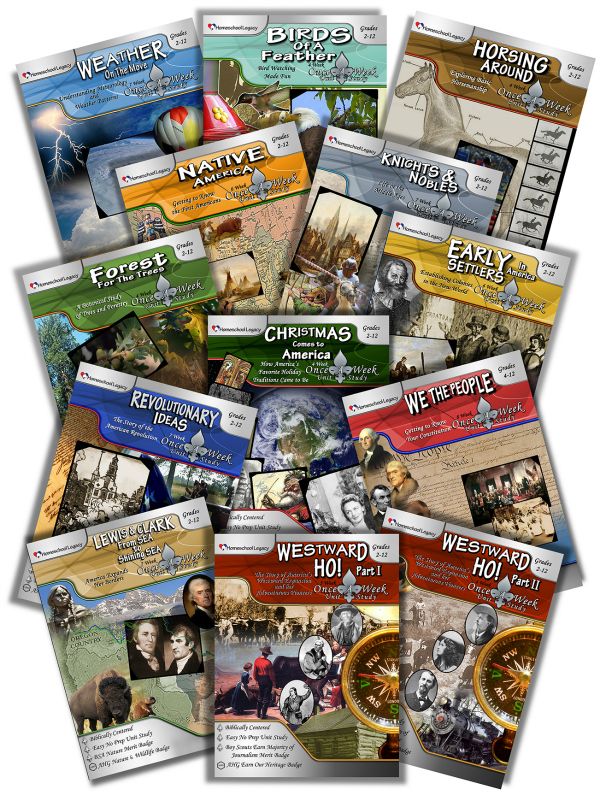
The TOS Review Crew is once again reviewing a group of Unit Studies from Homeschool Legacy.  This time there are 13 units being reviewed, that cover a variety of topics. Some of them are for more elementary ages, and others are for a wider age range.  This year we were chosen to review We the People: Getting to Know Your Constitution. This particular unit study has reading selections and activities that can be used with a wide range of ages, which makes it an especially good choice for a family with multiple children (which isn't to say that it can't be used with a smaller or only child family... because it can!).

You can see that there are history, holiday, and science titles. Interestingly enough, we were chosen to review a history/government title which coordinates with the title we reviewed in 2012 (Revolutionary Ideas~ The Story of the American Revolution Review).

There are many things that remain the same for this review, as the basic format of the unit studies hasn't changed overly much.

This study included material covering;

Bible (Biblical Worldview and weekly family devotions)
Quality Literature (Independent and Read-Aloud selections for many ages)
Language, History, and Research (Word studies, Vocabulary, and suggestions for research projects/reports that we tended to cover more as discussion than written papers, as my high schoolers are fairly busy covering their every day work)
Geography, Arts and Crafts, and Art Appreciation are touched on in a very limited way, which is understandable given the topic.
Field Trip Suggestions are given throughout, some of which are virtual field trips (Appreciated when field-tripping is more difficult to accomplish).

At this point it is important to let you know that my family received a digital copy of this unit study, not a physical copy. We discovered this time that we felt we might have fared better with a physical copy, as my eldest has a hard time reading and concentrating on content on her computer screen and does much better with a book in her hand.

HOWEVER, one of the huge benefits to this digital copy is that it has been reworked, and now includes links to various websites and videos, making it simple to click and go. The digital study also includes color photos now instead of the black and white photos we saw in our previous review. Nice upgrade!

We solved some of the digital/concentration issue by putting the document on my ipad and opening it in my pdf-notes app. This gave a nice screen size to the pages, and allowed for highlighting right on the page. I highlighted the bits for them to read in one color, and the bits for them to DO in another color. When they completed things they were check-marked in another color.

Some favorite things about this study remained the same as in our last review :

  • The addition of movies to school time (Although we had already watched "National Treasure" we thought it was great that it was recommended!) 
  • The easy links to get to various websites, videos, etc...
  • The inclusion of recipes and games (What good unit study doesn't have those? :) )
  • The great information (Of course!) and topics for discussion. 
  • Christian Worldview~ Although the history revisionists would try to suggest that people like Ben Franklin maintained less than a Christian Worldview, Homeschool Legacy does a fabulous job of including quotes that show this is far from true. Take for instance one of my daughter's favorite quotes by Mr. Franklin (taken from the weekly family devotional): 
What we found more difficult with this Once-a-Week Unit Study (beyond the electronic vs physical debate) also remained the same~ you can go back and read my first review (Scroll towards the end) to see why I don't feel this works really well for high school students in particular as a Once-A-Week Study, but why I also think that it is a great resource (If planned into your regular week for more than one day), particularly if you are looking for an interesting quarter (?) credit in Government for your high school student.

One more thing to mention, and then I'm down to the Nitty Gritty~ Those who have children involved in Boy Scouts of America or American Heritage Girls can use these unit studies to help them earn credit and/or badges, and the studies include forms and notes throughout to help with those endeavors.

Not So Nutty Nitty Gritty 
You can visit Homeschool Legacy on Facebook, Twitter, and Pinterest
Please click the banner below to visit the TOS Review Crew and see what others had to say. As always, I hope that this review was useful to you as you choose where best to spend your homeschool budget.
Blessings~


Click to read Crew Reviews
Crew Disclaimer

Friday, September 27, 2013

The Presidential Game (A review)


It's not every day that one runs into a game that can "make sense" of the electoral college (in as much as any sense can be made of that system ;) ). We had fun with this latest review item,  The Presidential Game. This is a board game for 2 or more players (you could have a "Campaign Team"), Republican and Democrat, and definitely for at least 11 years old, or older.

The Play

Each team has 150 "votes" (chips) to be placed on the states where they have the majority. Play is governed by chance (The roll of the dice, and draw of "politics cards"), and strategy (Whether to "campaign" or "fundraise," and which states to focus on in each activity).

Getting ready for the game...
The players decide how many turns or "weeks" the campaign will last, and the player with the highest roll goes first.
The first strategy decision, as I mentioned is whether to campaign or fundraise.

Fundraising can only happen in one of the big 4, California, Texas, Florida, and New York. If your players have the habit of forgetting, those 4 states have a "Currency" background as a reminder (nice touch!).

Now chance comes in to play, as the number of votes "won" during fundraising (or campaigning) all rest on the roll of the dice. Fundraisers must put 1/2 of the votes earned (from all three dice totaled) on the state where they did the fundraising, and the other votes can be placed on any other state, in any combination. After fundraising, another element of chance AND strategy enters, as the player draws a "politics card."

These cards have things on them like
"Your campaign plane gets grounded during a snowstorm in Montana. The local news interviews you live at the Billings Holiday Inn. Add 2 votes to Montana." or
"Your opponent's spouse is overheard telling a campaign worker that he/she can't stand seafood. Add 2 votes to Maine and 2 votes to Rhode Island"
These cards can be used at the end of your turn, or saved to be used later, after a "Campaign" turn, when politics cards are NOT drawn (part of the "strategy" involved).

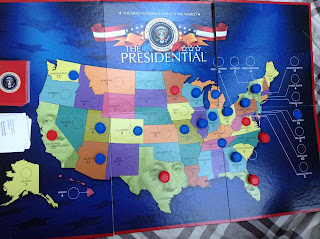
Game board after a few "weeks" of play
There are a few cards that say things like "Wisconsin Teachers Union lays off 30% of its employees. Your opponent adds 2 votes to Wisconsin. Play immediately." The cards that are "play immediately" give votes to your opponent.

Campaigning can happen in any state. When campaigning the player chooses 3 states to campaign in on that turn. The dice are rolled. The player then chooses which die to allocate to which state, and places the corresponding number of chips on the state. There are other specifics to play, which are more easily explained in the directions, which can be downloaded from the FAQ page.

The game comes with scoresheets, which we found to be a little confusing. Another option is to simply add and subtract EC votes as states are won and lost, using a blank piece of paper... :)
There is also an online option, the webmap calculator (Which certainly makes "keeping score" simpler, and I highly recommend it!). The screenshot to the left is from the webmap calculator at the end of the below photographed game~ interestingly enough it was just about the exact opposite of what the states would show in real life!

The instructions suggest that a "30 week" game should take about an hour, but we found that to be rather optimistic. We found that we could only get through 13-16 weeks in an hour. Thus it has been decided that we would play for a set period of time, regardless of the number of weeks.

When you do reach the end of your agreed upon weeks (or time in our case), the states that are still neutral are decided by the roll of one die per team/state, with the highest roll winning the state.

Eldest said "I understand the Electoral College better now, but I think it is utterly ridiculous! It makes sense to me now how the states can go back and forth during a campaign, and why the big states like California are such a major focus, but in the long run, it isn't necessary to win all the big states in order to win the election (however, it does make it easier). Playing this game was stressful for me, and I don't want to ever even contemplate going into politics."

Middlest thought that the game was interesting. He learned that each state has a certain number of votes, and whichever party has the most votes in the state gets all of the EC votes, even if it is really close, with just a little over 1/2 the popular vote. He decided that "the majority rules" per state is not the fairest system, and that he would prefer to see the election run by popular vote. Unlike his sister, he didn't find the game stressful at all, and thought it was fun to play.

I found it interesting that my eldest was "Stressed" by the game, but it made sense~ while competitive by nature, she doesn't like to play a game that doesn't seem to be entirely ruled by common sense. I tend to agree with both of my children, in that this game definitely reinforced my opinion that the Electoral College is a somewhat flawed system.

I do want to make sure that it is understood that the GAME is not flawed, and is in fact a GREAT strategy game for those who enjoy that sort of political play (like myself, and apparently my middlest!). Keeping score was definitely a little confusing to start out with.

I just had a brainstorm while writing this review, so haven't had the opportunity to try it out, but think it might work well for someone with younger players~ removing one element of strategy. One could skip "keeping score" and just use the chips to keep track of the moving of votes. At the end of the game you could count the scores to see who really won. I think the kids would be surprised, based on how much color they see on the board... :)

Not So Nutty Nitty Gritty 
A fun way to teach kids the power as well as the puzzling nature of the Electoral College.
Please click the banner below to visit the TOS Review Crew and see what others had to say. As always, I hope that this review was useful to you as you choose where best to spend your homeschool budget.
Blessings~


Photobucket

Followers

LinkWithin

Related Posts with Thumbnails