Wednesday, July 10, 2013

Some Golden Summer *Kindle* Nuggets

I just downloaded a slew of (Currently Free) Kindle ebooks~

There is something for just about everyone here!

SUMMER READING FOR THE KIDS


SUMMER READING FOR MOMS (Bethany House and Tyndale!)


SUMMER SCI-FI / FANTASY READING FOR THE YOUNG ADULT
             

SUMMER "PROJECTS" ???


COOKING, PALEO STYLE


Hope you find something you enjoy! 
Blessings~


Disclosure~ These are affiliate links~ The books were free at the time of posting, but please check to make sure that they are still when you click through. Some seem to be free for a very short time, and others are for a little longer. 

Monday, July 8, 2013

Socratic Method? What? (Teaching the Classics ~ A Review)


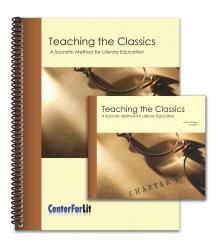
I had the delightful experience of sitting in on a couple of sessions with Adam Andrews a few years ago at our state homeschool convention. I enjoyed listening to Adam then, and was pleased to be given the opportunity by Institute for Excellence in Writing to review his seminar, "Teaching the Classics: A Socratic Method for Literary Education." This is available as a DVD series (4 discs/6 sessions), with an accompanying workbook for the teacher, or upper level student.

Andrew Pudewa introduces the seminar here: 

Adam Andrews is very engaging and animated to listen to, neither dry or boring. He projects a lively interest in the bones of literature, and shows that using the Socratic method is an accessible option for everyone. I LOVE that he starts every writing class (High School and College included) with great books, that just happen to be chosen from the Children's Picture Book section of the library. Good Literature is Good Literature, is Good Literature, regardless of the age for which it is intended. 

You can get a taste of Adam's style, and his reasoning for the importance of teaching the classics in this short (3 minute) clip:


Now that you have a sense of how engaging Adam Andrews is, let me give you a little summary of what you will be listening to for approximately 5 1/2 hours of seminar (Don't worry~ each disc is split into seminar sessions, so 45 minutes-ish for a whole chunk, or you can listen to it in little bits... there is even a helpful DVD guide that includes each section broken down my minutes, so you can find where to skip to if your watching is interrupted).

You can download a sample from the IEW website that includes the table of contents, introduction, and some of the first lesson, as well as a much clearer sample story chart than the one below.

Disc 1
Adam Andrews uses "Paul Revere's Ride" to discuss literary structure (briefly), literary style (devices like onomatopoeia, personification, and symbolism, to name just a few), and historical context and authorship. Wow... It can totally increase the depth of understanding of a work of literature if one knows just a couple of facts about the author and the historical context! I have a new appreciation for "Paul Revere's Ride" now that I've thought about the context! 

Disc 2
Here Adam Andrews delves more into the concept of the Socratic Method v. the Lecture method. Teach your students how to discern the difference between a good book and a bad book. The Socratic Method involves the student, and teaches the student HOW to think, not WHAT to think. 

Adam claims that there are basically 3 kinds of Education:

Education that teaches What to think 
(typical education of the masses, so that they can at least survive)
Education that teaches When to think 
(education for those who want to be specialists-college majors)
Education that teaches How to think 
(historically the education of aristocrats and statesmen)

Socrates professed to know nothing in and of himself, but only knew what questions to ask, which in turn taught his students how to think for themselves. Basically, the Socratic Method is the asking of good, leading questions, and the discussion that ensues.

Thankfully, Adam has provided a Socratic List of 21 basic "general" questions (with sub-questions that start very simply and become gradually more complex) that can be used to guide discussion, as I am often not so good at asking good questions myself. Note: It is recommended that you really only choose a few questions per book to discuss ~ too many would be overkill, killjoy, etc... (And we do NOT want to kill the love of good literature!).

Even just a few questions could be a little painful for some of my children, occasionally, because it is more work to learn how to think for themselves. It is far easier to be told what to think, and possibly to become specialists... ;) I have the suspicion that I have one of the three who will thrive with this particular sort of learning/discussion. He's only 6 right now, so it remains to be seen, but I do plan to incorporate this in his learning where it isn't already included. :) 

This disc then focuses on Plot and Conflict, walking through a story chart with Adam and his audience after Adam reads "The Tale of Peter Rabbit." There is so much interesting information to be gained by watching the seminar~ many little notes to scribble in the workbook! :) Adam then quickly works through some adult literary works, which helps us see how the Socratic Method and Story Charts can be used with much more complex bits of literature.

From there Adam moves on to a discussion of "Setting" using the story "Rikki-tikki-tavi," while still filling out the rest of a Story Chart, in a similar fashion to "Peter Rabbit."

Disc 3:
The sessions on this disc focus on Character (Via "Tom Sawyer") and Theme ("Martin the Cobbler"). Adam goes through a Story Chart during this part of the seminar as well. The more I see of this, the easier it will be to replicate it in my own teaching. Once through certainly wasn't enough for me to have a really good handle on it, myself, so I appreciate the repetition!

Disc 4
This disc contains a Practicum (Interesting concept for an individual watching this DVD course) that was used in the group setting of this seminar. This would be most effectively done with a group, or with your student(s), but is still very useful to watch, and participate on your own, following the directions, choosing questions from the Socratic List in the syllabus to ask about the poem "Casey At the Bat," and filling out a story chart for "Casey At the Bat."

The final section of this disc is a nuts and bolts discussion on how to actually implement the techniques from this seminar in your own home. Adam does a great job of distilling this information in a clear and memorable fashion.

For those who choose to do this with their upper level students, IEW has a free lesson plan download by Jill Pike, that will guide you in using this as a 6 week course, with weekly teacher notes, homework pages, and extra stories to use, in addition to those included in the workbook.

I highly recommend this seminar/workbook for every homeschool teacher. I think it will be especially beneficial for those who don't live anywhere near a homeschool convention,  as well those who lean towards "Classical Education," as well as just about anyone who wants their children to be able to ask the good questions, and be able to discern quality literature from brain candy, even from the very earliest ages.  

Not So Nutty Nitty Gritty 
Please click the banner below to visit the TOS Review Crew and see what others had to say. As always, I hope that this review was useful to you as you choose where best to spend your homeschool budget.
Blessings~


Photobucket

Friday, July 5, 2013

"Firecracker" Finds for July (Including a summer reading program)

I'm back again with some "Firecracker" finds for the month of July. Some of these are good for the whole month, others are current at the time of posting, but prices and/or "Free" status may have changed~ be sure to check the current price.

This month Christian Liberty Press is offering a historical novel (Downloadable e-book)
Lysbeth: A Tale of the Dutch
Teenage and adult readers will be inspired by this historical novel about a Dutch woman who is caught up in the terrors of the Spanish Inquisition during the 1500s. This lively and heart-rending story written by H. Rider Haggard in 1901 continues to remind readers of the value of religious liberty.
Grade: 8th - Adult
Book: 443 pages

Some Nuggets of Gold Kindle Freebies and Deals from Amazon~
(Thank you for shopping through my affiliate links!) 

 Lee Binz's book  College Application Essays: A Primer for Parents (Coffee Break Books) is currently free. This looks like a good read for those who are heading into (Or are already IN) the high school years!


Adventures In Odyssey  Voyage with the Vikings: 1 (AIO Imagination Station Books) is free at the time of posting~ planning to read this one with my newly 6 year old (Downloaded to *his* ipod~ hand-me-down from his big sister, originally mine... at least the kindle app still works on Gen 2! :D).


For the young learner in your home: Trains (Discover Series) My boys would have loved this when they were toddlers, when almost EVERYTHING was "Trains."

Not a "Deal," but related to the train topic~ I have to share one of my favorite train books: Train Song is a lovely, rhythmic read.

OH, and before I forget~ If you haven't joined The Homeschool Buyers Co-Op yet, you might want to consider it. Joining doesn't cost anything, but can save you a bundle AND open up opportunities for purchases that you wouldn't otherwise even think about. I purchased some LEGO Education kits (Simple Machines) through the HSBC years ago, my boys enjoy(ed) learning with familiar, fun materials (with specialty pieces that regular LEGO kits don't offer). Never would have done it without the deal they offered us through the Co-Op. :)

One of my favorite things that they offer is a summer reading program for all school-age kids. Many of the prizes are donated (New and used/good condition books, gift cards, and downloads), with weekly winners, and a grand prize winner at the end of the summer. Check it out!

Blessings~


Disclaimer~ Amazon affiliate links, and Homeschool Buyer Co-Op referral links were voluntarily used in this post. Thank you for clicking through. Small change does add up. :) 

Monday, July 1, 2013

Moving Beyond the Page Units (Tuck Everlasting and "Matter")


Moving Beyond the Page takes Literature, Science, and Social Studies books and leads your children to "move beyond the page," leading them to discover more about the given topic. Members of the TOS Review Crew were given the opportunity to choose 2 units of study from an incredibly wide range of ages and topics. We were given the online version of our literature unit, and the physical materials for our science or social studies unit. I opted for the Tuck Everlasting online- Literature Unit and we went for science with the  Matter Unit.

Moving Beyond the Page can be a full curriculum (With a unit from each discipline coordinating with one another) with the addition of Math, or as a "supplement," where you can pick and choose units by interest (This is the way we chose to use the units).

These units are intended for 10-12 year olds, and since my Middlest hadn't read "Tuck Everlasting" yet, and tends to be interested in matter (Thank you, Minecraft... ) I thought these would be a good fit.

Literature~ The online unit consists of lessons that are accessed online that coordinate with the softcover version of "Tuck Everlasting" that I was sent, along with some printable pdf files:
  • Reading and Questions pages ~ For comprehension and discussion. Each grouping of 3 chapters had only 3 or 4 questions, and I'm afraid these did not really draw my Middlest out~ They tended to run towards the "What do you think about .... ?" and "Why or why not?" which often send both of my oldest children into a blank stare. (sigh)
  • Activity Pages ~ These are mostly well thought out pages that deal with a variety of writing and grammar exercises (Similes, metaphors, parts of speech, etc...) as well as the occasional activity related to the story. My only semi-negative here is that the first lesson includes some grammar parts of speech cards ~ there are symbols for each ~ but they didn't "jive" with either of us, so we just didn't use them. 
  • Handy Guide to Writing ~ Very nice, appropriately titled "Handy Guide." Good to print up and keep in a writing notebook for quick reference. 
Other thoughts on the Literature unit. The student is instructed to create a vocabulary booklet in the first lesson. Because this isn't exactly up my 12 yo's alley, I decided to create a blank booklet based on the one in their diagram~ and unless one already has a  program to create booklets, I thought I should share this new tool I found:  http://www.imposeonline.com

The online lessons are set up so that the student can go through them on their own, with the "Parent overview" turned off, or the parent can use them as lesson plans. My only negative with these, is that you have to be somewhere with wifi in order to access them, as they are truly online, and not downloaded. This was a little bit of an issue with the advent of summer time, and doing more schooling outdoors~  made it difficult for us to access the lessons.

The first page of each lesson has an "introduction" which covers the Stuff You Need, Ideas to Think About, Things to Know, the Skills covered, and introductory Discussion questions for the chapters to be read. This was a different way to do literature, as my kids are used to reading and THEN answering questions, not intro questions before reading. My son wasn't that enamored of it, but it was good to change it up a little.

The second page moves into the activities, with directions that walk the student through each activity for the lesson. This page reads a lot like a teacher's guide, so it depends on your student whether they should go through this independently, or whether you want to use it as a teacher manual yourself. There are links to the specific activity pages, or you can find them in the larger pdf file mentioned above.

The final page in each lesson wraps up the lesson with more questions to discuss and things to review.
 Generally speaking, I think the grade descriptions are more correct than the age descriptions for the literature activities~ while the book was appropriate for my 12 year old  current 7th grader, I felt that the grade suggestion of 5th-6th grade was more precise for the activities.

Science~ Matter Unit 
I was pretty impressed with this package, in that it included a spiral bound curriculum, a book that the curriculum used as a "Text," and a materials kit, so that we'd have everything we needed with the exception of a few household items.

There were some experiments that were new to my Middlest, but I have to admit that many of the projects were ones that we had covered in our more eclectic learning over the past few years. However, we both learned a few things, even if we were just reading about experiments he had already done previously. One of our favorite projects was the very first one, where he split water into Hydrogen and Oxygen.

close up of hydrogen and oxygen bubbles forming 
He also had fun discovering a little more about some of the metals... similarities and individual properties.

From an organization perspective, I found the curriculum to be a little chaotic~ it seemed that we were always flipping from one page to another, rather than having things follow immediately. There was also a lot of flipping around the "Fizz, Bubble & Flash" text. I understood why the curriculum was written that way, but I didn't enjoy that aspect.

One other note about organization~ the "Teacher Notes" are the second half of the spiral-bound curriculum book. I would rather have a separate book, so that the answers aren't at the back of the student book, and I can have the ability to be looking at them while my student is going through his worksheets~ just seems a little awkward to me.

Final thoughts~ I really like the way everything is provided, but I'm less impressed with the way it is put together. The organization isn't quite a deal-breaker for me, but it isn't the easiest thing I've ever used. However, I would suggest reading more reviews, as this is the only science unit I saw, and it is possible that other units are more coordinated with the text.
I do think that if you were considering using "Fizz, Bubble & Flash" then this does go much more in-depth, and turn an 8+ kids book into a more scholarly 10-12 year old book.

Not So Nutty Nitty Gritty 
As I mentioned above, I hope that you will click the banner below to visit the TOS Review Crew and see what others had to say. As always, I hope that this review was useful to you as you choose where best to spend your homeschool budget.
Blessings~


Photobucket

Followers

LinkWithin

Related Posts with Thumbnails