Showing posts with label 2008/2009 Homeschool Year Reviews. Show all posts

Thursday, April 30, 2009

Memoria Press: Famous Men of the Middle Ages/Prima Latina

For those who follow a "Classical" method of schooling, I'm sure that Memoria Press is a familiar name. For the rest of us... it is a name worth becoming acquainted with!

I was sent two sets of products for review. The first, Famous Men of the Middle Ages, meshed quite nicely with our Tapestry of Grace unit on the middle ages. The second, Prima Latina , has been a fun addition as well.


Famous Men of the Middle Ages is a reprinting of the classic text by John Haaren, recommended by Tapestry of Grace as a core read-aloud for all ages in it's Year 2 Unit 1 (Middle Ages). When we started our TOG review, I was happy to find the text online for free at the Baldwin Project, but not so pleased that I had to either read aloud from my desktop or print many pages to bring with me. Imagine my delight when we were informed by Memoria Press that we could choose any of their Famous Men series to review.

How much more enjoyable to be able to bring this book with me outside to read in the front yard, or the back yard, on a blanket in the shade.... not worrying about pages blowing away... OK, I'm a "Book Person"! :) I love the high quality, heavy weight, slick pages, with color illustrations. NICE!

So... I like having the text "in hand". However, we were also sent a Student Guide(Workbook) and Teacher's Guide with 30 lessons, corresponding to the text, for a full year of study(Or less, if you take it at the TOG "pace"). The Teacher's Guide contains the complete student workbook, with answers filled in, as well as tests and a "Final Exam".

Overall thoughts on Famous Men of the Middle Ages:
My children really love hearing about the real people who "made history", so-to-speak. They are much less interested in spreading out the lessons and want me to read a new chapter every day. I actually hear groans when I tell them that we're done for the week! (That's a GOOD thing! Keep 'em thirsting for more!)

The Student Guide is a handy resource to have for the purposes of review, to see if they were really listening, and as something to add to the portfolio for assessment. I think the Teacher's Guide is helpful to have as well, so that Mom (Or Dad) has less work to do. One feature that I appreciated was the set of maps included in the back of the workbook series. It is such a time-saver to have them right there, making geography "Easy" and quick, instead of trying to search out just the right map for each lesson.

Overall, I would say that the Text is fairly appropriate for all ages (With some editing for the youngers, occasionally, depending on their "Sensitivities"... they weren't also called the "Dark Ages" for nothing...), with the student guide being most appropriate for 5th - 8th grade.

In my opinion, these books are very reasonably priced:
The entire set of Text, Student Guide, and Teacher's Guide is currently priced at $39.95 a savings of 25% off the list price for the set($52.85)

You can also purchase each book individually:
Famous Men of the Middle Ages Text $16.95

Famous Men of the Middle Ages Student Guide $17.95
Famous Men of the Middle Ages Teacher Guide w/ key $17.95

Updated photo which includes Instructional DVD and Flashcards
which were not available at the time of this review.
The Prima Latina text set was our second review product, and one that the kids and I thoroughly enjoyed(Well, ok... maybe middlest didn't "Thoroughly" enjoy it, but he was excited to show off some of his Latin vocabulary to his friends in the neighborhood. ;) ).

This set included a Teacher's Manual, Student Guide, and Pronunciation CD. This is the precursor to the highly acclaimed Latina Christiana, so I was again, delighted to be allowed to choose this as a beginning course in Latin for my children. It is most appropriate for 1st(Or advanced K) through 4th grade. It was a "little" slow for my 6th grader, but sometimes I like to "ease" into something new, and since she was already working on Japanese, I figured that simpler was better at this point in time.

Both of my "schooled" children (3rd and 6th) are quick to catch on to how the "Roots" work, and are starting to get the gist of how to figure out a word based on them. I appreciate the amount of review that is built into each lesson, without overwhelming anyone.

Not growing up in a culture that uses Latin, my children are getting a kick out of learning some of the Latin "prayers". We are actually turning them into something along the lines of Gregorian Chant, and even the 22-month-old gets a kick out of
"SancTUS, SancTUS, SancTUS
DomiNUS DeUS SabbaOTH!" (Emphasis mine... ;) )

Oh, they could also be enjoying it because their only other exposure to Latin has been a goofy CD (Grunt~ Pigorian Chant~ by Sandra Boynton) which they have enjoyed BEFORE learning any Latin... so it's a positive, FUN thing for them. :)

Although I spent my high school years singing in choirs with a number of Latin pieces, I found it helpful to have the pronunciation CD to keep my vowels straight. ;) (It's amazing what one forgets.

This is also a good foundation for learning any of the "Romance" languages, and although my daughter has been digging in her heels (Remember... she's learning Japanese, for goodness sake!), this may be an opening to her considering Spanish or French in the future. If not... it's going to come in handy when she takes those SAT's in a few years, with 125 Latin words, and 25 phrases under her belt...it's a good start, anyway, and a solid base for continuing on to Latina Christiana.

Prima Latina is set up in 25 Lessons, with 5 vocabulary words/ lesson, in addition to a "Practical Latin phrase", and one line of a Latin prayer (With each of four prayers being learned over the course).

There is an aspect of grammar taught in each lesson, so if you've been on the slower/gentler boat to grammar, this is a pleasant way to incorporate it into your day. It is also easy to break each lesson up into 4 or 5 sections so that you are doing a SHORT lesson each day, with built in review, and less chance of "burn out". Those Charlotte Mason "Bite sized" chunks are great for retention, and keeping things fresh... Once again, I can truthfully say that oldest asks for Latin each day, and middlest is often eager also.

You can check out samples from the Student book (Lesson I, Lesson XI), the Teachers Manual (Lesson 1 exercises with Answers, and Selected Teacher Pages). If you scroll down the main Prima Latina Page, you will find a number of FAQs and links that should answer a bunch of questions, including whether to start out with Prima Latina, or Latina Christiana.

Once again, I feel that Memoria Press is outstanding in presenting a quality product at a reasonable price:

The set of Teacher and Student Texts and Pronunciation CD is $32.95.
The Student Book and Teacher Manual are available individually for $14.95 each.
The Pronunciation CD is $4.95 separately.
If you'd like to add some flashcards for study, Latina Christiana I's flashcards fit well here ($14.95).

If you just don't have the time to actually "Teach" the course (Although it really *is* possible to do with just 5-10 minutes a day), there is also the option of popping in the Instructional DVD's ($45 for 3 DVD's), and letting Leigh Lowe (The author of Prima Latina) teach your children for you.

You can also purchase all five products as a set for $90.90, if that suits you.

OK, so that nearly sums up my review of Memoria Press. However, I would be remiss if I didn't mention that there is a page filled with articles that are interesting and thought-provoking as well as educational for those of us teaching. You know, the other day some public school teachers, in the course of conversation asked what I do for "professional development", and reading articles like these was one of my answers. ;)

Well... that ends my 2009 TOS Crew Reviews.... Stay Tuned for a "Top Picks" post to follow. I hope that you've enjoyed reading them and found them helpful when deciding where to spend your hard-earned homeschool budget dollars.

Blessings~
Lis

Wednesday, April 22, 2009

Tapestry of Grace The Middle Ages(Year 2 Unit1)

Well.... Tapestry of Grace was by far the largest and most time-consuming product we received to review this year at our house. I was so excited to be able to check it out in person, as I'd heard a lot about it from some local friends, had even downloaded the free 3 week Egyptian sample at one point, but didn't get around to using it, because my oldest is.... shall we say...."squeamish"~ Mummies and the like don't sit well with her.... maybe someday.... (There are actually two 3-week samples that you can try out... Go to Egypt and Sail to the New World)

For the purposes of review, we were asked to choose the year and unit that we wanted to review. I let the kids decide, and they agreed on Year 2, Unit 1, the Middle Ages. We were also allowed to choose one item from the supplemental materials (Evaluations:Tests, Quizzes, etc..., Writing Aids, Map Aids, Pop Quiz audio files and questions, and the Lapbook Disc~ You can learn more about each of these on this page). We chose to use the Lapbook, figuring that it was something both my oldest(6th grade) and middlest (3rd grade) would enjoy.

I understand that Tapestry of Grace has been revised once already, and now there is a new revision, with the Digital Edition. This was the basic edition that the TOS Crew received. With the DE, you download the entire unit, and print only the pages that you need. The folks at TOG have created a great FAQs page for the more techie-minded, and a super Samples page. A nifty new feature on the samples page allows you to preview the interface of the Digital Edition before you go downloading any files. Very cool, in my opinion!

*Please note that if you are a MAC user like myself, there is a little more to downloading and installing than if you are a PC user(1 click vs 3), but we can comfort ourselves in the thought that we get far fewer viruses and trojans! ;) )

Here are what I saw as some pros and cons to the DE:

Pros:
  • Can't get lost... you can always find it again on the TOG website... your license is good for life~ no matter how many times your computer crashes and burns... (EEK!)
  • Doesn't take up tons of bookshelf space: ~ CD cases vs Binders~
  • Immediate download and no shipping charge
  • Print only the pages you need... And... easily print as MANY copies as your family requires
  • Free Periodic Updates automatically make your Digital Edition the most up-to-date version available... for life
Now ~ I've mentioned in other reviews that I have some issues with Digital Editions of things, and this holds true for TOG.

Cons:(If you are like me...)

  • I am someone who likes to flip back and forth through pages *in my hand*, not on a screen
  • I have a toddler who is more jealous of my computer time than of my "book" time.
  • I don't have a laptop, so I am limited to being chained to my desk with a Digital Edition~ which doesn't help when much of my lesson-planning time is done out of house, in the waiting room at Oldest's Irish Step-Dance classes~
  • Visually, sometimes it's difficult to navigate a large document digitally... I guess this ties in with my first "Con" above.
  • No resale allowed, so no recouping of costs, which can be a major factor for some families.
Because of my visual/toddler/desktop issues, the kind folks at TOG sent me a hard copy of the unit I chose, for which I was very grateful.

Well..... WOW! What a LOT of information! It is overwhelming when you first look at it!

There is something that has been termed the TOG FOG, which is what you may feel the first 4 weeks or so, as you are getting used to seeing ALL the information that is here. The reason for the huge amount of data and detail included is that you are holding in your hand(or reading on your screen) not one year's worth or History/Humanities and Social Sciences, but FOUR years, for different ages.

Here is a great page that details the layout of TOG... be sure to click on each successive link, in order to get a feel for the whole program, and what it entails... However, I'm going to copy below one of the most important things for you to know about TOG week-by-week, which should help with that TOG FOG:

What is a week-plan? It’s a plan of study for one typical school week, based on the pace that a high school student must keep in order to cover all of world history, literature, church history, government, philosophy, and arts in a four-year time frame.

Remember, you are the teacher! Tapestry is your tool, not your master. Each week-plan presents a veritable educational buffet of options: reading assignments, activities, questions to answer, writing assignments, and more! What does all this mean? As with any buffet, you simply can’t eat it all. You must customize this curriculum to your unique family. No one student will do all the suggested reading and activities.

OK, so once I got that through my head, life became ever so much easier! No.... I don't have to do it ALL... indeed, I am not intended to do it ALL! Anyone who tries to do it ALL will probably FALL down in a dead faint caused by burnout! Oh, and don't be thrown by that "High school student" comment above... this is written for all grades, but I *do* think it may be the best for those who do have a Jr. High or Sr. High student with younger siblings, because they can all be studying the same era and many of the same people in history, all at the same time, which can ease the burden on mom considerably! :)

Forward ho! On with the curriculum!!

There is included on the website a very helpful section on Setting up Tapestry . I actually copied and pasted each of the First Steps into a word doc, and printed them out so that I could get myself organized. What a great help!

Now that I had myself set up, it was time to check out the book lists for the first week, and see what was available from my library, and free online. If you have difficulty finding the books at the library, this could make TOG significantly more expensive, but I was able to find the "History Core" and main "Read-Aloud" for my ages online at The Baldwin Project. After that I just picked whatever I could check out or ILL from my public Library.

You may ask.... how does our "Buffet" look?
  • Appetizer~ Geography
  • Main Course~ History, with side dishes of Literature, Biographies, and Church History
  • Dessert~ Fine Arts and Activities.
We chose not to partake of the writing thread, based on my children, their ages, and what is already working for them... It's OK to do that! We didn't want to get "Stuffed", or "over eat"! We also ignored the portions for Dialectic(7th-9th grade-sh) and Rhetoric(9th-12th) students, as it wouldn't have tasted very good to my 3rd and 6th graders, and would have been too difficult for them to "chew".

One of the favorite things was the "Main Course", because they just love to listen to stories, and hey, if the stories are true, so much the better (in most cases.... ). To give you an idea of what our weeks looked like, you can get an overview of Year 2 here (Unit One, The Middle Ages, being the first in the list). This page also has NUMEROUS interesting, supporting links (Also found on the LOOM) that will give you a feel for the sorts of things covered.

Another *NOTE ~ Even amongst Christians, different families have different ideas as to what is appropriate for their children to read/hear, and so you may wish to pre-read or at least scan books you aren't familiar with before jumping in feet first. My children are on the "Sensitive" end of things, so what bothers them wouldn't phase another child, but I had to be careful. As a "for instance"... I grew up reading Ali Babba and the 40 Thieves, and some of Sinbad the Sailor, etc... (recommended reading during the Byzantine Empire age), and I don't think I was bothered TOO much, but as an adult, I see them with different eyes, particularly given the recent history of the world. Those are books that I chose not to read. I didn't really feel this was an issue for the curriculum, as I am careful with everything they read, the Bible included... there is "meat" in there that is not fit for "Babes" to chew.

The Lapbook Component definitely added a little zip and zing to our study, and even snuck in some "Writing". I am glad to have this option for those that are more Kinesthetic, or crafty. I've also found that it's great to have something for the children to be "Decorating", coloring, what-have-you when reading, because they actually remember what they HEARD when they LOOK at whatever it was they drew or colored. COOL Connections! There are available complete Lapbook Kits, as well as the digital templates, which is what we received.

The Lapbooks are well organized, with complete directions, and "Schedule". The pages are grouped in "colors" so that you can print them on 5 different colored papers for visual interest, without everything being the same. For instance, the first lapbook component you would print is the geography flap book, but it isn't' first in the group, it is actually the last page in the file, in the "Red" colors. Ther was also some effort put into fitting more than one piece on a page, although not always. I appreciate paper/print efficiency.

Now we get down to the cost. I'm going to stick my neck out here, and say...

Tapestry of Grace can be:
an expensive proposition,
or
highly economical,
depending on your circumstances.

If you are of a "Classical" bent, and have more than one student to educate at a time, and the oldest is in, say, 6th grade, then this may be a no-brainer. You may use the curriculum twice with the older student, and possibly 3 times with the younger, if you cycle through as planned. In that instance, while the initial outlay is higher, you are paying for 5 years worth of curriculum... now it doesn't seem so bad, does it?

What are the actual numbers, you ask?
Digital Edition
Unit by Unit $45 (Trial?) or “payment plan”
Unit by Unit (X4 for the year= $180)
Full Year all at once $170
Bonus Bundle with Extras $250

Print Edition
Unit by Unit $60(Trial?) or “payment plan”
Unit by Unit (X4 for the year= $240)
Full Year all at once $225
Bonus Bundle with Extras $295

So... if we do the math from above, your cost for 2 children (Starting in 6th and 3rd... see, I had to use my own circumstances as the measure here... and I included each student taught as a "year" of curriculum) can be as low as
$170(Digital full year, no extras)/5 years of teaching (That's $34/"year")
or as high as
$295(Print edition bonus bundle)/2 years of teaching ($147.50/ "year")

I guess it's all in how you look at it, and how you can/will use it, no?

If you are interested in more information directly from TOG, there are some free downloads that you can take advantage of, and some materials that they will send to you for the cost of shipping. One that is really cool, regardless of what curriculum you use, is the Map of the Humanities
Map of the Humanities Download
I have to mention here that the support, both technical and otherwise, from the folks at TOG has been wonderful. They are ready to help you out with any questions you may have, and respond in a very timely manner.

My summation:
After a "Breakfast" of Bible, and a "Dinner" at the table of Tapestry of Grace, I feel like my children have been served a "delicious and nutritious meal", and when they get "hungry" for more, well, we have "Snacks" of Math and Language Arts.

For some other opinions, please check out the TOS Crew because the TOS Crew is all about helping you to make informed decisions on which curricula are best for your family.

Blessings~
Lis

Monday, April 20, 2009

Barchowsky Fluent Handwriting (BFH)

Well, let me just start this off by saying that when I was in 7th grade, I was a straight A student.... except for Handwriting, for which I regularly received C's.... so I have a little "angst" when it comes to teaching my children "penmanship". Because of this, I have been pleased to be able to use and review a couple of the Barchowsky Fluent Handwriting products in our home.

Barchowsky Fluent Handwriting manual with CD ($65.95) for all ages is the first one up for review.

The manual is spiral/Flexibound, allowing it to lay flat, AND keep the "Coils" neat.... Marvelous!
As a MAC user, I was delighted to see that there is a CD for PC's, and one for MAC's.

You can check out the table of contents and some samples from the manual as well as the CD-Rom at the link above, but I'll quickly list the table of contents for you here:
  1. How to Use This Program
  2. Posture, Pen Hold, and Paper Position
  3. Exercise Patterns, Related Letters, and Practice Words
  4. Reference for Lowercase Alphabet
  5. Reference for Capital Alphabet
  6. Reference for Numerals
  7. Joining Letters
  8. Missteps and Myths(Remediation helps)
  9. Practice Words and Sentences.
One of the benefits of this program was also one of the greater challenges for me, personally. That is, there is no scope and sequence, no "precise" progression of pages to "Teach", no set procedure. It is to be used as an individualized program, meeting each person where they need help. This means that as the teacher, I have to figure out which worksheets to use. I think my difficulty with this was indicative of how my brain processes things~ I have a hard time with "Teacher manuals" that are in digital format, where I can only see one page at a time. I prefer to have a hard copy in hand and be able to flip back and forth, however, the CD-Rom doesn't take up any space on my overflowing bookshelves.... (Ah... the pros and cons, the joys and struggles with Digital Media!)

OK, now that I have "that" out of the way... I have to say, I am impressed with the thoroughness of this program, and also the "Tone" that is taken. The goal is to create legible handwriting, starting wherever the student is "at", and if it doesn't look precisely like the exemplars(A page for students to trace, copy or use as a reference is known as an exemplar. From the BHF Glossary at the back of the manual)... that's OK. There is an understanding that people DO personalize their handwriting in the real world, and that everyone's handwriting needn't be a carbon copy... it just needs to be legible! :)

The CD-Rom contains lessons, suggestions for instruction, and video demonstrations, as well as numerous exemplars that you can print at will. The files are split into Levels 1-4, with 1 being more for younger students, and 4 for older. This does help a little with the "Where do I start" question, and provide a little bit of "direction". :)

Many of the pages are customizable, just note that you have to save them to your computer in order to print them. It is nice to be able to create "Copywork" for your children based on what they are interested in or are learning.

Tip: If you want to save on "practice sheet" printing costs, you could print each one that you need once, and use glossy sheet protectors to create a binder of write on/wipe off pages to use with a dry erase marker. Another Crew member mentioned laminating the pages as an option.... Thanks, Sheri! There are some sheets that would be adaptable to this concept, particularly in the lower levels.

To sum up~ I feel that this program is filled with many "helps" to cause legible handwriting to break out in my home, and that's a good thing! There is enough variety in the "Exemplars" to help keep my children's attention, and that's a good thing! And... I don't have to try to teach Palmer Penmanship(my apologies to the "Traditionalists" among us), and that's a good thing! :)

The second program that I received to review was Fix It... Write ($17.95)

This program is for the older student/adult who wishes to remediate their handwriting with regards to speed and legibility.
TheManual comes Three-Hole-Punched, ready for use in a binder. This way the lined practice sheets are easy to remove and copy for individual use.

Given my issues with digital formats, this manual was a relief for me! I could hand it to oldest and just have her follow through with the numbered lessons. However, if I see something that needs more work, I can hunt through the BHF CD-Rom, and print up applicable worksheets for her.
  • Part One of the manual(just a few pages) addresses problems common to handwriting, which is great for figuring out what ISN'T working.
  • Part Two is split into three sections to help fix those problems:
  • The Groundwork~ Days 1-3
  • Print-Script to Cursive with Italic features~ Days 4-18 (For learning Barchowsky Fluent Handwriting)
  • Conventional Cursive~ Days 4-15(Alternative for remediating the cursive one learned)
In short, with daily practice, handwriting can improve! Oldest is using this program(Albeit on a modified time schedule) and is progressing into a more legible hand, and that is a good thing!

Oh, and if you have a beginning writer, you may want to check out The Beginner's Handwriting with Teacher's Guide ($29.95), so that you can introduce them to writing the BFH way from teh start!

Check out what other crew members had to say about BFH, and let me know what you think!
Happy Handwriting!
Lis

Thursday, April 9, 2009

Apologia Science Exploring Creation with Zoology I (Flying Creatures of the Fifth Day) AND General Science

Apologia Science~

The name that seems to be synonymous with the study of science from a Christian worldview, you hear it a lot in Christian Schooling circles (Home or Private...), but what does it mean? Here's a definition from their website:

Apologia ~ What Does It Mean?
It appears eight times in the New Testament, in the context of people defending their faith or actions by reason and logic.

"But sanctify Christ as Lord in your hearts, always being ready to make a defense to everyone who asks you to give an account for the hope that is in you..." 1 Peter 3:15

Apologia Ministries exists to give the home-schooled student a scientific education that will help him or her make a reasoned defense of the Christian Faith.

In light of this, I felt so blessed to receive two curriculum to review that would help to prepare my children to give logical arguments for their faith using science to back up the Bible:

Exploring Creation with Zoology 1: Flying Creatures of the Fifth Day ~ Elementary Science designed for ages K-6, by Jeannie Fulbright ($35 Hardcover Textbook)

The book is broken down into 14 lessons, with the intent that the student takes 2 weeks to complete a lesson. This could move at different rates, depending on the age and ability of your child. You can find a table of contents, course overview and sample module in pdf form at the link posted above.

OK, so other than the Christian worldview, what makes this Science text different from others?

  • It is written directly to the student, in conversational style, directly engaging their minds.
  • Questions are in narration form rather than "fill in the blank/multiple choice".
  • "Notebooking" is recommended as a way of recording what was learned.
  • Fun and interesting projects and experiments (With readily available materials) finish up each lesson.
  • An optional course website is available with a link to a KnowledgeBase (questions that other students have asked and the answers that Dr. Wile has given), General links for the whole course, and many links for each chapter, for those who are interested in digging deeper. There are also blank notebook pages and Scientific Speculation Sheets, to make it easier for the student to order their thoughts.
  • The Author (Jennie Fulbright) has her own yahoo group where one can discuss all things related to these books or the scientific concepts found in these book. Help with notebooking, projects and experiments is available through this group, as well as many different schedules, tests and other materials created by homeschool moms. (Show me a public school science text with ONE author, who is willing to invest time in the students using the text!)
So... what are my thoughts on this curriculum?

  • Well... Mom likes it because I don't have to "Teach" the text... it teaches itself. and as a "help", there are answers to the narrative questions for each chapter at the back of the book.
  • Middlest likes it because it is easy to read and understand, and he likes the experiments and projects. He does admit that "notebooking" isn't his favorite thing, but we discovered that there are many resources* available for "lapbooking" these books in particular, which he prefers because the writing tends to be in smaller bites.
  • Another "mom like": It is already turning middlest into an Apologist... he's sharing some of what he is learning with his public schooled friends. COOL!
  • It is fun! Quick story: we were out on our Nature Scavenger Hunt when some neighborhood boys greeted us, and then asked us what we were selling. We didn't know what they were talking about, so they asked us again, this time referencing the clipboards with the scavenger hunt papers on them. "Oh! We're doing some schoolwork. Have you ever had to do a Nature Scavenger hunt?" Their replies... "No! Oh, that's right... you're homeschooled... Lucky!" ;)
  • Oldest enjoys hanging around and participating in the activities and projects, but she didn't do the narration and notebooking/lapbooking because she tested the other curriculum we recieved...

Exploring Creation With General Science 2nd edition Two-Book set~ This course is designed to be a student's first systematic introduction to the sciences, and is optimally designed for 7th or 8th graders, but as with all things, can go up or down a year depending on the child's interests and abilities. For a college-minded course of study, 7th grade is recommended. This course is written by Dr. Jay Wile and the set retails for $85.

The text book is split into 16 modules. Most modules contain an average of 3 experiments, although one has no experiments and a few have 5. The experiments utilize readily available household items making them easy to prepare for, but don't let this fool you. There are a number of "WOW!" experiments... this is not dull!

  • Similar to the Elementary Texts, it is written directly to the student.
  • There are suggestions for the student on how to "pace" themselves through the course.
  • "On Your Own" questions are scattered throughout each module.
  • A "Study Guide" Review is found at the end of each module, containing questions to help cement the material learned in the student's head. ;)
  • The companion "Solutions and Tests" manual contains the answers to the Study Guide questions for each module, as well as the answers to the Module Summaries (Appendix B in the textbook), the Tests and Answers for each module, and 4 Quarterly Tests and Solutions. There are also guidelines and a "point system" for grading the tests.
  • Like the Elementary Texts, there is a website for further study, news, and resources as "Extras".
I will mention once again that there are numerous online resources* (search YAHOO for "Apologia Science" groups, for example) which may make the course "come alive" even more for your hand-on Learner.

In addition, Apologia offers a Multimedia CD-Rom ($15), which is referenced in the text, an audio CD ($15) that narrates the text for the auditory learner, or learner who has some other difficulty with reading, and finally, there is FULL Course CD-Rom ($65) that includes the entire text, experiments, tests, etc, as well as the multimedia add-ons. This could be a good option for those who enjoy "Schooling" at the computer rather than with a hard copy book.

Now, I will admit that I don't have a great deal of experience with any other science "curriculums", but we have found Apologia to be interesting and easy to use. I appreciate that Apoligia has, at it's central "Core", a deep understanding and desire to communicate the truth of the Creator to students, so that they can in their turn make a logical defense of their faith in the intelligent design of a loving Creator God.

*Optional resources~
Knowledgebox Quest Lapbook and Journals for Elementary and High School (Some free samples to download, including the complete 1st Module for General Science)
Live and Learn Press Learn-N-Folder Notebooks for Elementary and some high school

I hope you check them out if you haven't yet, and let me know what you think! Oh, and if you want to read some other reviews, check out the TOS Crew ....
Blessings~
Lis

Friday, April 3, 2009

TruthQuest History~ American History for Young Students III

TruthQuest History~ What's that???

A QUEST for TRUTH in the study of history?
How does one find TRUTH in the past?

The typical frame of mind and worldview that public/secular schooling presents is that history is just events, and the dates, places and people related to those events. Michelle Miller would like to take that view of history and turn it on its head! She has put together a history program framework that looks at the BIG PICTURE using "binocular" lenses that focus on two "Big Beliefs" or main questions. Your answers to those two questions will color everything that you think and believe about the past, present and future, and indeed will shape the "history" of YOUR life.

The two Big Beliefs have been around for millenia~
Who is God?
Who is Man?

You will find, succinctly distilled, that a secular worldview and a Judeo-Christian worldview will see history through very different-colored lenses.
  • The secular worldview will see events as being orchestrated solely by man, because in the secular worldview, MAN is the driving force on earth.
  • The Judeo-Christian worldview sees God as the driving, indeed the CREATING force on the Earth, and that the study of history is actually the study of HIS-Story.

Understanding a little more about the philosophy of TruthQuest, let me give you a bit more detail about the program that I received for review. I asked for any one of the three American History Volumes for Young Students (Best for grades 1-5), and was sent Volume III, which covers the years of Reconstruction following the Civil War (1865) to pretty much the present (2000).

The introduction is written directly to the student, and each segment has a "Commentary" (written in bold type) written directly to the student. The bulk of the pages, however, are lists of books with age recommendations and some comments, depending on whether Michelle has personally read the books or not. (In this updated volume, she included current books that she hasn't read, at the request of many parents, so it is wise to pre-read most selections if you are assigning independent reading. Otherwise you can just edit as needed while reading.)

So... the concept is to read the commentary, which poses a question, or creates an inquiring thought process, and only then proceed to reading the literature recommended. Michelle has listed EVER so many books, that you are not likely to be able to read even half of them. She has given this plethora of choices so that you will have better success in finding books at the library that apply to each era. The books are rated according to independent reading level (Not read-aloud level).

This is a slightly different approach than I have used in the past. The other histories that we have done have had fairly closely scripted teacher's manuals, or at the very least, questions and topics to discuss. In TruthQuest, the topics to discuss tend to be indirectly referenced in the commentary, and it is up to you and your students to add them to your reading. An interesting way to help create curious, questioning, thoughtful children. I found TruthQuest for Young Students to be a great resource of historically arranged living books, that can be used as a framework for your chronological study of history, OR as a resource for you to pull reading selections from for whatever portion of history you are currently studying. Those applying a Charlotte Mason, Classical or Unit study approach will be most comfortable using these guides.

For more reviews, and particularly reviews of some of the older study guides(for 5-12th grade), which I understand include commentary of much greater depth, as well as deeper topics in general, be sure to check out the TOS Crew Reviews

The guides available for Young Students, Grades 1-5 are:
American Hist I (Exploration - 1800) ($24.95)
American Hist II (1800-1865) ($24.95)
American Hist III (1865-2000) ($29.95)

The Guides available for Older Students, Grades 5-12 are:
Ancient Egypt/Ancient Greece ($24.95)
Ancient Rome ($24.95)
Middle Ages (500-1400) ($24.95)
Renaissance Reformation Exploration (1400-1600) ($24.95)
Age of Revolution 1 (1600-1800) ($29.95)
Age of Revolution II (1800-1865) ($29.95)
Age of Revolution III (1865-2000) ($34.95)

If you click through to any of these pages you will be able to download the applicable table of contents, and a sample section of the guide to peruse and see if this will be a resource that you would like to use.

Let me know what you think!
Blessings~
Lis

Tuesday, March 31, 2009

Schleich Plastic Animals/Action Figures

Well, I can easily say that this particular package was one of the most anticipated, and most joyously greeted review products by my children.... after all, who doesn't love getting toys in the mail? We received from the wildlife selection:
Lioness, walking Lion cub Meerkat, standing
a lioness .....................a lion cub................ and a Meerkat

and from the more domestic selection :
Holstein Cow Sheep standing Lipizzaner Mare
a holstein cow....................a sheep......... and a lipizzaner mare

The selection I received range in price from $2.49 for the lion cub to $6.49 for the Lipizzaner Mare. (Click on the pictures to be brought to individual product pages and descriptions)

I don't know how familiar you are with Schleich plastic animals, or action figures, so let me share a little bit with you.

I want to preface my review with a couple of comments. We started out 11 year-old's "plastic animal" collection when she was a wee child of one, when we purchased a zoo membership. Her animals came with us everywhere, and were a great source of imaginative play, and even engineering, as we learned to stack them, like the Bremen Town Musicians. ;) Now, 10+ years later, her collection is housed in a largish plastic container, and while it no longer goes "Everywhere" with us, it does make appearances at friends' homes, and often come out for play when we have visitors. I will also mention that "plastic animals" frequently show up on both the 8 year old and 11 year old Birthday and Christmas "Wish lists".

OK, that's all well and good, but now you may like to know just exactly WHY plastic animals and Schleich animals in particular, found their way into a homeschooling review, right?

Well, here's my take on it.

CREATIVITY: My children love animals, stories about animals, facts about animals, videos that feature animals, and so on. So, it is no surprise that they enjoy using their imaginations, creating their own stories and plays with their creatures.
NARRATION: They can be found re-telling the stories that we have read together, or that they are reading.
SCIENCE~ Classification: If the collection is large enough, they can be set up in in sets of Family, Genus and Species... much more fun than classifying pictures on paper.... ;)
~ Contrasting and Comparing features within a family
ART: what great models to draw from! I can tell you that one of Schleich products' main features is their realistic modeling of the animals , and the detailed hand-painting of the figures.

In addition, the animals are manufactured to strict safety standards (Which is important with a sometimes "mouthy" toddler in the house), and are very sturdy. They have a great feel and "heft" in the hand.

What a fun way to learn more about the natural world that God created, by bringing some of these realistic figures into your home!

Schleich also carries action figures from the worlds of Knights(great for medieval studies), the American Frontier, Dinosaurs, Sea life, and for those who enjoy Tolkein and CS Lewis, figures from the worlds of Fantasy and Elves.


I hope you check them out... they get a big thumbs up from *my* family! You can read what othr TOS Crew members had to say as well...

Blessings~
Lis

Generations of Virtue

In today's world of excess and "anything goes", it is a delight to find a company like Generations of Virtue, whose motto is "Purity of Heart, Purity of Mind, Purity of Body".

Generations of Virtue has a mission to make available God-honoring, Bible-based tools for parents, teenagers, and pre-teens, specifically, to help build up and maintain pure hearts, minds and bodies, which can be challenging in the current culture.

As the mother of a pre-teen girl, I was blessed to receive for review the three-book set "Beautifully Made". ($18.99)

Book 1~ Approaching Womanhood~ is written to the pre-teen (recommended ages 8-12) whose body may just be starting to change. It covers the various signs of maturing physically, and how to care for that changing body in a gentle but straight-forward mannner.

Book 2~ Celebrating Womanhood~ is also written directly to the pre-teen/teenage daughter, to be shared with her when she crosses sthe milestone between girlhood and young woman. It covers monthly cycles and how to deal with them in more detail, with a few appropriate line drawn illustrations. There is a section on symbolism which, depending on the individual may be extremely encouraging, or not, so I suggest that mom's pre-read and decide if this section will be helpful or muddy the waters for your particular child. Towards the end of the book there are a couple of pages that talk about natural helps for some typical, cyclical discomforts, which I found useful.

Book 3~ Wisdom from a Woman- Mother's Guide~ is written directly to moms. Communication is a key theme, with the key word (For me anyway) being CHANGE~
Physical predictors of CHANGE
ideas for Celebrating CHANGE
Dealing with CHANGING moods
The biology of CHANGE (And those moods...)
and finally, some "Tips for Moms"

These little books are all short, quick reads. They don't beat the topic to death, or go into any more detail than necessary. They form a gentle but practical foundation for dealing with one of those "Facts of Life", prepared by someone who shares similar values, and the same Biblical worldview. Thank you, Generations of Virtue for supplying this much-needed resource for today's moms and daughters, so that we can have respectful, caring, practical conversations about growing into the young ladies God intends our daughters to be.

For more reviews, including other Generations of Virtues products, please check out what other TOS Crew members had to say.

Sunday, March 29, 2009

A Spelling Software Option for you....

Hey, all~

If you have a student that enjoys working on the computer for review and quizzes, and needs help with spelling, you may want to check out Spellquizzer software.

I didn't review this software, as I am totally on a MAC, and it isn't compatible, but many others on the TOS Crew *did* have the opportunity to try and review it, so please feel free to hop on over, and check their reviews out...

Let me know what you think... ;)

Blessings~
Lis

Monday, March 16, 2009

Home School in the Woods - New Testament Activity-Pak

Have you heard of Home School in the Woods ? Well, I had heard of them, and even downloaded a sample pack at some point, but as is sometimes the case with a "sample", I didn't "get to it".

Well, I am very pleased that through the TOS Crew, I *did* "get to" their complete New Testament Activity-Pak ! (BTW, Pak is not misspelled... it is for Amy Pak, the brains and the artistic hands behind the beautiful, vintage-style graphics in all of the Home School in the Woods products)

I have been greatly pleased with the "hands-on" opportunity to help some major points of the New Testament "stick" in my kids' heads. The combination of the scripture on the graphics, coloring them in, cutting them out, and putting each component together is great for all types of learners.

Now, I have to be sure to mention that there are no "lesson plans" included in this Activity Pak, so you may want to use them piece by piece as each project comes up in your Bible Study. OR you could choose to focus on the Pak as a whole, and do a unit study on the New Testament, covering those portions highlighted in the Pak. Particular pieces lend themselves well to helping with scripture memorization. (The Beatitudes strikes me as one...) This Pak is also great for those who study their history in a "classical" fashion~ Just add them into your study of that time period!

The topics covered in the New Testament Activity Pak are:
  • The Lineage from David to Jesus
  • The Birth of Jesus Christ
  • Miracles of Jesus
  • The Beatitudes
  • Fruit of the Spirit
  • The Parables of Jesus
  • The Last Supper
  • The Crucifixion
  • The Resurrection
  • The Ascension
  • Pentecost
  • Prophesies Fulfilled
  • The Twelve Disciples
  • Paul's Missionary Journeys
  • Postcards from Paul
  • A Newspaper Project (The New Testament News), which is a great Creative Writing Project
  • And an Armor of Salvation Poster project.
It is interesting to note how the brain works. My oldest was coloring the pictures for the Beatitudes "pizza book" while I was reading aloud to her and my middlest. Even a week or two later, looking at the book, she remembers what I was reading about when she was coloring. (Note to self... the time-line figures would be better options for her to color, when I'm reading history!) ;)

Oh, and about that "Pizza book", the directions are a little tricky, if you haven't done much "minit" book making, or lapbooking. We didn't have too much trouble, but part of that is because I had already checked out the "Pizza Book Kit" from Tobin's Lab that The Old Schoolhouse is offering in their freebie directory . While you are scrolling down to find the Tobin's Lab be sure to check out the Mini Authors Activity-Pak from Homeschool in the Woods! That will certainly give you a feel for the quality that you can expect from Amy Pak!

The New Testament Activity-Pak is available for immediate download for $18.95, or you can order it on CD for $19.95. There are two other Activity-Paks available, one for the Old Testament, and an Artists Activity-Pak that I can see would keep us busy for quite some time! :)

The ages recommended for these Paks are 3rd-8th grade. I would caution that some projects are better for younger, and some will be a bit more challenging for the olders. Depending on your children, and their ages, your help *may* be required for "construction" purposes. ;) They will ALL be beautiful, though!

Now, I hope you will visit some of my fellow TOS crew mates and their blogs~ some of them have some really wonderful pictures of their kids' work on this Pak (my digital camera woes are many, so I have no photos...). If you only have time to visit one, hop on over to Susan's Blog~ because Susan already owned the New Testament Activity-Pak, Amy Pak kindly agreed to let her bless someone with a give-away-drawing on her blog for the same.(The drawing ends on April 3rd... better hope that baby is either early or late, Susan!)

Blessings~
Lis

Wednesday, March 11, 2009

One 2 Believe Noah's Ark set

Well, the good folks at One 2 Believe have sent us another playset to review and, well.... to play with!

You may recall the Nativity set that I mentioned back in November??? This time we were sent a Noah's Ark playset.

Let me give you my observations, and then I'll do another comparison for you:

The Ark is made of a rather thin but sturdy plastic that stands up to play fairly well. It took a little while to figure out that the deck is removable, and adult assistance is still occasionally requested, but that is a bonus in my mind... the animals are easily stowed below, and that way, when toddler-boy starts moving things around, they don't all get dumped, which is what happens with some other toys that we have...

I have heard that it floats well, but we haven't actually tested this aspect of play out... we'll probably wait for summer and toddler splashing pool to dunk the critters.

I have to say that the timing of this playset coming was good, with a toddler underfoot, and schooling going on, especially as he is beginning to "pretend play" with things more now. He is still fond of sheep, by the way... :) Oh, did I mention that the figures are "designed to fit perfectly in a young child's hand"? The carting of the sheep makes me concur with that statement!

So what all is included with this set?
The ark and Noah and 7 pairs of animals:
Camels
Donkeys
Sheep
Elephants
Lions
Monkeys
Ostriches (I have to note, middlest son used these ostriches for his models when making his Noah's Ark "Car" for AWANA's car night... so~ another use~ artistic "model"... ;) )

Included with the set is a booklet that tells the story of Noah and the flood, along with "Spiritual Stepping Stones" which can also be accessed in the free resources section of the One2Believe website. This talks about the general ages and stages of spiritual concepts; what most children can and/or are ready to understand, and when.

Now for those comparisons:

One2believe
Friendly characteristics
Mostly not chokeable (3+)(Noah's staff is removable, and definitely a chokable item)
Immoveable parts
Expandable play with other sets
$30($29.99 to be precise) for ark, Noah and 7 pairs of animals
Self contained storage that stays shut!

FisherPrice
Cute
Not chokeable (1+)
Immoveable parts
Expandable play with other sets
$38.75 for ark, Noah and 3 sets of animals. If you want to add on other "ark" animals, it will cost between $20 and $45 more to bring the total number of animals up to 7 pairs, and the total cost up to $83.73

Playmobil
Typical playmobil
Choking hazard!!! (3+ and intended for 4-10 year olds)
Movable parts including a crane
Expandable play with other sets
$90 for ark, noah and his wife, 13 pairs of animals, and typical playmobil accessories

I know that I mentioned this in the nativity review as well, but I think it is worth repeating:
Here’s one more thing to consider when making your purchase… I haven’t checked out what “charities” Playmobil and Fisher Price support, but one2believe supports many ministries in both the United States and abroad including Hero Antigua, Samaritans Purse, Focus on the Family, FamilyLife and local Southern California ministries. If you want your money to go further than the corporation, one2believe might be a good choice for you!

If you want to read some more reviews, be sure to stop by the TOS CREW Blog
Blessings~
Lis

Thursday, March 5, 2009

ARTistic Pursuits (K-3 Book2) and (Jr. High Bk1)

What a blessing to be able to review these two books from the ARTistic Pursuits art program. We are an art lovin' family, and this has been great fun!

I'll give you some pros and cons, and then my summary.

Pros:
  • Art Programs directed specifically towards the Homeschooled Student, whether for individual instruction or classroom "Co-op" instruction.
  • Interesting text, and color photos of great artwork directly in the manuals... no need to go "Searching" for work by a particular artist. It's all there!
  • Methodical lessons that build on one another.
  • Art Supplies are easy to buy, bundled, directly from ARTistic Pursuits, or two other discount art supply sites. You can add the "bundle" to your cart, and delete those items you already own. EASY!
Cons:
  • Initial cost: Approximately $43/ book and $30-$50 per book if you need to buy ALL of your art supplies. However, if you break this down into 32 weekly lessons, it averages out to a little over $3/week, so not really all that bad! AND with each successive volume, you will already have purchased some of the supplies, so the cost should go down....

Now for a summary discussion of each book

Grade K-3 Book 2 Stories of Artists and Their Art covers Gothic, Renaissance, and Academy Art of the 18th Century. This fit in very well with our current History study of the Middle Ages! What Providence!

I like the way Brenda Ellis (the author/publisher) has created fictional stories about the artists in their youth, to give the children a "Connection" with the past. She also highlights terms that one may run across in the study of Art History. It is never to early to start building that core of knowledge, and she does so in a very gentle and gradual manner. I mentioned in my "pros" that the artwork of the masters is right there in the manual, and there are observation/discussion questions as well.

Two of the projects my son did were using "gold leaf" (Foil chocolate wrappers!) and watercolor, and oil pastel "Scratch Art. We are doing a "Fresco" on plaster-coated cardboard next. The results have been delightful, and enjoyed by all!

You can see samples from this book and others in the series on the ARTistic Pursuits website.

Junior High Book 1 The Elements of Art and Composition featuring World Art.

This book is also set up well, and is written directly to the student, eliminating the necessity of "Teacher Preparation and Lecture". Each Unit has four distinct lessons (Set apart with gold type, so easy for the student to see, and know what needs to be done) covering:
Building a Visual Vocabulary
Art Appreciation and Art History
Techniques
Application (A final project for the unit)

Another thing I like about the lessons being written directly to the student is that it gives my older student something to do that is interesting AND allows me to do something, either with my 8 year old, OR my toddler(like get him down for a nap!!)

You can see samples from this book here.

Other offerings include
Grades K-2(Featuring art from the Ancients through Modern)
  • Volume 1: An introduction to the Visual Arts
  • Volume 2:Stories of Artists and Their Art
  • Volume 3: Modern Painting and Sculpture
Grades 4-6(Featuring American Art)
  • Book 1: The Elements of Art and Composition
  • Book 2:Color and Compostion
Junior High(Featuring World Art)
  • Book 1: The Elements of Art and Composition
  • Book 2:Color and Compostion
Senior High(Featuring European Art)
  • Book 1: The Elements of Art and Composition
  • Book 2:Color and Compostion

There is an excellent set of FAQs on the website, which includes a discussion about why all three series, from Gr. 4-Sr. High school are useful, and that covering what "looks like the same material" isn't REALLY the same. If you are familiar with the Classical approach, you will recognize this concept.

Don't forget to check out other crew members' reviews on a variety of the manuals available and their experiences with ARTistic Pursuits.

One final note:
I was so pleased with the classic art pieces chosen to go along with these books. I have been disappointed innumerable times with "Children's Art Books" that include "art" which my 11 year old is quick to term "inappropriate". I have wondered, with SO many possible pieces of art, WHY those paintings, sculptures , and drawings with nudity or questionable themes have been chosen for CHILDREN'S viewing(I mean.. really... Michaelangelo was fairly prolific!). Just doesn't make sense to me. Thank you, Brenda, for creating an art program that includes art history and appreciation with pictures/manuals that I am not afraid to let my children peruse on their own.

Till next time~
Lis

Wednesday, March 4, 2009

Math Mammoth Golden 6-B, Light Blue Grade 2

We were recently given the opportunity to review a couple of products from Maria Miller's Math Mammoth Worksheets and Mathtexts~
Golden Series 6-B, and Light Blue Complete Grade 2

Golden Series 6-B, a series of worksheets which covers operations that may typically be learned in 6th grade:
- Geometry
- Integers and coordinate system
- Equations
- Ratio and percent
- Probability
- Statistics
These worksheets were originally intended to be used for tutoring students who were having trouble with their math, and needed extra help. As such, they are not complete work-texts, and do not have instruction. They are simply worksheets that enable the student to do extra work on a given subject, with some material presented differently. We are able to use them for extra practice on a few portions of intergers and coordinate systems, and ratio and percent, but realized that there were some things that our normal math program hadn't yet covered, and since the sheets don't give instruction, we will be saving them until needed. You can see some Sample pages if you scroll down... on the right hand side of the screen, to see if these are a good fit for you.

I think that these could be very helpful for those who have children that need a little extra practice, and are extremely cost effective, especially if you are planning to use them for more than one child, as they are "non-consumable", meaning you can print as many worksheets as you need for your household. (Remember how much those "workbooks" at Staples, Walmart, Teacher stores cost? These really are a deal, if they are what you are looking for!)

These will not be a great fit for you, or a necessary purchase if your child is a whiz at math, and doesn't need extra practice, UNLESS your child loves math so much that they beg to have extra problems... in which case... go for it! :)

The cost is very reasonable:
Golden 6B is 78 pages Golden 6A is 85 pages
(73 worksheets) (78 worksheets)
Price: $8.00 PDF download Price: $8.50 PDF download
Answer key $2 Answer key $2

OR you can purchase both 6A and B plus both answer keys in a package for $14.50

Light Blue Grade 2 Complete Curriculum was the series my 8 year old is reviewing/using.
Unlike the Golden series, the Light Blue series is packaged as a complete curriculum, with
instructions and sample problems throughout.

From the Website:

The two books for grade 2 focus on

  • memorizing the basic addition and subtraction facts with single-digit numbers
  • developing fluency with multidigit addition and subtraction
  • place value with 3-digit numbers.
Also included is introduction to multiplication concept, measuring and geometry topics, clock reading and money (US, Euro, or Canadian). Please see the table of contents for 2-A and 2-B for complete lesson lists.

The worksheets are very interesting, because they focus on teaching practical math, using some different methods, and puzzles, in addition to some general "Drilling" of the math facts. There are also word problems used throughout the lessons, which help children understand the "how" and the "why" of their math operations.
Samples for 2A, Samples for 2B

One thing I appreciated were the suggested links included in the text, for online resources. There is a plethora of free resources available and listed for almost every topic. Great for extra practice, review, and I just LOVE "homework" that feels like a game! :)

I have to say that some of the methods of finding the answers were confusing to my son(He is used to "completing 10" in a slightly different way than is used in portions of Math Mammoth) but that is the blessing of showing the work in different ways... you can figure out what "works" and makes sense for your child. For instance I don't remember ever learning "Number Rainbows", but thought they were an interesting concept, and may be easier for some children to use than a number line. You can see Number Rainbows here at Maria Miller's Math Blog.

All in all, I would say that this is a good, solid 2nd grade math program. Oh, I also need to mention that Math Mammoth uses a topical approach rather than the popular spiral approach to mathematics, so you may be interested to see how that works for your child.
Prices:
Part A alone: $15.50
Part B alone: $15.50
A & B $29.70

The prices I listed for both Series are for PDF downloads. You can find Math Mammoth E-products at The Math Mammoth Kagi Store, or Currclick,

If you would like CD and/or printed worktexts for the light blue series, you can find them at WinterPromise for $32 for the CD only, and $52 for the Cd AND printed Worktext.

You can purchase books from more series at prices ranging between $8.40 and $21.95, with the option to purchase some books in Spanish, also.

If you aren't happy with your current Math program, you may want to check this out, and see if Math Mammoth will work for you. At these prices, it isn't cost-prohibitive to "sample" and see.

Blessings~
Lis

Sunday, March 1, 2009

Five In A Row(FIAR) Volume 3


Mostly FIAR-related activity photos Fun stuff! 
This is one review that I am *extremely* pleased to be able to write, as this has been my core curriculum of choice since 2002. Yes... that's right, ever since my oldest was in Kindergarten, we have been "Rowing" with Jane Claire Lambert and Five In A Row.

It has boggled my mind over and over when I have heard people say things like "oh yes, I used that for Kindergarten", or maybe even "Kindergarten and 1st grade....But we've moved on."

Whoa!
Let me tell you a little bit about the concept, and then I'll tell you what we love, and why we've used it for more or less 1st -4th grade, moving into Beyond FIAR for 5-7th grade.


FIAR is, once again, a combination of things I love, good stories, beautiful artwork, and unit studies. Jane Claire Lambert, a homeschooling veteran of 17 years, searched out gems in the picture book world of literature, and pulled together unit studies utilizing those books as the core of her curriculum. Her style of teaching/learning is called "Conversational learning/teaching", a very gentle method of educating that really does "stick".

The basic concept of Five In a Row is that the story is read five days in a row. Each day you can pull something different from the story~ Geography, Social Studies/History, Science, Language Arts, Fine Arts, and even a little bit of Applied Math(But not enough for a complete math program... that subject must be supplemented, as well as phonics). Then, when you read the story each day, whether you comment on the previous day's "lesson" or not, your child is most likely "reviewing" in their head!

click to purchase on Amazon *affiliate link
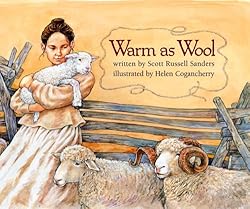
Day 1 you read a story(We'll use Warm as Wool by Scott Russell Sanders as our example), being sure to include the author and illustrator in your reading. Then you talk about the location of the story, in this case, the main character's family moves from Connecticut to Ohio. So you pull out a map and find Connecticut, then trace the way to Ohio.

sample Story disc
From Angelo, Vol 4
You can use the "Story Discs" (found in the back of the manual) which have representative drawings for each book to make a literature map... coloring the disc, putting the name of the story on the back (laminating for durability, if you like), and placing the disc on the map(Or you can draw your own disc!). With Warm As Wool, the disc could "travel" from Connecticut to Ohio. I usually include some of the history and social studies discussion from the manual on this first day as well.


Warm as Wool has 5 lessons for Social Studies, and since I have an older student, I like to try to hit them all, so I'll do one for each of the 5 days. When my kids were younger (K-2) I would only do one or two of the lessons, keeping in mind that we could always "Re-row" the book in a couple of years, if we wanted to. Just to give you an idea, the topics for Social Studies are:
*Covered Wagons(This could play into Art as well),
*Relationships~ Suffering,
*Geography and History~ as mentioned above~ You can include the Great Lakes in this lesson as well.
*Character~ Prudence, Vision, and Perseverance
*Log Cabin Life

Day 2, pull out the story disc, and see if your student can place it correctly. Then read the story again. This is the day I usually go over the science lesson, as it adds quickly to the interest level, especially if there is an experiment. Warm as Wool doesn't have an experiment exactly, but I did plan ahead. You see there are these great FIAR message boards, where FIAR moms and dads get together and discuss what they are doing with each book. There are also archives of some of the great ideas, projects, and resources that people have used over the years (Some time ago it was mentioned on the FIAR Boards that the Pendleton Wool Company had an educational kit for educators, so I sent away for it, and still have it to use with my second student! I don't know if it will always be available, but you can always check.).

Day 3, if you have a child that balks at reading the same book "Five days In A Row" (I don't... my kids love the repetition), you could have the child read the story this time, then go for Language Arts or Art, again, starting the story by placing the disc on the map. There are 4 Language Arts "Discussions" that you can choose from in the Warm As Wool lesson. Some are very short and sweet, just casually mentioning Book Jackets, Prologues, and Authors notes. There are others that might take 5-20 minutes, depending on the age of your student, and how far you want to go. Simile, Descriptive Language, and "Remembering What You've Read" (Otherwise known as "Narration" ;) ).

Day 4 is Art, with options to discuss Musical Instruments, and the Illustrations with a focus on facial expressions and imagination.

Day 5 can be an Applied Math day, and a fill in for any of the lessons that you didn't get to. You could also use this day to review, utilizing one of the new Fold-N-Learns (Free when you subscribe to the blog)  available for many of the books at the FIAR Digital Store. A fun way to read the book this last day is to leave out words or phrases, or change them up, and see if your kids can "catch you".

Now here is one of the things that I LOVE, LOVE, LOVE about FIAR. It is so incredibly simple to use "As is".... Choose your story, grab your manual, and go snuggle up on the couch to read. The lessons are all IN the manual, so there is very little else that you have to gather(Although it is helpful to have a map handy...;) )!

If you WANT to you can add in go-along books, activities, create your own lapbooks, notebook, etc, but none of that is essential for a well-balanced and complete lesson. As a matter of fact, many of the FIAR "Veterans" have discovered that KISS (Keep It Simple, Sweetie) is the way to go much of the time.

There is a wealth of information on the FIAR Website, both in the message boards, and in articles by the Lamberts. Oh, and about that website, and the forums... They are like an extension of the Lambert's living room. They have invited us all in to gather and chat about our journeys with FIAR, things that work, and so much more.

The Lamberts have poured their hearts into the homeschool community, and that that is a huge portion of what FIAR is all about to me. The building of RELATIONSHIP through EDUCATION. My relationship with my children. Their relationships with me, each other, and the world. Our relationships individually, and as a family, with God. And as a special blessing, through the FIAR "Family", relationships with other homeschoolers throughout this country and the world.

OK, so I have one more quick "Story" to share, and then I'll give you all the pertinent details on FIAR.

The Story of Ping
FIAR inspired art by Eldest
When Middlest was rowing
When we started our homeschool journey 7 years ago, my husband was willing to give it a go, but wasn't quite as certain that it would work. So... first day of Kindergarten we started in Volume 1 with the first book, The Story of Ping. We read the story, found the Yangtze River on the map, and then jumped right in to the Science lesson, because I figured that would be a good thing to show Daddy when he came home. The science experiment I chose to do was discovering the property of bouyancy. I had my 5 year old and my 2 year old collect about 7 or 8 small things from around the yard and the house. We made a chart for each group, with a place to mark a guess as to whether each item would sink or float, and then a place to mark what actually happened.

The timing was such that Daddy arrived home as we were filling out our "Data sheet", and boy was he impressed! "Wow! This is REAL science! Hypothesis, Experiment, Observation, and Summary" Of course it was all done on a 2-5 year old level, but things stuck! My son has known since he was 2, because of that experiment, what the word Bouyant meant, and how to use it correctly! (And it wasn't even HIS lesson!)

Alright, I suppose I have enthused enough, and I'm sure that you can tell by now, that I am a huge fan of FIAR. I hope that you will check it out, and see how delightful educating your grammar aged children at home can be!

SO... the details:
FIAR is available in a number of levels.
Before FIAR is a volume for the pre-K crowd, and is less structured.
Cost: $35.00 for 23 units PLUS an entire section on learning readiness activities for children aged 2-4

FIAR Volumes 1-3 for 4-8 year olds (We used it through 3rd grade), and Volume 4 for 7-8/9 year olds(We used it through 4th grade)
Cost:$35.00 with 19 lessons in Vol 1, 21 lessons in Vol 2, and 15 lessons in Vol 3
$75 for Volume 4, which includes the Christian Character and Bible Study Supplement and Recipes for each of the 15 units.

Sample Lessons are available on each product page
Beyond FIAR Volumes 1-3 is a series for 8-12 year olds (We're using it for 5-7th grade) with 4 chapter books in each volume~ 2 historic, and 2 fiction
Cost $24.95

I will mention that there are some books in the manuals that have gone OOP(Out Of Print).

Many of the books can be found via InterLibraryLoan(ILL), and even if you can't find them, there are more than enough other units in the manuals to make them well worth the price. This is one of the most well-rounded and inexpensive curriculums out there, especially if you are interested in using the Library. Even if you find that your children (and you) fall in love with the books, and want to start your own FIAR library in your home, it is possible to do so slowly and fairly inexpensively. (I'm currently trying to collect 3 sets of all of the FIAR books, because my Eldest and Middlest have told me that they each want their own set to use with any children that they might have, and I'm expecting that my littlest will follow in their footsteps. :) )

Let me know if you have any questions! I'd be happy to answer them as well as I can, but be sure to check out the FIAR FAQs page first. :)

Blessings~
Lis


Followers

LinkWithin

Related Posts with Thumbnails